

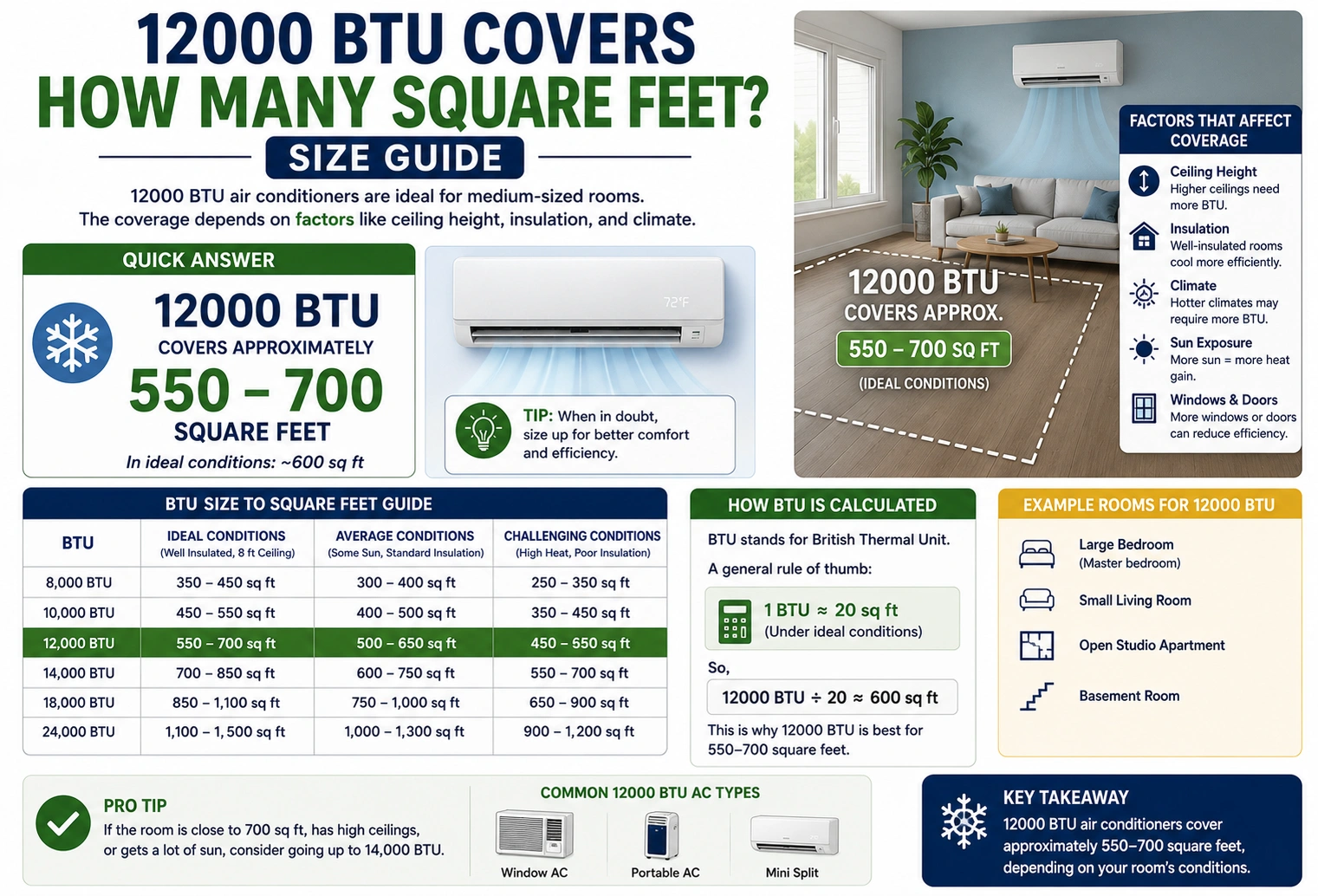
If you’re shopping for a new air conditioner, one of the first questions you’ll likely ask is 12000 BTU covers how many square feet. Choosing the correct BTU rating is essential because an air conditioner that’s too small won’t cool effectively, while one that’s too large may cycle on and off too frequently, reducing efficiency and comfort.
The general guideline is:
A 12,000 BTU air conditioner can cool approximately 450 to 550 square feet under average conditions.
However, the exact coverage depends on several factors, including ceiling height, insulation, climate, sunlight exposure, and the number of people using the space.
This guide explains what BTUs mean, how cooling capacity is determined, and whether a 12,000 BTU unit is the right choice for your room.
Quick Answer
| AC Capacity | Recommended Room Size |
|---|---|
| 12,000 BTU | 450–550 sq ft |
Answer: A 12,000 BTU air conditioner typically cools between 450 and 550 square feet under standard conditions.
What Does BTU Mean?
BTU stands for British Thermal Unit. It measures the amount of heat an air conditioner can remove from a room in one hour.
In simple terms:
- Higher BTU = More cooling power
- Lower BTU = Smaller cooling area
BTU ratings help you match an air conditioner to the size of your room.
How Many Square Feet Can a 12,000 BTU AC Cool?
Most HVAC sizing guides recommend a 12,000 BTU unit for rooms between 450 and 550 square feet.
Examples include:
- Large bedrooms
- Studio apartments
- Living rooms
- Family rooms
- Small office spaces
- Finished basements
If the room is well insulated and receives little direct sunlight, a 12,000 BTU unit may cool slightly more than 550 square feet. Conversely, hot climates or poorly insulated spaces may require a higher BTU rating.
Factors That Affect Cooling Coverage
The recommended square footage is only a guideline. Several factors influence how effectively an air conditioner cools a room.
Ceiling Height
Most BTU recommendations assume an 8-foot ceiling.
Rooms with higher ceilings contain more air and may need additional cooling capacity.
Sunlight Exposure
Rooms with large south- or west-facing windows often absorb more heat.
You may need a larger AC unit if your room receives strong afternoon sunlight.
Insulation
Well-insulated homes retain cool air better, allowing a 12,000 BTU unit to cool a larger space.
Older homes with poor insulation may require more BTUs.
Number of Occupants
People generate body heat.
If several people regularly occupy the room, consider increasing the cooling capacity.
Heat-Producing Appliances
Kitchens, laundry rooms, and home offices with multiple electronics generate additional heat.
Climate
Homes in hotter regions often require larger AC units than homes in mild climates.
BTU Room Size Chart
| BTU Rating | Recommended Coverage |
|---|---|
| 5,000 BTU | 100–150 sq ft |
| 6,000 BTU | 150–250 sq ft |
| 8,000 BTU | 250–350 sq ft |
| 10,000 BTU | 350–450 sq ft |
| 12,000 BTU | 450–550 sq ft |
| 14,000 BTU | 550–700 sq ft |
| 18,000 BTU | 700–1,000 sq ft |
| 24,000 BTU | 1,000–1,500 sq ft |
These ranges are estimates and may vary slightly by manufacturer and installation conditions.
Is a 12,000 BTU AC Right for Your Room?
A 12,000 BTU air conditioner is often an excellent choice for:
Living Rooms
Comfortably cools most average-sized family rooms.
Master Bedrooms
Provides sufficient cooling for larger bedrooms.
Studio Apartments
Many studio apartments fall within the recommended size range.
Home Offices
Keeps larger office spaces comfortable during long workdays.
Finished Basements
Suitable for moderately sized finished basement rooms with proper insulation.
Real-World Examples
Here are a few room sizes and whether a 12,000 BTU unit is appropriate.
| Room Size | Recommendation |
|---|---|
| 12 × 15 ft (180 sq ft) | More than enough |
| 15 × 20 ft (300 sq ft) | Excellent choice |
| 20 × 25 ft (500 sq ft) | Ideal |
| 22 × 26 ft (572 sq ft) | May need 14,000 BTU depending on conditions |
| 30 × 30 ft (900 sq ft) | Too small |
Why Proper AC Sizing Matters
Choosing the correct BTU rating improves both comfort and efficiency.
Better Cooling
A properly sized unit cools the room evenly.
Lower Energy Bills
Correct sizing reduces unnecessary energy consumption.
Longer Equipment Life
Properly sized air conditioners cycle normally, reducing wear on components.
Improved Humidity Control
An appropriately sized AC removes moisture more effectively than an oversized unit.
Common Sizing Mistakes
Buying Based Only on Square Footage
Always consider insulation, windows, ceiling height, and climate.
Choosing the Largest Unit Available
Oversized air conditioners cool too quickly without removing enough humidity.
Ignoring Sun Exposure
Sunny rooms often need additional cooling capacity.
Forgetting Occupancy
Rooms with several occupants generate more heat and may require a larger unit.
Expert Tips for Choosing the Right AC
- Measure your room carefully before purchasing.
- Consider ceiling height in addition to floor area.
- Increase BTU capacity for kitchens or rooms with heavy sun exposure.
- Seal air leaks and improve insulation to maximize cooling efficiency.
- Consult HVAC professionals if cooling multiple connected rooms.
Quick BTU Reference Table
| Room Size | Suggested BTU |
|---|---|
| 150 sq ft | 5,000 BTU |
| 250 sq ft | 6,000 BTU |
| 350 sq ft | 8,000 BTU |
| 450 sq ft | 10,000–12,000 BTU |
| 500 sq ft | 12,000 BTU |
| 700 sq ft | 14,000 BTU |
| 1,000 sq ft | 18,000 BTU |
9. Frequently Asked Questions
1. 12000 BTU covers how many square feet?
A 12,000 BTU air conditioner typically cools between 450 and 550 square feet under average conditions.
2. Is a 12,000 BTU AC enough for a 500-square-foot room?
Yes. A 500-square-foot room generally falls within the recommended coverage range for a 12,000 BTU unit.
3. Can a 12,000 BTU AC cool two rooms?
It depends on the layout. An open floor plan may cool effectively, but separate enclosed rooms often require additional cooling units.
4. What happens if I buy an oversized air conditioner?
An oversized AC may cool the room too quickly, leading to poor humidity control, uneven temperatures, and increased energy use.
5. Does insulation affect BTU requirements?
Yes. Better insulation allows an air conditioner to cool a larger area more efficiently, while poor insulation may require a higher BTU rating.
10. Conclusion
If you’re wondering 12000 BTU covers how many square feet, the general answer is 450 to 550 square feet under standard conditions. This makes a 12,000 BTU air conditioner a popular choice for large bedrooms, living rooms, studio apartments, and medium-sized offices.
Keep in mind that square footage is only one part of the equation. Ceiling height, insulation, climate, sunlight, occupancy, and heat-generating appliances all affect cooling performance. By choosing the right BTU rating for your specific space, you can enjoy better comfort, improved energy efficiency, and longer-lasting air conditioning performance.
Discover More Articles
How Many Feet in 200 Yards? Easy Conversion Guide