

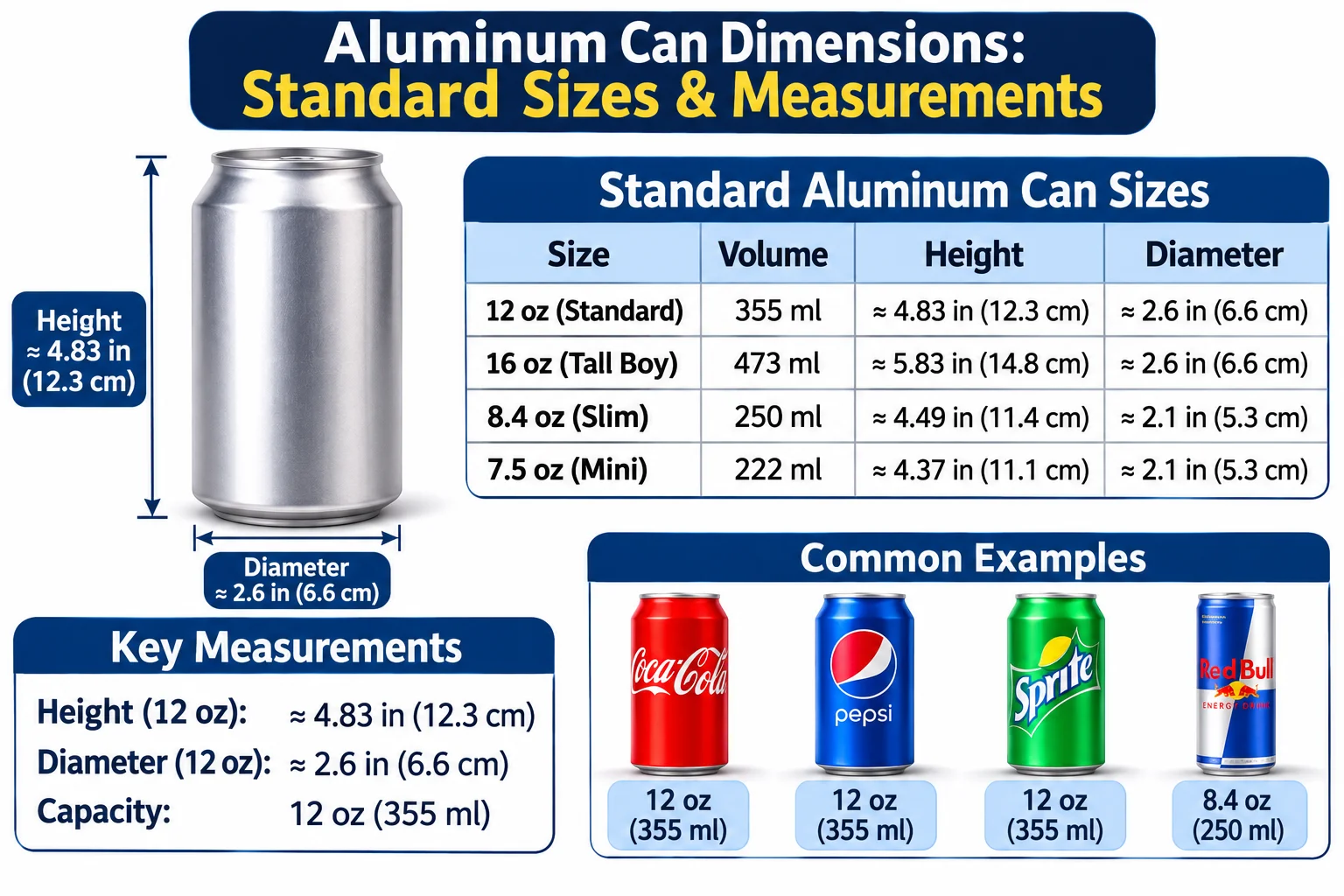
Aluminum can dimensions vary according to the can’s capacity, shape, manufacturer, and intended use. A common 12 oz beverage can is approximately 4.8 to 4.9 inches tall and 2.6 inches in diameter, or roughly 12.2 to 12.5 cm tall and 6.6 cm wide.
Other aluminum cans can be much slimmer, taller, shorter, or wider. For example, a 250 mL slim can has a very different shape from a standard 12 oz soda can, even though both are aluminum beverage containers.
Understanding can height, diameter, circumference, and capacity is useful for storage, packaging, product design, cup holders, displays, and DIY projects.
Quick Answer: What Are Aluminum Can Dimensions?
There is no single standard dimension for every aluminum can. Beverage cans are manufactured in several common sizes.
For a typical 12 oz beverage can, a useful approximate measurement is:
- Height: 4.8–4.9 inches
- Diameter: about 2.6 inches
- Height: about 12.2–12.5 cm
- Diameter: about 6.6 cm
- Capacity: 12 US fluid ounces
- Capacity: about 355 mL
Here is a quick comparison of common aluminum beverage-can formats:
| Can Size | Capacity | Approx. Height | Approx. Diameter |
|---|---|---|---|
| Slim can | 8.4 oz / 250 mL | ~5.2 in | ~2.1 in |
| Standard can | 12 oz / 355 mL | ~4.8–4.9 in | ~2.6 in |
| Tall can | 16 oz / 473 mL | ~6.0–6.2 in | ~2.6 in |
| Large can | 24 oz / 710 mL | ~7.0–8.0 in | Varies |
These are general reference dimensions rather than universal specifications. The actual measurements can vary by can design and manufacturer.
Standard 12 oz Aluminum Can Dimensions
The 12 oz aluminum beverage can is one of the most familiar can formats.
A typical can is approximately 4.8 to 4.9 inches tall and around 2.6 inches in diameter.
In metric units, that is approximately:
12.2–12.5 cm tall × 6.6 cm in diameter
The 12 oz can is widely used for soda, sparkling water, energy drinks, and other beverages.
| Measurement | Approximate Size |
|---|---|
| Capacity | 12 US fl oz |
| Capacity | ~355 mL |
| Height | 4.8–4.9 in |
| Height | ~12.2–12.5 cm |
| Diameter | ~2.6 in |
| Diameter | ~6.6 cm |
| Circumference | ~8.2 in |
| Circumference | ~20.8 cm |
The can’s cylindrical shape gives it a relatively small footprint while providing enough internal volume for a 12 oz beverage.
Aluminum Can Dimensions by Capacity
Can capacity is one of the biggest factors affecting its physical dimensions.
However, capacity alone does not determine the exact shape. Two cans can hold similar amounts of liquid while having different heights and diameters.
8.4 oz Slim Can
The 8.4 oz or 250 mL format is commonly associated with slim beverage cans.
It is generally taller and narrower than a traditional 12 oz can.
A typical reference size is approximately:
- Height: 5.2 inches
- Diameter: 2.1 inches
- Capacity: 250 mL / 8.4 fl oz
The narrow diameter makes this format useful for products designed around a slim profile.
12 oz Standard Can
The 12 oz can is one of the most common aluminum beverage formats.
Approximate dimensions are:
- Height: 4.8–4.9 inches
- Diameter: 2.6 inches
- Capacity: 355 mL / 12 fl oz
Its shorter, wider shape distinguishes it from many slim cans.
16 oz Aluminum Can
A 16 oz can holds approximately 473 mL.
These cans are generally taller than standard 12 oz cans while maintaining a similar cylindrical profile.
A typical reference range is approximately:
- Height: 6.0–6.2 inches
- Diameter: around 2.6 inches
Exact dimensions vary depending on the manufacturer and can design.
24 oz Large Can
A 24 oz can contains approximately 710 mL.
Because it holds substantially more liquid than a standard 12 oz can, it is usually much taller or otherwise larger.
Dimensions vary considerably among manufacturers and products, so there is no single universal height and diameter for every 24 oz aluminum can.
For a precise packaging project, measure the specific can or use the manufacturer’s technical specification.
Aluminum Can Height and Diameter
Two measurements are especially important when describing an aluminum can: height and diameter.
Height measures the distance from the bottom of the can to the top.
Diameter measures the width straight across the circular body.
For a standard 12 oz aluminum can, these measurements are approximately:
Height: 4.8–4.9 inches
Diameter: 2.6 inches
The ratio between these dimensions gives the can its familiar cylindrical appearance.
If you are designing a container around the can, both measurements matter.
For example, a storage compartment may be wide enough for the can but too short to accommodate its height.
Aluminum Can Dimensions in Inches and Centimeters
If you need both imperial and metric measurements, the following chart provides useful reference values.
| Can Type | Height | Diameter |
|---|---|---|
| 8.4 oz slim | ~5.2 in / 13.2 cm | ~2.1 in / 5.3 cm |
| 12 oz standard | ~4.8–4.9 in / 12.2–12.5 cm | ~2.6 in / 6.6 cm |
| 16 oz tall | ~6.0–6.2 in / 15.2–15.7 cm | ~2.6 in / 6.6 cm |
| 24 oz large | Varies | Varies |
The standard 12 oz can is a particularly useful reference because it is common in many beverage categories.
When converting measurements, remember:
1 inch = 2.54 centimeters
Therefore, a 2.6-inch diameter is approximately:
2.6 × 2.54 = 6.604 cm
Rounded:
6.6 cm
Aluminum Can Circumference
Circumference is the measurement around the outside of a can.
It can be calculated using:
Circumference = π × diameter
For a standard can with an approximate diameter of 2.6 inches:
3.14159 × 2.6 ≈ 8.17 inches
So the circumference is approximately 8.2 inches.
In centimeters, that is approximately:
20.8 cm
| Measurement | Approximate Value |
|---|---|
| Diameter | 2.6 in |
| Radius | 1.3 in |
| Circumference | 8.2 in |
| Diameter | 6.6 cm |
| Circumference | ~20.8 cm |
Circumference is useful when designing a label that wraps around the can or calculating the amount of material needed to surround it.
Aluminum Can Size Comparison Chart
Different aluminum cans can have noticeably different proportions.
| Can Type | Capacity | Approx. Height | Approx. Diameter | General Shape |
|---|---|---|---|---|
| Slim 8.4 oz | 250 mL | ~5.2 in | ~2.1 in | Tall and narrow |
| Standard 12 oz | 355 mL | ~4.8–4.9 in | ~2.6 in | Shorter and wider |
| Tall 16 oz | 473 mL | ~6.0–6.2 in | ~2.6 in | Tall |
| Large 24 oz | 710 mL | Varies | Varies | Large |
The table demonstrates why the phrase “standard aluminum can dimensions” needs context.
A standard 12 oz can has one set of dimensions, while a slim 250 mL can has another.
How to Measure an Aluminum Can
If you need exact dimensions, measuring the physical can is straightforward.
A ruler or tape measure is enough for most household applications.
Measuring Height
Place the can upright on a flat, level surface.
Measure vertically from the bottom to the highest point at the top.
Keep the measuring tool straight rather than following the curved surface.
Record the result in inches or centimeters.
Measuring Diameter
Place the measuring tool across the circular top or bottom.
Measure from one outside edge directly through the center to the opposite edge.
This gives you the diameter.
Do not measure diagonally.
Measuring Circumference
Wrap flexible measuring tape around the widest cylindrical section.
If you do not have flexible tape, use a piece of string or paper.
Mark where the material completes one full circle and then measure that length using a ruler.
This provides the circumference.
Aluminum Can Dimensions for Storage
Storage design requires more than simply knowing the can’s capacity.
For a standard 12 oz aluminum can, the approximate footprint is based on a diameter of 2.6 inches.
If you want to store three cans side by side, a basic width calculation is:
2.6 × 3 = 7.8 inches
That is the approximate body width without additional spacing.
A practical storage compartment should provide some clearance.
The same principle applies to height.
If a can is approximately 4.9 inches tall, a compartment that is exactly 4.9 inches high may make inserting or removing the can difficult.
A small amount of extra space makes the design more practical.
Aluminum Can Dimensions for Cup Holders
The diameter is often the most important measurement when determining whether an aluminum can fits a cup holder.
A typical 12 oz can has a diameter of around 2.6 inches.
Many cup holders are designed around beverage containers of similar dimensions, but their openings can vary.
Some are narrower, while others are much wider.
A cup holder that fits a standard soda can may not necessarily hold a slim can securely.
The best approach is to measure the cup-holder opening and compare it with the can’s diameter.
Remember that the holder should provide enough support without being so tight that the can cannot be removed easily.
Aluminum Can Dimensions for Custom Labels
The cylindrical body of an aluminum can makes circumference especially useful for label design.
For a 2.6-inch diameter can, the circumference is approximately 8.2 inches.
A full-wrap label therefore needs to cover roughly this distance around the can.
However, the label’s usable height may be less than the total can height.
The top and bottom of the can have curved sections, and the label may need to stay within the straight cylindrical portion.
For accurate label production, measure:
- Straight-body height
- Circumference
- Seam or overlap allowance
- Distance from the top and bottom edges
- Actual can diameter
For commercial packaging, manufacturer’s specifications should take priority over general measurements.
Aluminum Can Dimensions vs Other Beverage Containers
Aluminum cans are designed differently from many plastic bottles and glass containers.
A can generally has a cylindrical body with a relatively consistent diameter, while bottles may have shoulders, necks, and irregular shapes.
| Container | Typical Shape | Main Dimension Considerations |
|---|---|---|
| Aluminum beverage can | Cylinder | Height and diameter |
| Plastic bottle | Variable | Height, body width, neck |
| Glass bottle | Variable | Height, body and neck |
| Slim can | Narrow cylinder | Height and smaller diameter |
| Large can | Larger cylinder | Height and diameter |
This makes aluminum cans relatively simple to measure and design around.
Why Aluminum Can Dimensions Matter
Knowing the dimensions of an aluminum can can be useful in many situations.
Packaging
Manufacturers need precise dimensions to design boxes, trays, cartons, and shipping containers.
Refrigeration
Consumers need to know whether cans will fit vertically or horizontally within a refrigerator.
Product Displays
Retail displays need enough space to hold the cans securely and efficiently.
Transportation
Cans are often packed into cases, and their dimensions affect how many units can fit within a package.
DIY Projects
Aluminum cans are sometimes reused for crafts, organizers, and other projects.
Accurate dimensions make it easier to create a design that fits the can.
Manufacturing
Industrial equipment can be designed around specific can dimensions, including filling, labeling, packaging, and handling machinery.
Common Measurement Mistakes
One of the biggest mistakes is assuming that every aluminum can has the same dimensions.
They do not.
Can dimensions vary based on:
- Capacity
- Manufacturer
- Beverage type
- Can shape
- Market
- Packaging design
Another common mistake is confusing diameter with circumference.
A can with a 2.6-inch diameter has a circumference of roughly 8.2 inches.
It is also easy to confuse capacity with physical size.
A 12 oz can holds 12 fluid ounces of liquid, but that does not mean the can is 12 inches tall or 12 inches wide.
Finally, remember that approximate measurements are fine for general planning but may not be sufficient for precision manufacturing.
Tips for Measuring an Aluminum Can Accurately
Use these simple practices when exact dimensions matter.
- Measure the actual can. Do not rely solely on a generic can-size chart.
- Measure several times. Repeated measurements can identify small errors.
- Use the same unit throughout your project. If your design is in inches, keep the measurements in inches before converting.
- Measure the widest point. This is particularly important when designing holders.
- Add clearance. Avoid making storage openings exactly equal to the can’s measured diameter.
- Distinguish capacity from dimensions. Fluid ounces and milliliters describe volume, while inches and centimeters describe physical size.
Frequently Asked Questions
What are the dimensions of a standard aluminum can?
A common 12 oz aluminum beverage can is approximately 4.8–4.9 inches tall and 2.6 inches in diameter, or about 12.2–12.5 cm tall and 6.6 cm wide.
How tall is a 12 oz aluminum can?
A typical 12 oz aluminum beverage can is approximately 4.8 to 4.9 inches tall, depending on the specific manufacturer and design.
How wide is an aluminum soda can?
A typical standard beverage can has a diameter of approximately 2.6 inches, or about 6.6 centimeters.
What is the circumference of a 12 oz aluminum can?
Using an approximate 2.6-inch diameter, the circumference is about 8.2 inches, or approximately 20.8 centimeters.
Are all aluminum cans the same size?
No. Aluminum cans come in many capacities and shapes. Slim 250 mL cans, standard 12 oz cans, 16 oz cans, and large 24 oz cans can have noticeably different dimensions.
Conclusion
Aluminum can dimensions depend on the can’s capacity and design, but a typical 12 oz beverage can is approximately 4.8–4.9 inches tall and 2.6 inches in diameter. That is roughly 12.2–12.5 cm tall and 6.6 cm wide.
Other formats can be taller and narrower or larger overall. An 8.4 oz slim can, for example, has a noticeably different shape from a standard 12 oz can.
For everyday planning, the most important measurements are height, diameter, circumference, and capacity. If you are designing a holder, package, label, shelf, or storage compartment, use these measurements as a starting point and then measure the exact can whenever a precise fit is required.
Discover More Articles
Coke Can Dimensions: Height, Diameter, and Size Guide
Arizona Tea Can Dimensions: Complete Size & Measurement Guide