

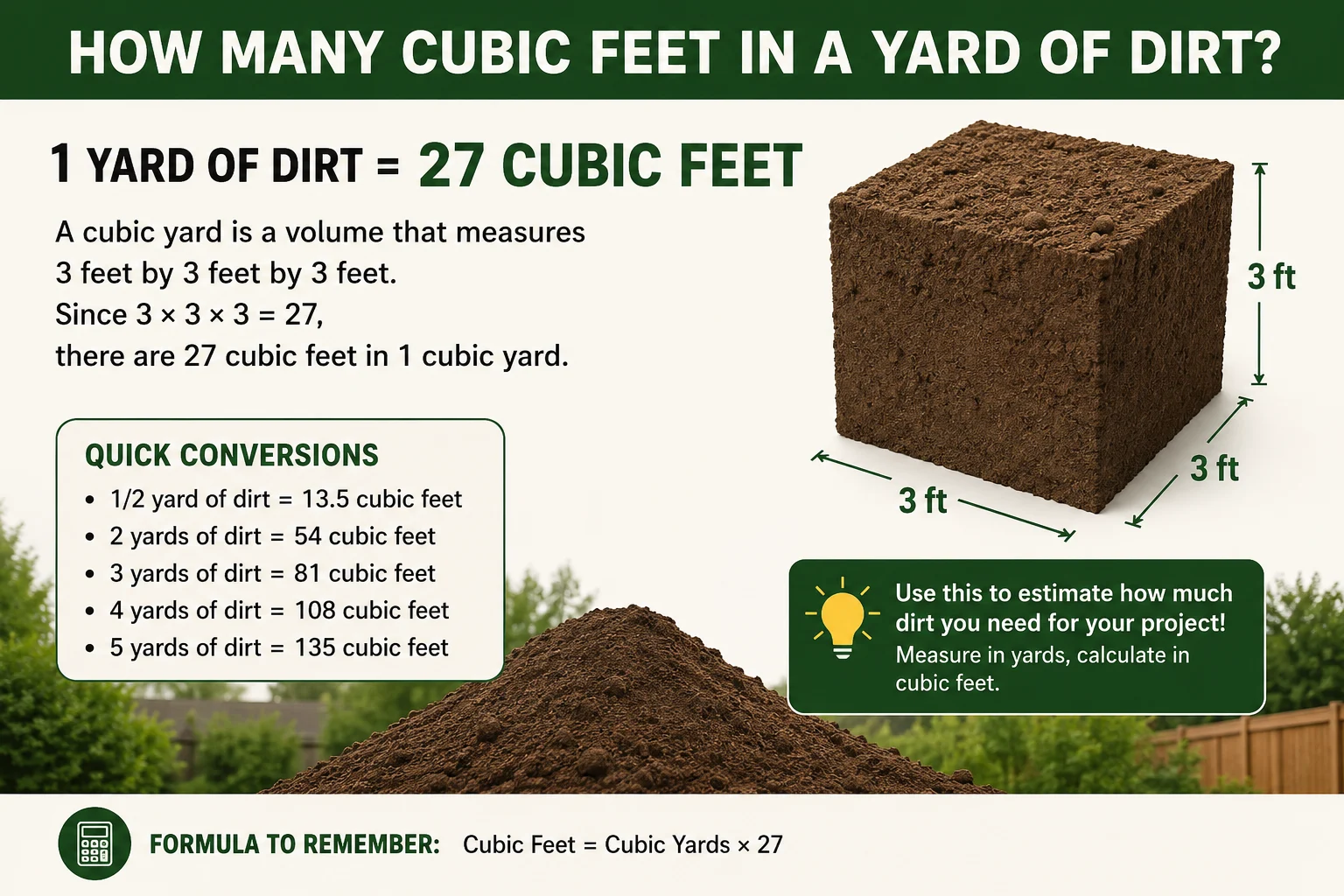
If you are planning a landscaping, gardening, or construction project, you have probably asked yourself: how many cubic feet in a yard of dirt?
Understanding this simple conversion can save you time, money, and frustration. Whether you are filling raised garden beds, leveling a yard, or ordering soil for a major project, knowing how to convert cubic yards to cubic feet helps you buy the right amount of dirt.
The quick answer is simple:
1 cubic yard=27 cubic feet
But there is more to understand if you want accurate measurements and better project planning. In this guide, you will learn how cubic yards and cubic feet work, how to calculate soil volume, and how much coverage you can expect from a yard of dirt.
Understanding Cubic Yards and Cubic Feet
Before diving deeper into conversions, it helps to understand the measurements themselves.
What Is a Cubic Foot?
A cubic foot is a unit of volume. It measures the amount of space inside a cube that is:
- 1 foot long
- 1 foot wide
- 1 foot high
Think of a standard moving box. Many medium-sized boxes are close to one cubic foot in size.
What Is a Cubic Yard?
A cubic yard is much larger. It measures the volume inside a cube that is:
- 3 feet long
- 3 feet wide
- 3 feet high
Because each side is three times larger, the total volume becomes much bigger.
3×3×3=27
That is why one cubic yard equals 27 cubic feet.
Why These Measurements Matter
Dirt, gravel, mulch, sand, and concrete are usually sold by cubic yard. However, many homeowners measure their projects in feet.
Understanding the relationship between these measurements prevents overordering or underordering materials.
How Many Cubic Feet in a Yard of Dirt?
The exact conversion is:
1 yard of dirt=27 cubic feet of dirt
This conversion never changes regardless of the type of dirt.
For example:
| Cubic Yards | Cubic Feet |
|---|---|
| 1 yard | 27 cubic feet |
| 2 yards | 54 cubic feet |
| 3 yards | 81 cubic feet |
| 5 yards | 135 cubic feet |
| 10 yards | 270 cubic feet |
This table is helpful when estimating landscaping materials for large projects.
Cubic Yard to Cubic Feet Conversion Formula
If you need to convert cubic yards into cubic feet, use this formula:
Cubic Feet=Cubic Yards×27
Formula Breakdown
The number 27 comes from multiplying:
- 3 feet × 3 feet × 3 feet
That creates the total volume inside one cubic yard.
Easy Examples
Example 1: Convert 2 Cubic Yards
2×27=54 cubic feet
So, 2 cubic yards equals 54 cubic feet.
Example 2: Convert 4.5 Cubic Yards
4.5×27=121.5 cubic feet
So, 4.5 cubic yards equals 121.5 cubic feet.
Why Dirt Is Measured in Cubic Yards
Most suppliers sell dirt in cubic yards because large projects require significant amounts of material.
Here are some common uses:
Landscaping
Landscapers use cubic yards for:
- Lawn leveling
- Flower beds
- Retaining wall backfill
- Soil replacement
Gardening
Gardeners buy dirt for:
- Raised beds
- Vegetable gardens
- Compost mixing
- Soil improvement
Construction
Construction crews use fill dirt for:
- Foundation preparation
- Grading
- Drainage work
- Excavation filling
Measuring in cubic yards simplifies bulk ordering.
Coverage Chart for One Yard of Dirt
One cubic yard of dirt covers different amounts of area depending on the depth.
Here is a simple coverage chart:
| Depth | Coverage Area |
|---|---|
| 1 inch | 324 square feet |
| 2 inches | 162 square feet |
| 3 inches | 108 square feet |
| 4 inches | 81 square feet |
| 6 inches | 54 square feet |
| 12 inches | 27 square feet |
Why Depth Matters
The deeper the soil layer, the less area it covers.
For example:
- A thin layer of topsoil spreads over a large area.
- A deep raised bed requires much more dirt.
This is one of the most common mistakes homeowners make when ordering soil.
How to Calculate Dirt Needed for Your Project
Calculating dirt volume is easier than many people think.
Step 1: Measure Length and Width
Measure the area in feet.
Example:
- Length = 12 feet
- Width = 10 feet
Step 2: Determine Depth
Convert depth into feet.
Example:
- 6 inches = 0.5 feet
Step 3: Multiply Measurements
Use this formula:
Volume=Length×Width×Depth
Example:
12×10×0.5=60 cubic feet
You need 60 cubic feet of dirt.
Step 4: Convert to Cubic Yards
Divide cubic feet by 27.
60÷27≈2.22 cubic yards
You would order approximately 2.5 cubic yards to allow for settling and waste.
Types of Dirt and Their Uses
Not all dirt is the same. Choosing the right type matters.
Topsoil
Topsoil is nutrient-rich soil used for:
- Gardens
- Lawns
- Flower beds
It is ideal for plant growth.
Fill Dirt
Fill dirt contains little organic material and is mainly used for:
- Leveling land
- Filling holes
- Construction support
It is cheaper than topsoil.
Garden Soil
Garden soil is blended with compost and nutrients. It works best for:
- Raised beds
- Vegetable gardens
- Decorative planting areas
Knowing the difference helps avoid costly mistakes.
Common Mistakes When Ordering Dirt
Many people order the wrong amount of soil because of simple calculation errors.
Ordering Too Little
Small measurement mistakes can lead to shortages. Always round up slightly.
Ignoring Soil Compaction
Fresh dirt settles over time, especially after rain. Add 10% to 15% extra for many projects.
Mixing Up Square Feet and Cubic Feet
Square feet measure area.
Cubic feet measure volume.
This confusion causes inaccurate orders.
Forgetting Depth
Coverage changes dramatically based on soil depth. Always calculate carefully.
Expert Tips for Buying Dirt
Professionals use a few smart strategies to avoid problems.
Measure Twice
Double-check all measurements before ordering.
Add Extra Material
Ordering slightly more dirt is usually cheaper than paying for a second delivery.
Consider Moisture Content
Wet dirt weighs more and may compact differently.
Ask About Delivery
Some suppliers dump dirt in one pile. Make sure you have enough space.
Know Your Project Goals
Choose topsoil for plants and fill dirt for structural work.
Cubic Yard vs Cubic Foot Comparison Table
Here is a quick comparison table for easy reference:
| Measurement | Cubic Foot | Cubic Yard |
|---|---|---|
| Dimensions | 1 ft × 1 ft × 1 ft | 3 ft × 3 ft × 3 ft |
| Total Volume | 1 cubic foot | 27 cubic feet |
| Common Use | Small projects | Bulk materials |
| Material Quantity | Small amount | Large amount |
This chart makes it easier to understand the scale difference.
Real-World Examples
Example 1: Raised Garden Bed
A raised bed measures:
- 8 feet long
- 4 feet wide
- 1 foot deep
Calculation:
8×4×1=32 cubic feet
Convert to cubic yards:
32÷27≈1.19 cubic yards
You would need about 1.5 cubic yards of soil.
Example 2: Lawn Topdressing
A lawn area is 500 square feet and needs 2 inches of topsoil.
Depth conversion:
2 inches=122 feet
Volume calculation:
500×122=83.3 cubic feet
Convert to cubic yards:
83.3÷27≈3.09 cubic yards
You would need around 3.5 cubic yards.
FAQs
1. How many cubic feet are in one yard of dirt?
One cubic yard of dirt contains 27 cubic feet.
2. How much area does one yard of dirt cover?
Coverage depends on depth. At 3 inches deep, one cubic yard covers about 108 square feet.
3. How do I convert cubic feet to cubic yards?
Divide cubic feet by 27.
4. Is a cubic yard the same for all types of dirt?
Yes. The volume stays the same regardless of whether it is topsoil, fill dirt, or garden soil.
5. Should I order extra dirt?
Yes. Most experts recommend ordering 10% to 15% extra to account for settling and waste.
Conclusion
Understanding how many cubic feet in a yard of dirt is essential for landscaping, gardening, and construction projects. The key conversion to remember is simple:
1 cubic yard=27 cubic feet
Once you know this basic formula, estimating soil needs becomes much easier. You can accurately calculate project volume, avoid expensive mistakes, and order the right amount of material the first time.
Whether you are building raised beds, leveling a lawn, or filling a large excavation area, using cubic yard and cubic foot conversions helps you plan smarter and work more efficiently.
Discover More Articles
How many cubic feet in a yard of dirt?