
If you’re ordering soil, mulch, gravel, or concrete, you may wonder: how many cubic feet is a yard?
The quick answer is:
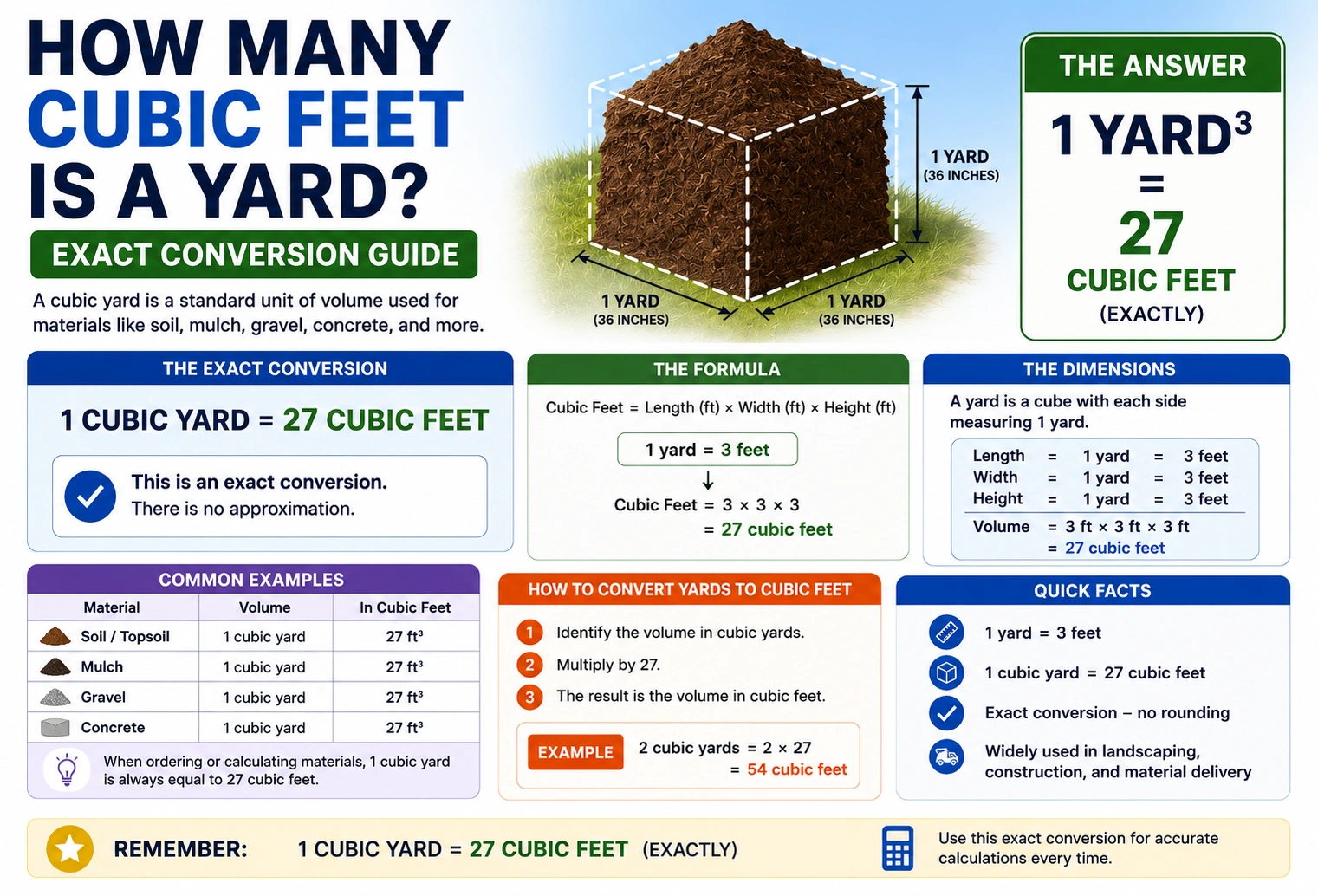
1 Cubic Yard=27 Cubic Feet
So:
- 1 cubic yard equals 27 cubic feet.
This is one of the most common volume conversions used in landscaping and construction.
Quick Answer
A cubic yard measures:
- 3 feet long
- 3 feet wide
- 3 feet high
The volume is calculated as:
3×3×3=27
Result:
- 1 cubic yard = 27 cubic feet
What Is a Cubic Yard?
A cubic yard is a unit of volume commonly used for:
- Soil
- Mulch
- Gravel
- Sand
- Concrete
- Compost
A cubic yard represents a cube measuring:
3 ft×3 ft×3 ft
How to Convert Cubic Yards to Cubic Feet
Use this formula:
Cubic Feet=Cubic Yards×27
Since every cubic yard contains 27 cubic feet, simply multiply by 27.
Example 1: 2 Cubic Yards
2×27=54 Cubic Feet
Answer:
- 2 cubic yards = 54 cubic feet
Example 2: 5 Cubic Yards
5×27=135 Cubic Feet
Answer:
- 5 cubic yards = 135 cubic feet
Cubic Yards to Cubic Feet Conversion Chart
| Cubic Yards | Cubic Feet |
|---|---|
| 1 | 27 |
| 2 | 54 |
| 3 | 81 |
| 4 | 108 |
| 5 | 135 |
| 10 | 270 |
| 20 | 540 |
This chart provides quick reference for common project sizes.
Common Uses for Cubic Yards
Landscaping
Materials often sold by the cubic yard include:
- Mulch
- Topsoil
- Compost
- Decorative stone
Concrete Projects
Concrete suppliers frequently quote material quantities in cubic yards.
Construction
Excavation and fill materials are often measured using cubic yards.
Practical Example
Imagine you need mulch for a garden bed.
The supplier sells mulch by the cubic yard.
If you purchase:
3 Cubic Yards
you receive:
3×27=81 Cubic Feet
of material.
Why This Conversion Matters
Knowing the conversion helps you:
- Estimate material needs
- Compare supplier pricing
- Avoid ordering too much or too little
- Plan landscaping and construction projects accurately
Common Conversion Mistakes
Confusing Square Feet and Cubic Feet
Square feet measure area.
Cubic feet measure volume.
They are not interchangeable.
Forgetting the Third Dimension
Volume calculations require:
- Length
- Width
- Height
Using Linear Measurements
A cubic yard is a volume measurement, not a length measurement.
FAQs
1. How many cubic feet are in one cubic yard?
One cubic yard equals 27 cubic feet.
2. Why is a cubic yard 27 cubic feet?
Because a yard is 3 feet, and:
3×3×3=27
3. How many cubic feet are in 2 cubic yards?
54 cubic feet.
4. Is a cubic yard the same as a square yard?
No. A cubic yard measures volume, while a square yard measures area.
5. What materials are commonly sold by the cubic yard?
Soil, mulch, gravel, sand, compost, and concrete.
Conclusion
Understanding how many cubic feet is a yard is essential for landscaping, gardening, and construction projects. The standard conversion is:
1 Cubic Yard=27 Cubic Feet
This means:
- 1 cubic yard = 27 cubic feet
- 2 cubic yards = 54 cubic feet
- 5 cubic yards = 135 cubic feet
Whether you’re ordering soil, mulch, gravel, or concrete, knowing this conversion helps you accurately estimate material quantities and complete your project efficiently.
Discover More Articles
How Many Square Feet Is a Pickleball Court? Official Court Size Guide