
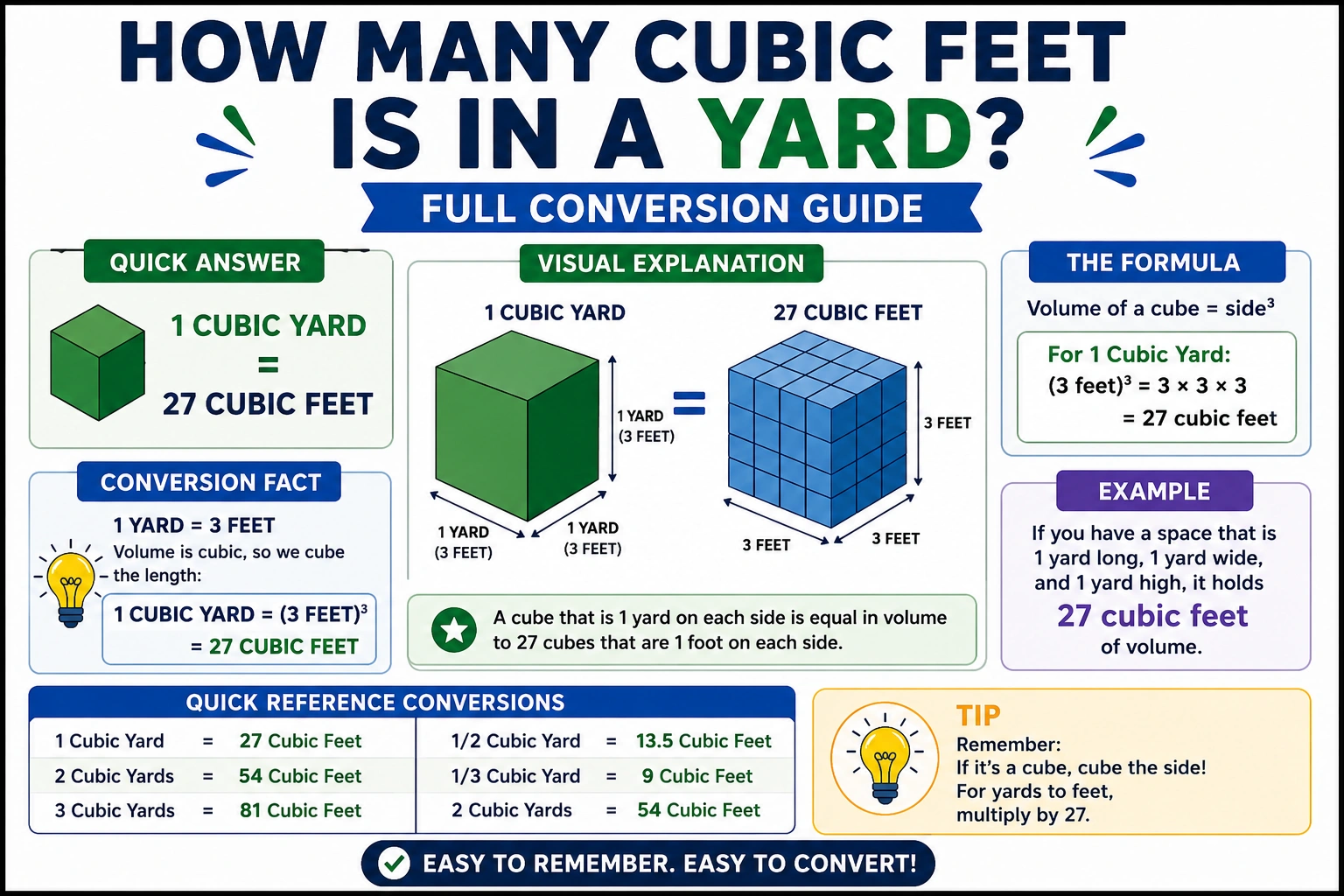
If you are wondering “how many cubic feet is in a yard,” the exact answer is:
1 cubic yard=27 cubic feet
So, one cubic yard equals exactly 27 cubic feet.
This conversion is commonly used for:
- Mulch
- Soil
- Concrete
- Gravel
- Sand
- Landscaping materials
Understanding cubic yard conversions helps homeowners and contractors estimate material needs more accurately.
In this complete guide, you will learn:
- How to convert cubic yards into cubic feet
- The exact conversion formula
- Real-world volume examples
- Helpful conversion charts
- Common mistakes
- Expert material estimation tips
Let’s begin.
Quick Answer for Cubic Yard to Cubic Feet
The exact conversion is:
- 1 cubic yard = 27 cubic feet
The standard formula is:
Cubic Feet=Cubic Yards×27
Since:
- A cubic yard measures 3 feet × 3 feet × 3 feet
The total volume becomes:
3×3×3=27
Understanding Cubic Yards and Cubic Feet
Before converting measurements, it helps to understand these units.
What Is a Cubic Yard?
A cubic yard is a unit of volume in the imperial system.
It represents a cube measuring:
3 ft×3 ft×3 ft
Cubic yards are commonly used for:
- Landscaping materials
- Concrete
- Gravel
- Soil
- Mulch
What Is a Cubic Foot?
A cubic foot measures the volume of a cube that is:
1 ft×1 ft×1 ft
Cubic feet are commonly used for:
- Refrigerators
- Storage space
- Soil bags
- Appliance capacity
Volume Measurement Basics
Volume measures:
- Length
- Width
- Height
Unlike square feet, cubic measurements include depth.
How to Convert Cubic Yards to Cubic Feet
Converting cubic yards into cubic feet is simple.
Conversion Formula
Use this formula:
Cubic Feet=Cubic Yards×27
Step-by-Step Calculation
Step 1: Write the formula
Cubic Feet = Cubic Yards × 27
Step 2: Insert the value
For one cubic yard:
1×27=27
Step 3: Final answer
- One cubic yard equals 27 cubic feet
Exact Result
The exact measurement is:
- 27 cubic feet
No rounding is needed.
What Does One Cubic Yard Look Like?
Volume measurements can be difficult to visualize.
Here are practical examples.
Pickup Truck Comparisons
One cubic yard may fill:
- A small pickup truck bed
Depending on truck size.
Soil and Mulch Examples
A cubic yard of mulch can cover:
- Large garden beds
- Landscaping areas
- Flower beds
Concrete Volume Examples
Concrete projects often calculate material in cubic yards.
Small patios and walkways may require:
- One or more cubic yards
Cubic Yard to Cubic Feet Conversion Chart
Here is a quick conversion chart.
| Cubic Yards | Cubic Feet |
|---|---|
| 0.25 yard | 6.75 cu ft |
| 0.5 yard | 13.5 cu ft |
| 1 yard | 27 cu ft |
| 2 yards | 54 cu ft |
| 3 yards | 81 cu ft |
| 5 yards | 135 cu ft |
This chart simplifies material calculations.
Why Cubic Yard Conversions Matter
Understanding volume conversions helps avoid costly mistakes.
Landscaping
Mulch and soil are often sold by:
- Cubic yard
- Cubic foot
Construction
Concrete projects require precise volume calculations.
Gardening
Raised beds need accurate soil estimates.
Material Ordering
Correct calculations help avoid:
- Underbuying
- Overbuying
- Delivery delays
Common Volume Conversion Mistakes
Simple mistakes can create inaccurate estimates.
Mixing Square Feet and Cubic Feet
Square feet measure:
- Area
Cubic feet measure:
- Volume
Using Incorrect Formulas
Always multiply cubic yards by:
- 27
Ignoring Depth
Volume calculations always include:
- Height or depth
Underestimating Material Needs
Many materials settle after installation.
Professionals often order:
- Extra material
Expert Tips for Measuring Volume
These tips improve project accuracy.
Measure Carefully
Even small errors can affect total volume.
Order Extra Material
Professionals often recommend:
- 5%–10% extra
Understand Material Compression
Mulch and soil may settle after spreading.
Use Online Calculators
Digital tools reduce mistakes and speed up planning.
Practical Situations Where Cubic Yards Are Used
Cubic yard calculations are common for:
- Mulch delivery
- Concrete pouring
- Gravel installation
- Soil projects
- Compost spreading
- Landscaping jobs
FAQs
How many cubic feet are in one cubic yard exactly?
One cubic yard equals exactly 27 cubic feet.
Why does one cubic yard equal 27 cubic feet?
Because:
- 3 feet × 3 feet × 3 feet = 27 cubic feet
What formula converts cubic yards into cubic feet?
Use this formula:
Cubic Feet=Cubic Yards×27
Is cubic yard the same as square yard?
No. A cubic yard measures:
- Volume
A square yard measures:
- Area
What materials are sold by cubic yard?
Common materials include:
- Soil
- Mulch
- Gravel
- Sand
- Concrete
- Compost
Conclusion
So, how many cubic feet is in a yard?
The exact answer is:
- 27 cubic feet
1 cubic yard=27 cubic feet
Understanding cubic yard conversions helps with:
- Landscaping
- Construction
- Gardening
- Concrete planning
- Material estimation
Once you understand the simple conversion formula, converting cubic yards into cubic feet becomes fast and easy for nearly any home improvement or outdoor project.
Discover More Articles
How Many Feet Is Cornhole? Official Size Guide