

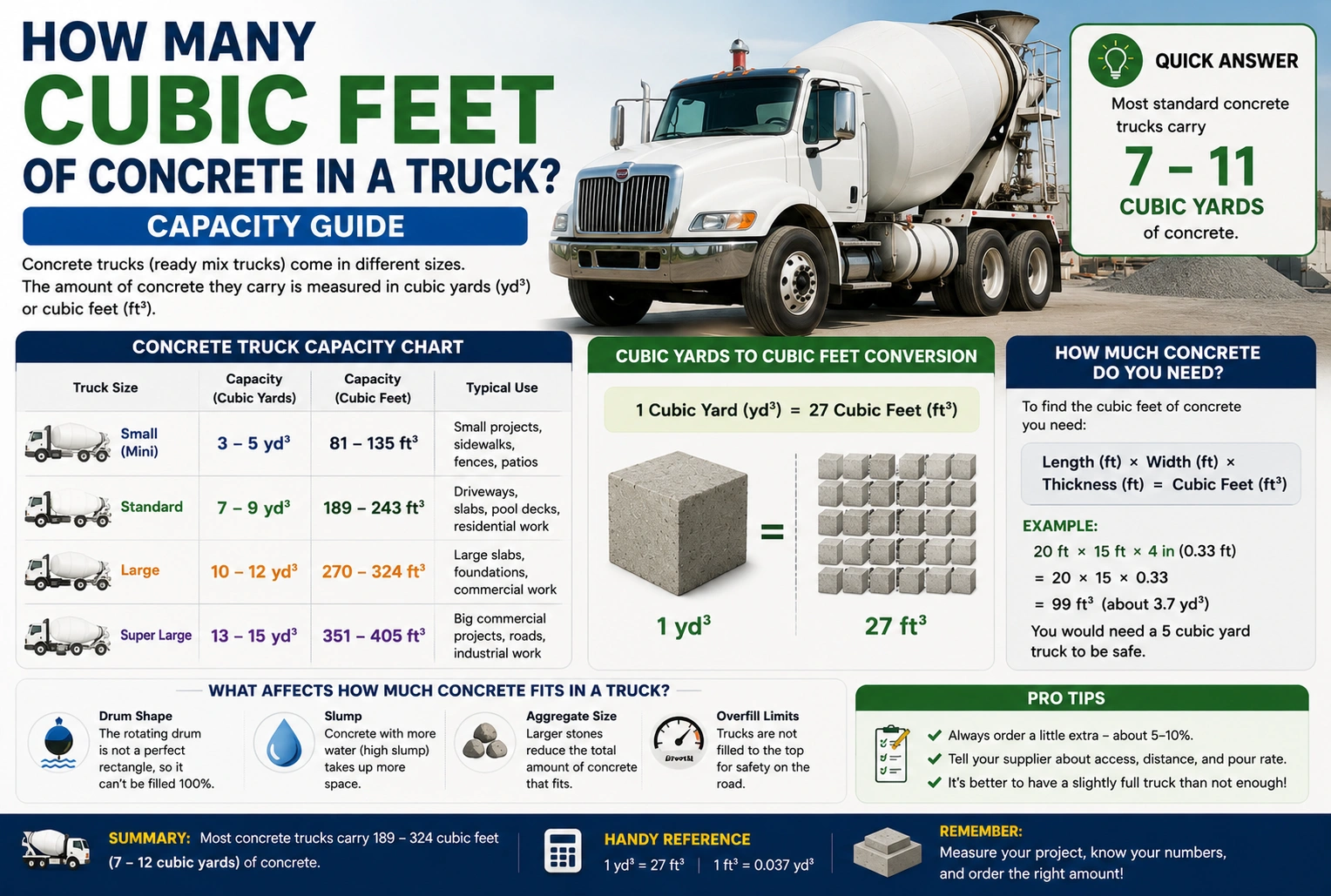
If you’re asking how many cubic feet of concrete in a truck, the answer depends on the size of the ready-mix concrete truck.
Most standard concrete mixer trucks carry between 8 and 10 cubic yards of concrete.
Since:
1 cubic yard = 27 cubic feet
A standard truck typically holds:
- 8 cubic yards = 216 cubic feet
- 9 cubic yards = 243 cubic feet
- 10 cubic yards = 270 cubic feet
Most residential deliveries fall within this range.
Quick Answer
| Concrete Truck Capacity | Cubic Feet |
|---|---|
| 8 cubic yards | 216 cu ft |
| 9 cubic yards | 243 cu ft |
| 10 cubic yards | 270 cu ft |
A typical ready-mix truck carries 216–270 cubic feet of concrete, depending on its capacity.
Standard Concrete Truck Capacity
Concrete mixer trucks are available in several sizes.
The most common capacities include:
- 8 cubic yards
- 9 cubic yards
- 10 cubic yards
Larger commercial projects may use specialty trucks with higher capacities, while small projects may use mini-mix trucks carrying only a few cubic yards.
Cubic Yard to Cubic Feet Conversion
To convert cubic yards into cubic feet, use the formula:
Cubic Feet = Cubic Yards × 27
For example:
- 8 × 27 = 216 cubic feet
- 9 × 27 = 243 cubic feet
- 10 × 27 = 270 cubic feet
This simple conversion is helpful when estimating concrete requirements.
Common Concrete Truck Sizes
| Truck Capacity | Cubic Feet | Typical Use |
| 3 cu yd | 81 cu ft | Small residential jobs |
| 6 cu yd | 162 cu ft | Patios and driveways |
| 8 cu yd | 216 cu ft | Standard residential projects |
| 9 cu yd | 243 cu ft | Medium commercial work |
| 10 cu yd | 270 cu ft | Large residential and commercial pours |
These capacities may vary slightly depending on the truck manufacturer and local regulations.
Factors That Affect Capacity
Several factors determine how much concrete a truck can safely transport.
Weight Limits
Road weight regulations often limit the maximum amount of concrete a truck can carry.
Truck Size
Larger mixer drums can transport more concrete but must still comply with axle weight restrictions.
Job Site Conditions
Steep driveways, narrow roads, or limited access may require smaller trucks or multiple deliveries.
Concrete Mix Design
Different concrete mixes have varying densities, which can slightly affect the maximum load a truck can safely transport.
Real-World Examples
Understanding how much concrete a truck can carry helps when planning residential and commercial projects.
Residential Driveway
A standard driveway may require 8–10 cubic yards of concrete, meaning one full-size ready-mix truck is often enough for the entire pour.
Concrete Patio
A medium-sized patio usually needs only a few cubic yards of concrete. In many cases, a partial truckload or a mini-mix truck is sufficient.
House Foundation
Foundations often require multiple truckloads depending on the home’s size and slab thickness. Contractors schedule deliveries so the concrete can be placed continuously.
Commercial Projects
Large warehouses, parking lots, and industrial buildings typically require several ready-mix trucks arriving in sequence to keep the pour consistent.
How Much Area Can One Truck Cover?
The coverage depends on the thickness of the concrete slab.
Here are approximate coverage estimates for a 10-cubic-yard truck (270 cubic feet).
| Slab Thickness | Approximate Coverage |
|---|---|
| 4 inches | About 810 sq ft |
| 5 inches | About 648 sq ft |
| 6 inches | About 540 sq ft |
| 8 inches | About 405 sq ft |
Actual coverage varies depending on project dimensions and site conditions.
Common Ordering Mistakes
Ordering Too Little Concrete
Running short during a pour can create delays and cold joints, which may weaken the finished slab.
Ordering Too Much
Excess concrete increases project costs and creates disposal challenges.
Forgetting Waste Allowance
Most contractors order 5–10% extra concrete to account for uneven ground, forms, spillage, and minor calculation differences.
Ignoring Site Access
Large mixer trucks need adequate space to enter, turn, and safely discharge concrete. Restricted access may require smaller trucks or a concrete pump.
Tips for Planning a Concrete Delivery
Measure Carefully
Calculate the slab’s length, width, and thickness before ordering.
Schedule the Delivery
Coordinate truck arrival with the construction crew so the concrete can be placed immediately after delivery.
Prepare the Site
Complete excavation, forms, reinforcement, and grading before the truck arrives to avoid unnecessary delays.
Confirm Capacity
Ask your supplier how many cubic yards the truck will deliver and whether multiple loads are needed for your project.
Frequently Asked Questions
How many cubic feet of concrete does a standard truck carry?
A standard ready-mix concrete truck usually carries 216 to 270 cubic feet, depending on whether its capacity is 8, 9, or 10 cubic yards.
How many cubic yards are in a full concrete truck?
Most full-size mixer trucks hold 8–10 cubic yards of concrete, although capacities vary by manufacturer and local transportation regulations.
How many cubic feet are in one cubic yard?
One cubic yard equals 27 cubic feet.
Can a concrete truck carry more than 10 cubic yards?
Some specialty mixer trucks can transport more, but road weight limits and local regulations often restrict standard trucks to around 10 cubic yards.
How do I know how much concrete I need?
Measure the length, width, and thickness of the slab, calculate the total volume, and then convert it into cubic yards before placing your order. Adding 5–10% extra is a common practice to account for waste and minor variations.
Conclusion
If you’re wondering how many cubic feet of concrete in a truck, a standard ready-mix concrete truck typically carries 216 to 270 cubic feet, which equals 8 to 10 cubic yards of concrete. The exact capacity depends on the truck size, local transportation regulations, and the concrete supplier’s equipment.
Knowing a truck’s capacity helps you estimate the number of deliveries your project will require, reduce waste, and keep concrete pours running smoothly. Whether you’re building a patio, driveway, foundation, or commercial slab, understanding these volume conversions makes project planning more accurate and efficient.
Discover More Articles
How Many Feet Does a Rabbit Have? Rabbit Anatomy Explained