

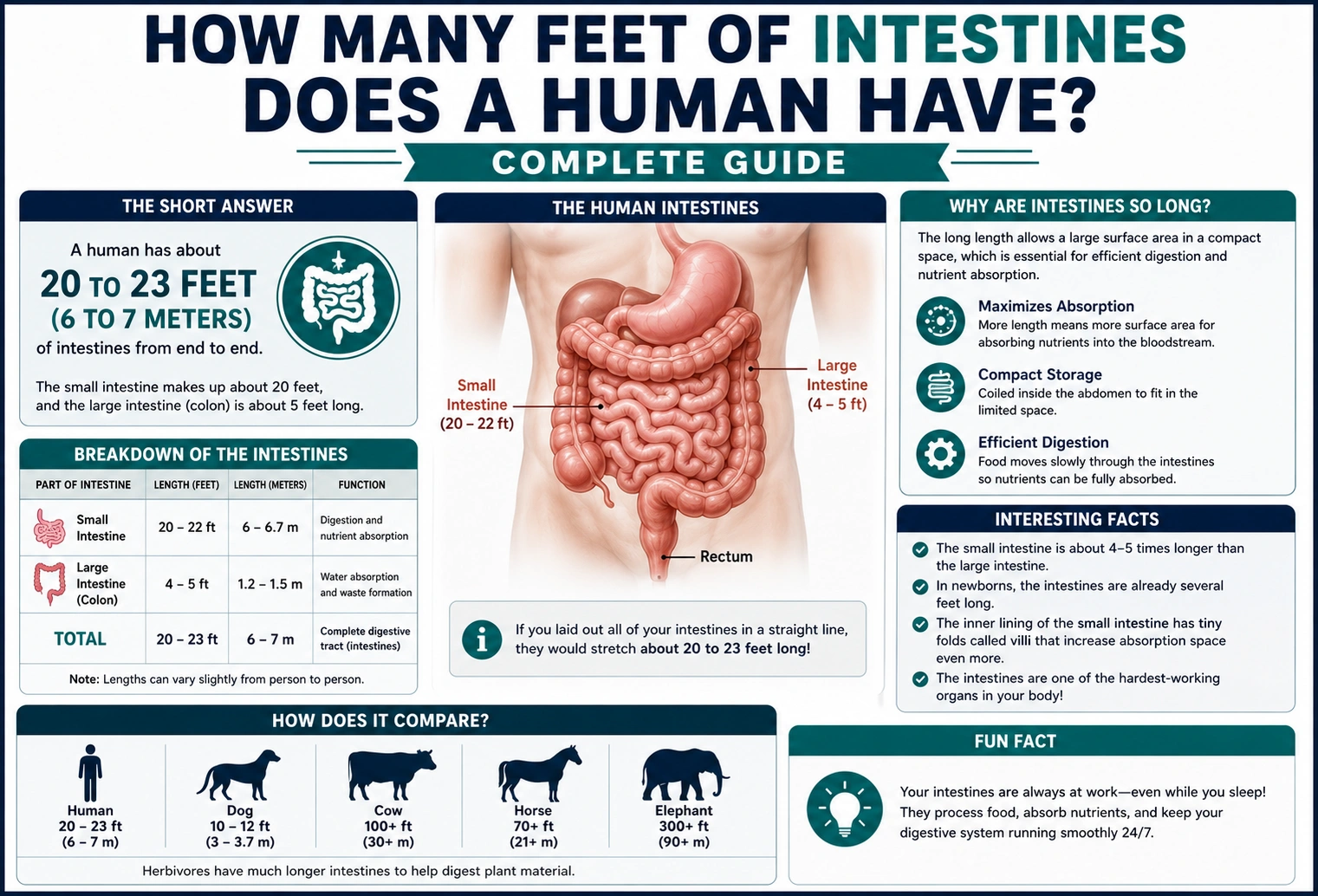
Many people are surprised to learn just how long the human digestive system is. If you’ve ever wondered how many feet of intestines does a human have, the answer is much longer than most people expect.
The quick answer is:
- The average adult human has about 25 feet of intestines.
This includes both the small intestine and the large intestine working together to digest food, absorb nutrients, and remove waste.
Understanding the Human Intestinal System
The intestines are a major part of the digestive system.
They help:
- Break down food
- Absorb nutrients
- Process water
- Eliminate waste
The intestinal tract consists of two primary sections:
- Small intestine
- Large intestine
How Many Feet of Intestines Does a Human Have?
The average adult intestinal system measures approximately:
22+5≈27 feet
However, because lengths vary between individuals, most educational and medical sources commonly state:
- About 25 feet total
- Roughly 22 feet of small intestine
- Roughly 5 feet of large intestine
So the total intestinal length generally falls between:
- 25 and 27 feet
Small Intestine Length
The small intestine makes up most of the digestive tract.
Average Adult Measurements
The small intestine is approximately:
22 feet
long in the average adult.
Some people may have slightly shorter or longer intestines depending on body size and anatomy.
Function of the Small Intestine
The small intestine is responsible for:
- Digesting food
- Absorbing nutrients
- Absorbing vitamins
- Processing carbohydrates, proteins, and fats
Most nutrient absorption occurs here.
Large Intestine Length
The large intestine, also called the colon, is shorter but equally important.
Average Adult Measurements
The large intestine measures approximately:
5 feet
in length.
Function of the Large Intestine
The colon helps:
- Absorb water
- Process waste
- Store stool before elimination
- Support beneficial gut bacteria
Why Are Human Intestines So Long?
Many people wonder why such a long organ can fit inside the body.
The answer is that the intestines are:
- Folded
- Looped
- Coiled tightly within the abdomen
This design provides a large surface area for nutrient absorption while fitting into a relatively compact space.
Interesting Facts About Human Intestines
The Small Intestine Is Actually Longer
Despite its name, the small intestine is much longer than the large intestine.
The term “small” refers to its diameter, not its length.
Surface Area Is Enormous
The inner lining contains millions of tiny structures called villi.
These increase nutrient absorption efficiency.
The Digestive Tract Continues Beyond the Intestines
Including the stomach, esophagus, and other digestive structures, the entire digestive tract is even longer.
Every Person Is Slightly Different
Intestinal length varies according to:
- Age
- Height
- Genetics
- Overall body size
Common Misconceptions
Everyone Has Exactly the Same Length
Intestinal length varies from person to person.
The Large Intestine Is the Longest Section
The small intestine is actually much longer.
Intestines Stretch Straight Across the Body
They are tightly folded and coiled within the abdomen.
Real-World Comparison
If you stretched the average adult intestines into a straight line, they would be approximately:
25 feet
or longer.
That’s roughly:
- The length of a two-story house
- Longer than many school buses are wide
- About the length of two midsize cars parked bumper to bumper
FAQs
1. How many feet of intestines does the average adult have?
Most adults have approximately 25–27 feet of intestines.
2. How long is the small intestine?
The average small intestine is about 22 feet long.
3. How long is the large intestine?
The large intestine is about 5 feet long.
4. Why are intestines so long?
Their length provides a large surface area for nutrient absorption and digestion.
5. Do all people have the same intestine length?
No. Length varies based on age, genetics, and body size.
Conclusion
Understanding how many feet of intestines does a human have reveals just how remarkable the digestive system is. The average adult has approximately:
22+5≈27 feet
of intestines, consisting of:
- About 22 feet of small intestine
- About 5 feet of large intestine
Although packed neatly inside the abdomen, these organs provide the extensive surface area needed to digest food, absorb nutrients, process water, and maintain overall health. Their impressive length is one of the many fascinating features of the human body.
Discover More Articles
How Many Square Feet Will a Quart of Paint Cover? Complete Coverage Guide