
If you’re planning a building project, buying property, designing a workshop, or simply trying to understand space dimensions, you may be asking: how many square feet is 40×60?
The answer is straightforward, but understanding how that number translates into usable space can help with budgeting, planning, and construction decisions.
The quick answer is:
A 40×60 space contains 2,400 square feet.
This size is commonly used for garages, workshops, warehouses, barndominiums, agricultural buildings, and commercial structures because it provides a large amount of flexible space without requiring a massive footprint.
In this guide, you’ll learn how to calculate the square footage of a 40×60 area, see real-world examples, compare it to other building sizes, and understand what can fit inside a 2,400-square-foot structure.
Quick Answer
How Many Square Feet Is 40×60?
A space that measures:
- 40 feet wide
- 60 feet long
Contains:
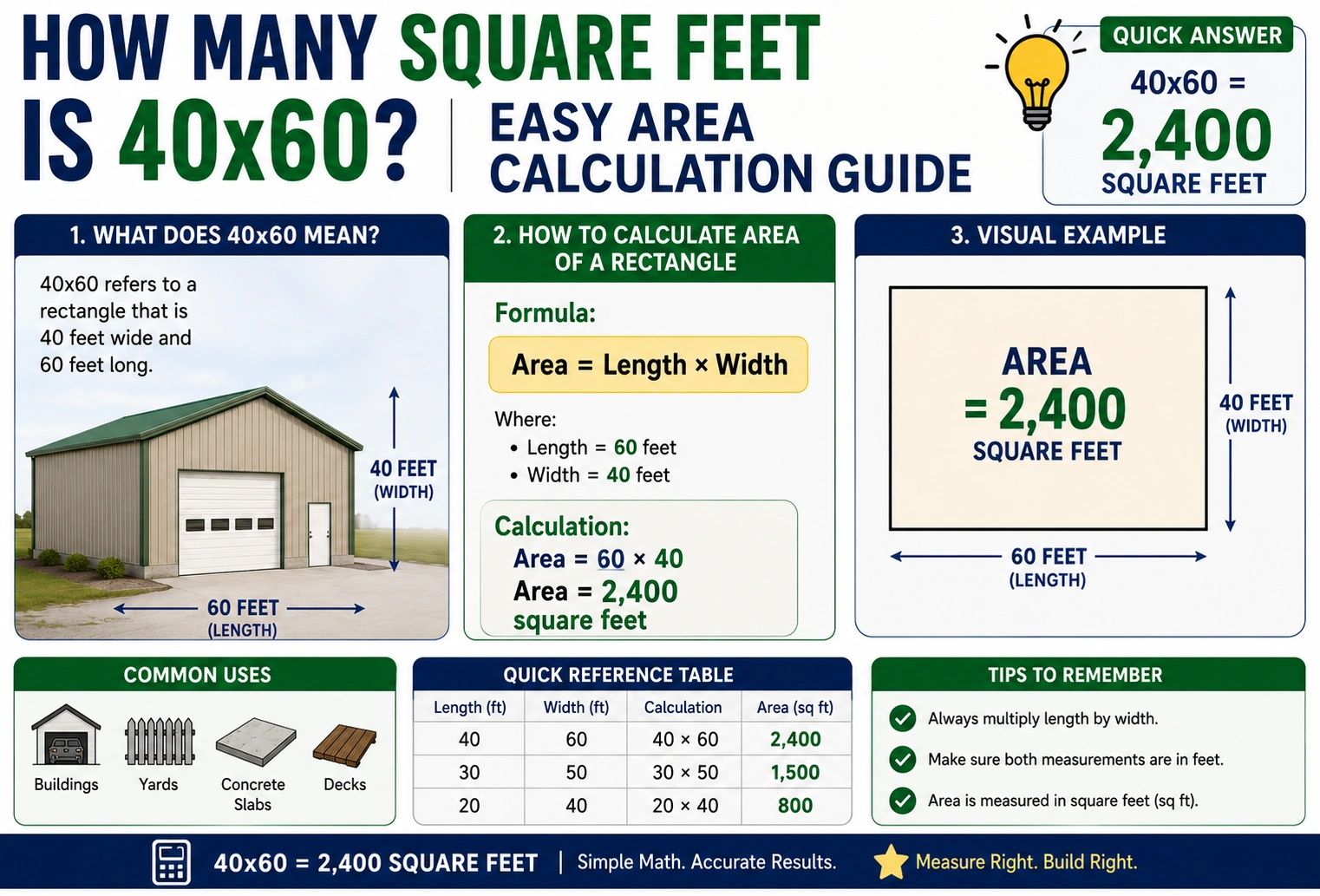
40 × 60 = 2,400 square feet
Therefore:
✅ 40×60 = 2,400 square feet
This calculation applies whether you’re measuring:
- A garage
- A workshop
- A warehouse
- A house
- A building lot
- An indoor floor space
Understanding Square Footage
Before calculating area, it helps to understand what square footage means.
What Is Square Footage?
Square footage is the measurement of area.
It tells you how much surface space exists inside a rectangle, square, room, building, or piece of land.
For rectangular spaces:
Area = Length × Width
This gives the total area in square feet.
Why Square Footage Matters
Square footage helps determine:
- Building costs
- Flooring needs
- Roofing estimates
- Property values
- Heating and cooling requirements
- Material quantities
Because many construction estimates are calculated per square foot, knowing the exact area is essential.
How Many Square Feet Is 40×60?
The calculation is simple.
Formula
For any rectangle:
Length × Width = Square Feet
Step-by-Step Calculation
For a 40×60 area:
40 × 60 = 2,400
Result:
2,400 square feet
This is the exact area of a rectangular space measuring 40 feet by 60 feet.
40×60 Square Footage Calculation Explained
Here’s the calculation visually:
A rectangular building:
- Width: 40 feet
- Length: 60 feet
Produces:
2,400 square feet of floor area
This means there are 2,400 individual one-foot-by-one-foot squares within the space.
For example:
- 24 rooms measuring 10×10 feet
- 6 rooms measuring 20×20 feet
- One large open workshop
Could fit within approximately 2,400 square feet.
Common Uses for a 40×60 Space
A 40×60 building is popular because it balances affordability with functionality.
Workshop
Many mechanics and hobbyists choose a 40×60 workshop because it offers enough room for:
- Vehicles
- Equipment
- Storage
- Workbenches
Garage
A 2,400-square-foot garage can often accommodate:
- Multiple vehicles
- Boats
- RV storage
- Tools and equipment
Barndominium
Many modern barndominiums use a 40×60 footprint.
This allows space for:
- Bedrooms
- Bathrooms
- Kitchen
- Living room
- Garage area
Agricultural Building
Farmers commonly use 40×60 structures for:
- Equipment storage
- Livestock shelter
- Hay storage
- Workshops
Commercial Space
Small businesses may use a 40×60 building as:
- Warehouse space
- Retail storage
- Manufacturing area
- Office facility
What Can Fit Inside a 40×60 Building?
Many people struggle to visualize 2,400 square feet.
Here are some examples.
Vehicles
A 40×60 garage may fit:
- 8–10 standard cars
- Several pickup trucks
- An RV and multiple vehicles
Residential Living Space
A typical American home ranges from 1,500–2,500 square feet.
A 40×60 building provides:
About the same living space as a large family home.
Basketball Court Comparison
A full basketball court measures approximately:
- 4,700 square feet
A 40×60 building is roughly:
Half the size of a basketball court
Apartments
Many apartments measure:
- 800–1,200 square feet
A 2,400-square-foot space equals:
- Two to three average apartments
40×60 Size Comparison Chart
| Dimensions | Square Feet |
|---|---|
| 20×20 | 400 sq ft |
| 20×40 | 800 sq ft |
| 30×40 | 1,200 sq ft |
| 30×50 | 1,500 sq ft |
| 40×40 | 1,600 sq ft |
| 40×50 | 2,000 sq ft |
| 40×60 | 2,400 sq ft |
| 50×60 | 3,000 sq ft |
| 60×60 | 3,600 sq ft |
This chart shows how a 40×60 building compares to other common sizes.
Converting 40×60 Square Feet to Acres
Land is often measured in acres rather than square feet.
One acre equals:
43,560 square feet
To convert:
2,400 ÷ 43,560 = 0.055 acre
Result:
40×60 equals approximately 0.055 acre
This is a little over 5% of one acre.
Cost to Build a 40×60 Structure
Construction costs vary widely depending on:
- Location
- Materials
- Labor
- Building type
However, using estimated costs:
| Cost Per Sq Ft | Estimated Cost |
|---|---|
| $30 | $72,000 |
| $50 | $120,000 |
| $75 | $180,000 |
| $100 | $240,000 |
| $150 | $360,000 |
Actual prices may differ significantly depending on the project’s specifications.
Advantages of a 40×60 Building
Flexible Layout
The space can be divided into:
- Living quarters
- Workspaces
- Storage areas
Cost Efficiency
Larger buildings often provide a lower cost per square foot.
Future Expansion
Many owners leave room for future additions.
Multiple Uses
A 40×60 structure can serve residential, commercial, industrial, or agricultural purposes.
Common Mistakes When Calculating Square Footage
Mixing Up Area and Perimeter
Area measures space inside a structure.
Perimeter measures the distance around it.
For a 40×60 rectangle:
- Area = 2,400 square feet
- Perimeter = 200 feet
These measurements are different.
Using Incorrect Dimensions
Always verify whether dimensions refer to:
- Interior measurements
- Exterior measurements
Forgetting Additional Floors
A two-story 40×60 building would provide:
2,400 × 2 = 4,800 square feet
Many people overlook this distinction.
How Square Footage Impacts HVAC Needs
A 2,400-square-foot building generally requires a larger heating and cooling system than smaller structures.
Factors affecting HVAC sizing include:
- Ceiling height
- Insulation
- Climate
- Building use
This is why square footage is often the first measurement HVAC professionals request.
9. FAQs
1. How many square feet is a 40×60 building?
A 40×60 building contains exactly 2,400 square feet.
2. Is 2,400 square feet considered large?
Yes. A 2,400-square-foot structure is comparable to many large family homes and provides substantial usable space.
3. How do you calculate 40×60 square feet?
Multiply the width by the length:
40 × 60 = 2,400 square feet.
4. How many acres is a 40×60 lot?
A 40×60 area equals approximately 0.055 acre.
5. Can a 40×60 building fit multiple vehicles?
Yes. A 40×60 garage or shop can often accommodate several vehicles, equipment, and storage space.
10. Conclusion
If you’re wondering how many square feet is 40×60, the answer is 2,400 square feet. By multiplying the width (40 feet) by the length (60 feet), you can quickly determine the total area of the space.
Whether you’re planning a garage, workshop, barndominium, warehouse, or residential home, a 40×60 structure offers a generous amount of usable space. Understanding its square footage helps with budgeting, construction planning, material estimates, HVAC sizing, and property comparisons. With 2,400 square feet, a 40×60 building provides the flexibility needed for a wide variety of residential and commercial applications.
Discover More Articles
How Many Feet Is 3 Stories? Building Height Guide
How Many Square Feet Are in Half an Acre? Easy Conversion Guide