
- how big is a single wide trailer in square feet
- typical length and width of single wide trailer
- square footage of single wide mobile home by size
- is a single wide trailer big enough
Semantic / LSI Keywords:
- mobile home dimensions
- manufactured home size
- trailer home layout
- living space comparison
- compact housing
How Many Square Feet Is a Single Wide Trailer?
If you’re exploring affordable housing options, you’ve probably asked: how many square feet is a single wide trailer? It’s a crucial question because size directly affects comfort, layout, and lifestyle.
The short answer:
A single wide trailer typically ranges from 600 to 1,300 square feet, depending on its length and design.
But there’s more to it than just numbers. In this guide, you’ll learn exact dimensions, real-life examples, comparisons, and how to decide if this size works for you.
What Is a Single Wide Trailer?
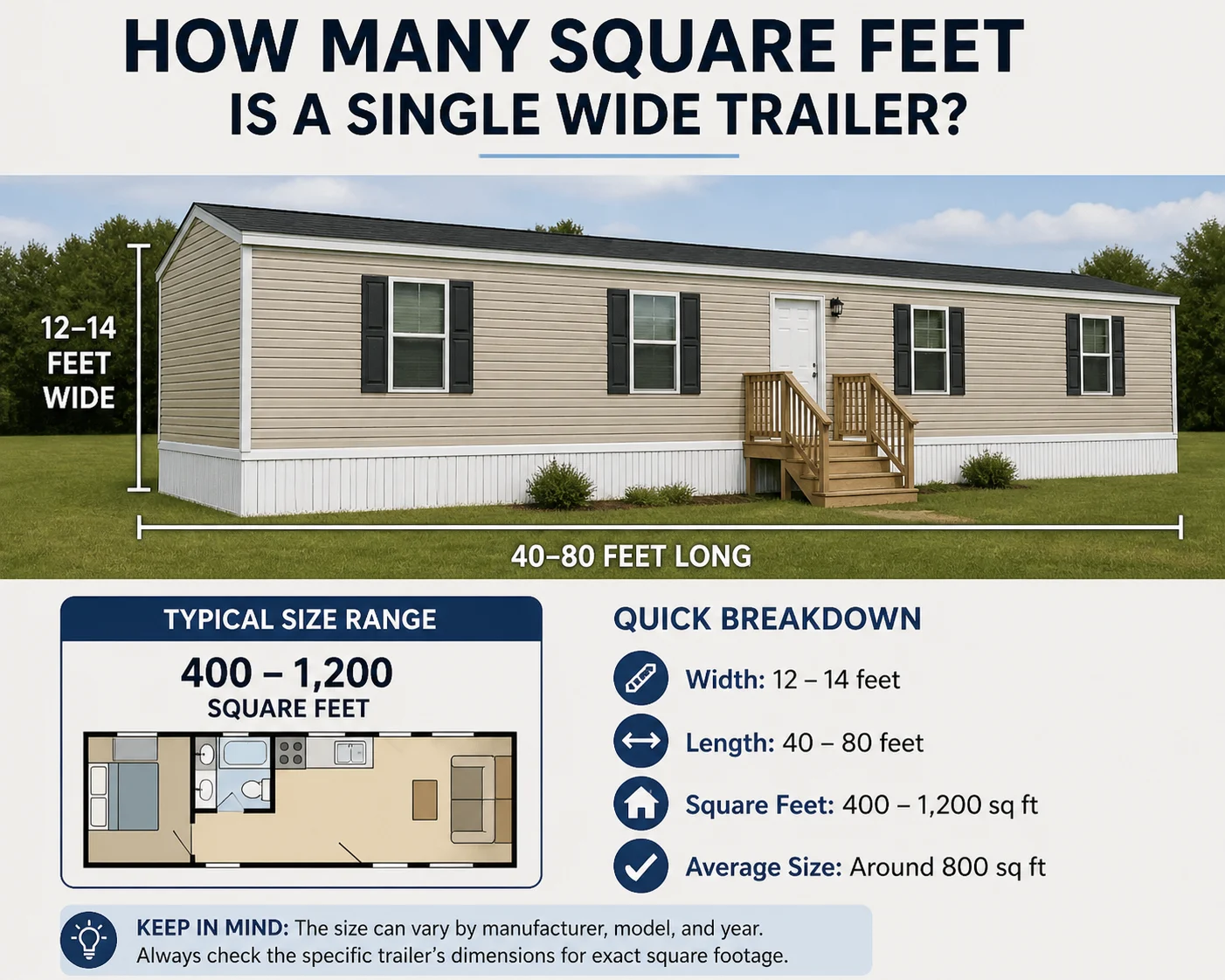
A single wide trailer (also called a single wide mobile home) is a type of manufactured home built in one long, narrow section.
Key characteristics:
- Usually 14 to 18 feet wide
- Typically 40 to 80 feet long
- Transported as one unit
- Designed for compact, efficient living
Unlike double wides, these homes are not split into sections, making them easier to transport and often more affordable.
How Many Square Feet Is a Single Wide Trailer (Exact Answer)
So, let’s break it down clearly.
Most single wide trailers fall into this range:
- Minimum: ~600 square feet
- Average: 800–1,000 square feet
- Maximum: ~1,300 square feet
Typical Dimensions Breakdown
| Width | Length | Approx. Square Feet |
|---|---|---|
| 14 ft | 50 ft | 700 sq ft |
| 14 ft | 70 ft | 980 sq ft |
| 16 ft | 60 ft | 960 sq ft |
| 16 ft | 80 ft | 1,280 sq ft |
| 18 ft | 70 ft | 1,260 sq ft |
👉 As you can see, length plays the biggest role in total square footage.
Common Single Wide Trailer Sizes and Their Square Footage
Here are some of the most common configurations:
1. Small Single Wide
- Size: 14 x 40
- Square feet: 560 sq ft
- Ideal for: singles or minimalists
2. Mid-Size Single Wide
- Size: 14 x 60
- Square feet: 840 sq ft
- Ideal for: small families or couples
3. Standard Single Wide
- Size: 16 x 70
- Square feet: 1,120 sq ft
- Ideal for: families of 3–4
4. Large Single Wide
- Size: 18 x 80
- Square feet: 1,440 sq ft (rare but possible)
How Square Footage Impacts Layout and Living Space
Square footage isn’t just a number—it defines how your home feels and functions.
Bedrooms
- 600–800 sq ft → 1–2 bedrooms
- 800–1,100 sq ft → 2–3 bedrooms
- 1,100+ sq ft → 3 bedrooms possible
Bathrooms
- Smaller units: 1 bathroom
- Larger units: 1.5 to 2 bathrooms
Living Areas
- Open-plan kitchen + living room is common
- Limited hallway space
- Compact dining areas
Real-Life Layout Examples
800 sq ft trailer:
- 2 bedrooms
- 1 bathroom
- Small kitchen + living area
1,000 sq ft trailer:
- 3 bedrooms
- 1–2 bathrooms
- Larger living room
1,200+ sq ft trailer:
- 3 bedrooms
- 2 bathrooms
- Separate dining space
Comparing Single Wide vs Double Wide vs Tiny Homes
Understanding size becomes easier when you compare.
| Type | Average Square Feet | Width | Best For |
|---|---|---|---|
| Single Wide | 600–1,300 | 14–18 ft | Budget living |
| Double Wide | 1,000–2,500 | 20–32 ft | Families |
| Tiny Home | 100–400 | Varies | Minimalists |
👉 A single wide sits right in the middle—more space than tiny homes, less than traditional houses.
Benefits of Single Wide Trailer Size
1. Affordability
Smaller size means:
- Lower purchase cost
- Reduced utility bills
- Cheaper maintenance
2. Efficient Living
- Less wasted space
- Easier to clean
- Lower energy usage
3. Easier Placement
- Fits on smaller lots
- Ideal for mobile home parks
Drawbacks of Limited Square Footage
1. Space Constraints
- Smaller bedrooms
- Limited closet space
- Compact kitchens
2. Storage Challenges
- Fewer cabinets
- Minimal attic or basement options
3. Less Privacy
- Rooms closer together
- Shared walls
How to Calculate Square Feet of a Single Wide Trailer
It’s actually very simple.
Formula:
Square Feet = Width × Length
Example:
- Width = 16 ft
- Length = 70 ft
👉 16 × 70 = 1,120 square feet
Always measure exterior dimensions for accuracy.
Expert Tips for Maximizing Space
Even a smaller trailer can feel spacious with smart design.
1. Use Multi-Functional Furniture
- Sofa beds
- Foldable tables
- Storage ottomans
2. Go Vertical
- Wall shelves
- Tall cabinets
- Hanging storage
3. Keep It Minimal
- Avoid clutter
- Choose smaller furniture
- Stick to essentials
4. Open Layout Design
- Combine kitchen and living space
- Use light colors to create openness
Common Mistakes Buyers Make
1. Ignoring Layout
Square footage doesn’t guarantee comfort. Poor layout can waste space.
2. Overestimating Storage
Many buyers assume there’s more storage than reality.
3. Not Measuring Furniture
Large furniture can overwhelm a small space.
4. Forgetting Future Needs
Think about:
- Family growth
- Work-from-home space
- Storage expansion
Is a Single Wide Trailer Big Enough for You?
It depends on your lifestyle.
It’s a great fit if you:
- Live alone or as a couple
- Want affordable housing
- Prefer low maintenance
- Like minimalist living
It may feel small if you:
- Have a large family
- Need a home office
- Own lots of belongings
👉 For many people, 800–1,000 sq ft is surprisingly comfortable with the right setup.
9. FAQs
1. How many square feet is a standard single wide trailer?
Most standard single wide trailers are 800 to 1,100 square feet.
2. What is the smallest single wide trailer size?
The smallest models can be around 500–600 square feet, usually 14×40.
3. Can a single wide trailer have 3 bedrooms?
Yes, larger models (1,000+ sq ft) can include 3 bedrooms, though space may be tight.
4. Is a single wide bigger than a tiny home?
Yes, significantly. Single wides are typically 2–5 times larger than tiny homes.
5. How wide is a single wide trailer?
Most are between 14 and 18 feet wide.
10. Conclusion
So, how many square feet is a single wide trailer?
In most cases, you’re looking at 600 to 1,300 square feet, with 800–1,000 sq ft being the most common range.
While that may sound small compared to traditional homes, single wide trailers offer a smart balance of affordability, functionality, and comfort. With thoughtful design and efficient use of space, they can feel much larger than the numbers suggest.
If you’re considering one, focus not just on square footage—but also layout, storage, and how you plan to live in the space. That’s what truly determines whether it feels like home.