

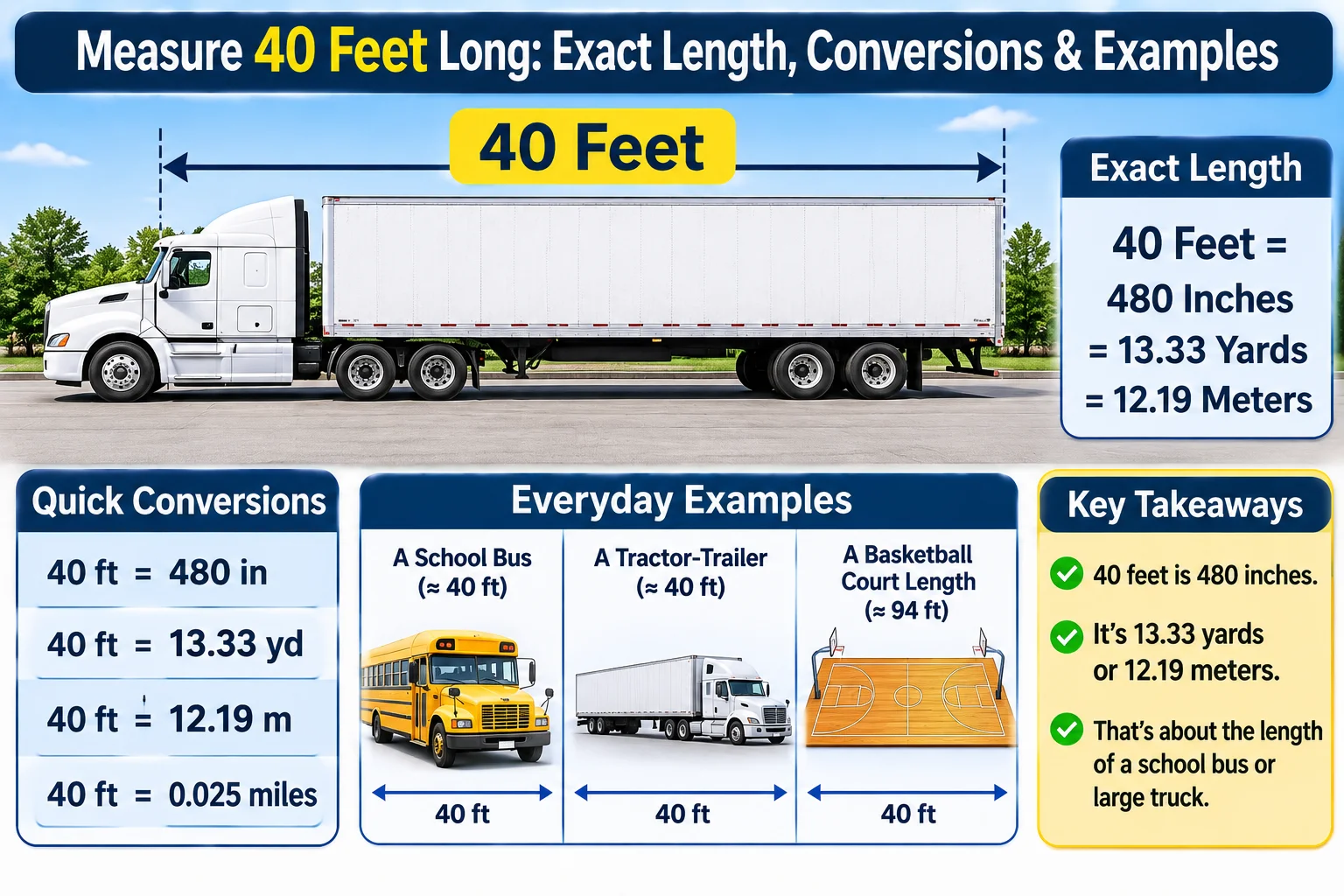
Measuring 40 feet is useful when planning construction projects, checking property dimensions, measuring outdoor spaces, or estimating the length of large objects. It is a considerably longer distance than most household measurements, so understanding its size can make planning easier.
40 feet equals 480 inches, 12.19 meters, or 13.33 yards. It is also equal to 40 standard one-foot measurements placed end to end.
Whether you are measuring a driveway, garden, fence, building section, or another long space, knowing how to visualize and calculate 40 feet can help you get accurate results.
Quick Answer: How Long Is 40 Feet?
Forty feet is equal to 480 inches or approximately 12.19 meters. It is also 13 yards and 1 foot long.
| Measurement Unit | Equivalent to 40 Feet |
|---|---|
| Feet | 40 ft |
| Inches | 480 inches |
| Yards | 13.33 yards |
| Meters | 12.192 m |
| Centimeters | 1,219.2 cm |
| Millimeters | 12,192 mm |
| Kilometers | 0.012192 km |
| Miles | 0.00758 miles |
A 40-foot distance is approximately the length of a four-story building’s height if each floor is around 10 feet tall, although actual building heights vary.
How to Measure 40 Feet Accurately
Measuring 40 feet requires a longer measuring tool or a method that combines several smaller measurements. The best option depends on whether you are measuring a straight outdoor distance, a building, or an object.
1. Use a Long Measuring Tape
A 50-foot or 100-foot measuring tape is a convenient choice for measuring 40 feet.
Follow these steps:
- Place the tape’s zero mark at the starting point.
- Extend the tape along the area you want to measure.
- Keep it straight and close to the ground.
- Stop at the 40-foot mark.
- Mark the endpoint if you need to identify the measured distance.
A longer tape helps avoid repeatedly repositioning the tool.
2. Use a Measuring Wheel
A measuring wheel is useful for measuring long distances across driveways, lawns, sidewalks, and construction sites.
Push the wheel along the ground from the starting point. Its counter records the distance traveled.
A measuring wheel is especially practical when the distance is too long for a standard household tape measure.
3. Use a 100-Foot Tape Measure
A 100-foot tape measure provides enough length to measure 40 feet in one pass.
This option is useful for:
- Property measurements
- Fence installation
- Landscaping
- Outdoor construction
- Sports and recreational areas
4. Combine Smaller Measurements
If you only have a 10-foot measuring tape, you can measure 40 feet in four sections.
| Measurement | Total Distance |
|---|---|
| First 10 feet | 10 ft |
| Second 10 feet | 20 ft |
| Third 10 feet | 30 ft |
| Fourth 10 feet | 40 ft |
Keep each section aligned with the previous endpoint. This prevents gaps and overlapping measurements.
How to Convert 40 Feet Into Different Units
Converting 40 feet into other units helps when reading construction plans, comparing international product dimensions, or measuring large spaces.
40 Feet to Inches
One foot contains 12 inches.
Multiply 40 by 12:
\[ 40\times12=480 \]
Therefore, 40 feet equals 480 inches.
40 Feet to Yards
One yard equals 3 feet.
Divide 40 by 3:
\[ 40\div3=13.333 \]
So, 40 feet equals approximately 13.33 yards, or 13 yards and 1 foot.
40 Feet to Meters
One foot equals 0.3048 meters.
\[ 40\times0.3048=12.192 \]
Therefore, 40 feet equals 12.192 meters.
40 Feet to Centimeters
One foot equals 30.48 centimeters.
\[ 40\times30.48=1,219.2 \]
This means 40 feet is equal to 1,219.2 centimeters.
Complete 40-Foot Conversion Table
| Unit | Equivalent |
|---|---|
| Inches | 480 |
| Yards | 13.333 |
| Meters | 12.192 |
| Centimeters | 1,219.2 |
| Millimeters | 12,192 |
| Kilometers | 0.012192 |
| Miles | 0.00758 |
What Does 40 Feet Look Like? Everyday Comparisons
Forty feet can be difficult to visualize because it is much longer than most everyday household objects. Comparing it with familiar structures and vehicles makes the distance easier to understand.
1. A Large School Bus
Many full-size school buses measure approximately 35–45 feet long, depending on the model.
A 40-foot distance is therefore close to the length of some large school buses.
2. A Four-Story Building
If each floor has an approximate floor-to-floor height of 10 feet, four floors together would measure around 40 feet.
This provides a useful vertical comparison, although actual building heights depend on ceiling heights, structural elements, and roof design.
3. A Large Recreational Vehicle
Some large motorhomes and recreational vehicles measure close to 40 feet long.
Their size makes them a useful reference for imagining a long distance on the ground.
4. Four Standard Parking Spaces
A typical parking space is around 9 feet wide and 18 feet long, although dimensions vary.
Two standard parking-space lengths placed end to end measure approximately 36 feet. Adding another 4 feet brings the total to 40 feet.
5. Thirteen and One-Third Yardsticks
A standard yardstick measures 3 feet.
Thirteen complete yardsticks plus one additional foot equal 40 feet.
This is a mathematical comparison rather than a practical way to measure the entire distance.
Everyday Comparison Table
| Object or Structure | Approximate Length or Height | Comparison With 40 Feet |
|---|---|---|
| Large school bus | 35–45 feet long | Similar length |
| Four-story building | Around 40 feet tall | Similar height |
| Large motorhome | Up to around 40 feet long | Similar length |
| Two parking-space lengths | Around 36 feet | Slightly shorter |
| Standard yardstick | 3 feet | About 13⅓ yardsticks |
These comparisons are approximate. Actual measurements vary by model, design, and location.
Where Is a 40-Foot Measurement Commonly Used?
A 40-foot measurement is useful in many construction, landscaping, transportation, and outdoor planning situations.
1. Fencing and Property Boundaries
Forty feet can describe a short section of residential fencing or a boundary line.
For example, if you need to install a fence along a straight 40-foot boundary, measuring the distance accurately helps estimate the required fencing material.
However, the total material needed may be greater if you include gates, corners, and additional sections.
2. Driveways and Outdoor Spaces
A 40-foot length may be used when planning driveway dimensions, garden layouts, walkways, or outdoor seating areas.
It can also help determine where to place landscaping features or outdoor structures.
3. Construction Projects
Builders and contractors regularly use measurements of this length when planning:
- Building sections
- Structural materials
- Wall layouts
- Support beams
- Outdoor structures
- Utility installations
Accurate measuring is important because even small errors can affect alignment and material requirements.
4. Landscaping and Gardening
A 40-foot measurement can help when planning long garden beds, planting rows, irrigation systems, or lawn sections.
For example, a straight planting row measuring 40 feet can be divided into smaller sections to organize plant spacing.
5. Vehicle and Storage Planning
Some large recreational vehicles and trailers approach 40 feet in length.
Understanding this distance helps when checking parking areas, garage spaces, storage facilities, and turning clearance.
How Much Area Does 40 Feet Cover?
Forty feet describes length, not area. To calculate square footage, you also need the width.
For example, a rectangular area measuring 40 feet long and 10 feet wide has an area of 400 square feet.
Use this formula:
\[ \text{Area}=\text{Length}\times\text{Width} \]
Examples of Areas That Are 40 Feet Long
| Length | Width | Total Area |
|---|---|---|
| 40 ft | 5 ft | 200 sq. ft. |
| 40 ft | 8 ft | 320 sq. ft. |
| 40 ft | 10 ft | 400 sq. ft. |
| 40 ft | 12 ft | 480 sq. ft. |
| 40 ft | 15 ft | 600 sq. ft. |
| 40 ft | 20 ft | 800 sq. ft. |
This distinction is important when estimating flooring, concrete, grass, or other materials.
40 Feet Compared With Other Common Lengths
Comparing 40 feet with nearby measurements helps you understand its size and the difference between longer and shorter distances.
| Measurement | Inches | Meters |
|---|---|---|
| 10 feet | 120 | 3.048 |
| 15 feet | 180 | 4.572 |
| 20 feet | 240 | 6.096 |
| 25 feet | 300 | 7.62 |
| 30 feet | 360 | 9.144 |
| 35 feet | 420 | 10.668 |
| 40 feet | 480 | 12.192 |
| 45 feet | 540 | 13.716 |
| 50 feet | 600 | 15.24 |
40 Feet vs. 30 Feet
Forty feet is 10 feet longer than 30 feet.
| Feature | 30 Feet | 40 Feet |
|---|---|---|
| Inches | 360 | 480 |
| Meters | 9.144 | 12.192 |
| Yards | 10 | 13.33 |
| Difference | — | 10 feet |
40 Feet vs. 50 Feet
Fifty feet is 10 feet longer than 40 feet.
| Feature | 40 Feet | 50 Feet |
|---|---|---|
| Inches | 480 | 600 |
| Meters | 12.192 | 15.24 |
| Yards | 13.33 | 16.67 |
| Difference | — | 10 feet |
How to Estimate 40 Feet Without a Measuring Tape
If you do not have a long measuring tape, several methods can help you estimate a 40-foot distance.
These methods are useful for rough planning, but they are not substitutes for accurate measurements.
Use a Measuring Wheel App
Some mobile applications estimate walking distance using GPS or motion sensors.
You can use these tools to estimate longer outdoor distances, but accuracy may vary depending on the device and environment.
Use Your Walking Steps
An average adult walking step may cover approximately 2.5 feet.
At that pace, 16 steps would cover around 40 feet.
However, step length differs between people and can change with walking speed. This method should only be used for rough estimates.
Use a 10-Foot Reference
If you have an object or measuring tool that is exactly 10 feet long, repeat its length four times.
10 × 4 = 40 feet.
Make sure each section begins where the previous section ends.
Use Parking Space Lengths
A typical parking space is approximately 18 feet long. Two parking spaces placed end to end would cover around 36 feet.
You can use the remaining 4 feet as a rough visual estimate, but parking-space dimensions are not standardized everywhere.
Common Mistakes When Measuring 40 Feet
Measuring a long distance requires attention to alignment and starting points. Avoid these common mistakes:
- Confusing feet with inches: Forty feet equals 480 inches, not 40 inches.
- Using a short tape incorrectly: Repeated measurements can create gaps or overlaps.
- Allowing the tape to bend: Keep the measuring tape straight for a direct distance.
- Using walking steps as exact measurements: Step lengths vary from person to person.
- Ignoring slopes or uneven ground: A tape laid along a slope measures the surface distance rather than the horizontal distance.
- Confusing length with area: Forty feet does not tell you how many square feet a space contains without knowing its width.
For construction, fencing, and property measurements, use an appropriate measuring tool and verify important dimensions before starting work.
Frequently Asked Questions About Measuring 40 Feet
1. How many inches are in 40 feet?
There are exactly 480 inches in 40 feet. Multiply 40 by 12 because every foot contains 12 inches.
2. How many meters is 40 feet?
Forty feet equals 12.192 meters. This conversion is useful when working with metric construction plans or international product specifications.
3. What common object is about 40 feet long?
Some full-size school buses and large recreational vehicles measure close to 40 feet long. Their actual dimensions depend on the model.
4. How many yards are in 40 feet?
Forty feet equals approximately 13.33 yards. One yard contains 3 feet, so divide 40 by 3.
5. Can I measure 40 feet without a long measuring tape?
Yes. You can use a 10-foot measuring tool four times, a measuring wheel, or an estimated walking-step method. For accurate results, use a suitable measuring tape or wheel.
Conclusion
Forty feet is a substantial length equal to 480 inches, 12.192 meters, or approximately 13.33 yards. It is close to the length of some full-size school buses and large recreational vehicles, making those objects useful visual references.
You can measure 40 feet with a long measuring tape, measuring wheel, or several smaller measurements. For construction, landscaping, and property projects, always verify the distance carefully to avoid measurement errors.
Discover More Articles
Measuring 4 Inches: Easy Guide With Size Comparisons
Measure 3 Feet: Exact Length, Conversions, and Everyday Comparisons


