

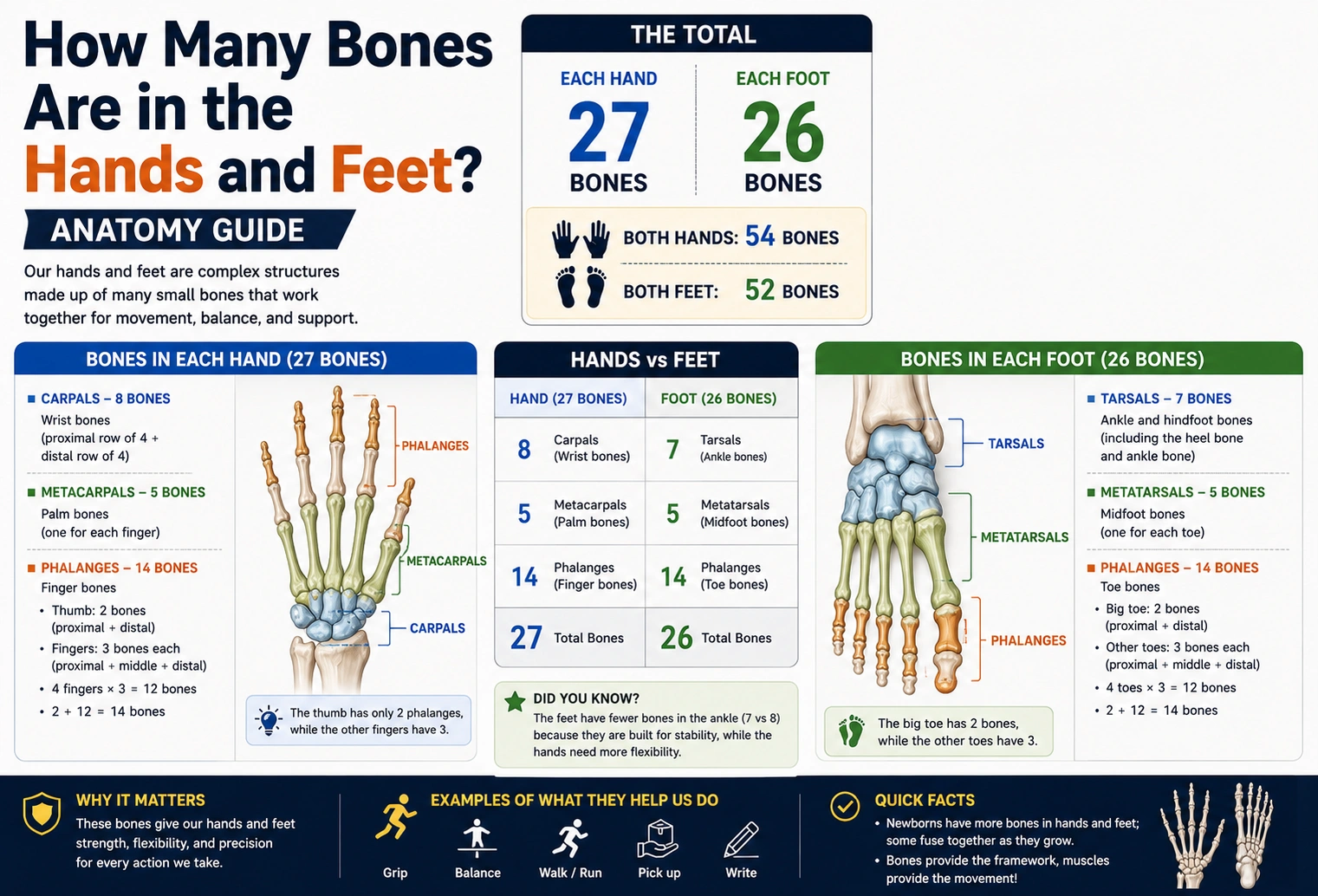
If you’re wondering how many bones are in the hands and feet, the human body has a total of 106 bones in both hands and both feet.
The breakdown is:
- 27 bones in each hand
- 26 bones in each foot
Therefore:
27 + 27 + 26 + 26 = 106 bones
These bones allow the hands and feet to perform complex movements while supporting and stabilizing the body.
Quick Answer
| Body Part | Bones Per Side | Both Sides |
|---|---|---|
| One hand | 27 | 54 |
| One foot | 26 | 52 |
| Hands + feet | — | 106 |
So, the answer is:
There are 106 bones in the two hands and two feet combined.
This count refers to the standard adult human skeleton.
How Many Bones Are in One Hand?
Each human hand contains 27 bones.
The bones are divided into three major groups:
- 8 carpal bones
- 5 metacarpal bones
- 14 phalanges
The calculation is:
8 + 5 + 14 = 27 bones
The carpals form the wrist, the metacarpals make up the palm, and the phalanges form the fingers.
How Many Bones Are in One Foot?
Each human foot contains 26 bones.
They are divided into:
- 7 tarsal bones
- 5 metatarsal bones
- 14 phalanges
The calculation is:
7 + 5 + 14 = 26 bones
The tarsals make up the ankle and rear portion of the foot, the metatarsals form the middle of the foot, and the phalanges form the toes.
Bone Breakdown of the Hand
The 27 bones in each hand are arranged to provide both strength and flexibility.
Carpal Bones: 8
The wrist contains eight small carpal bones.
They are arranged in two rows and connect the hand to the forearm.
The eight carpals are:
- Scaphoid
- Lunate
- Triquetrum
- Pisiform
- Trapezium
- Trapezoid
- Capitate
- Hamate
Metacarpals: 5
The palm contains five metacarpal bones.
Each corresponds generally to one finger or the thumb.
They are numbered from the thumb side toward the little-finger side.
Phalanges: 14
Each hand contains 14 finger bones, called phalanges.
The thumb has two phalanges:
- Proximal
- Distal
Each of the other four fingers has three:
- Proximal
- Middle
- Distal
Therefore:
2 + (4 × 3) = 14 phalanges
Bone Breakdown of the Foot
Each foot contains 26 bones.
These bones provide a combination of stability, flexibility, and support for walking and standing.
Tarsal Bones: 7
The seven tarsal bones include:
- Talus
- Calcaneus
- Navicular
- Cuboid
- Medial cuneiform
- Intermediate cuneiform
- Lateral cuneiform
The talus connects the foot to the lower leg, while the calcaneus forms the heel.
Metatarsals: 5
Each foot has five metatarsal bones.
They form much of the middle and front portion of the foot and connect the tarsal bones to the toes.
Phalanges: 14
Each foot has 14 phalanges.
The big toe contains two phalanges:
- Proximal
- Distal
The other four toes each contain three:
- Proximal
- Middle
- Distal
Therefore:
2 + (4 × 3) = 14 phalanges
Total Bones in Both Hands and Feet
Now we can calculate the complete total.
Both Hands
27 × 2 = 54 bones
Both Feet
26 × 2 = 52 bones
Combined Total
54 + 52 = 106 bones
Therefore, the two hands and two feet contain 106 bones.
Why Do Hands and Feet Have So Many Bones?
The large number of small bones in the hands and feet provides a combination of mobility, flexibility, stability, and strength.
The hands need many joints and small bones to perform precise movements such as:
- Gripping
- Writing
- Typing
- Picking up objects
- Pinching
- Manipulating tools
The feet need a complex bone structure to:
- Support body weight
- Absorb forces
- Maintain balance
- Adapt to surfaces
- Help produce forward movement
The arrangement of many bones and joints allows these structures to perform their specialized functions.
Hand and Foot Bone Comparison
Although the hands and feet have similar numbers of bones, their structures are adapted for different jobs.
| Feature | Hand | Foot |
|---|---|---|
| Total bones | 27 | 26 |
| Small wrist/ankle bones | 8 carpals | 7 tarsals |
| Palm/midfoot bones | 5 metacarpals | 5 metatarsals |
| Finger/toe bones | 14 phalanges | 14 phalanges |
The hands are primarily designed for fine movement and manipulation, while the feet are designed for support, balance, and movement.
How Hand Bones and Foot Bones Work Together
The bones do not work independently. They form interconnected structures through joints, ligaments, muscles, and tendons.
Hand
The hand’s many small bones allow the fingers and thumb to move in different directions.
The thumb is especially important because its arrangement allows it to oppose the fingers, making precise gripping possible.
Foot
The foot’s bones form arches and provide a stable platform for the body.
The heel and midfoot absorb and distribute forces, while the forefoot and toes help with balance and push-off during walking.
Are the Bones in the Hands and Feet the Same?
No. The two structures have some similarities but are not identical.
Both contain:
- Five long bones in the middle region
- Fourteen phalanges
- Multiple small bones near the wrist or ankle
However, the hand has 8 carpals, while the foot has 7 tarsals.
That difference is why each hand has 27 bones while each foot has 26.
Hands and Feet Together Compared With the Whole Skeleton
An adult human skeleton normally contains 206 bones.
The hands and feet together contain:
106 bones
That means more than half of the bones in the adult skeleton are located in the two hands and two feet.
Calculation:
106 ÷ 206 × 100 ≈ 51.5%
So approximately 51.5% of the bones in an adult skeleton are found in the hands and feet.
What Are the Largest Bones in the Hands and Feet?
The bones vary greatly in size.
In the Hand
The metacarpals are among the larger bones of the hand and form the framework of the palm.
In the Foot
The calcaneus, or heel bone, is the largest bone in the foot.
It plays an important role in supporting body weight and absorbing impact.
Do Babies Have the Same Number of Bones?
No. Newborns have more skeletal elements than adults because some bones are not yet fused.
As a person grows, certain bones fuse together.
The exact bone count can also vary slightly between individuals because some people have additional small accessory bones or anatomical variations.
The commonly cited 206 bones refers to the standard adult skeleton.
Frequently Asked Questions
How many bones are in both hands and feet?
There are 106 bones in both hands and both feet combined.
That includes:
- 54 bones in both hands
- 52 bones in both feet
How many bones are in one hand?
One human hand contains 27 bones:
- 8 carpals
- 5 metacarpals
- 14 phalanges
How many bones are in one foot?
One human foot contains 26 bones:
- 7 tarsals
- 5 metatarsals
- 14 phalanges
How many bones are in both hands?
Both hands contain:
27 × 2 = 54 bones
How many bones are in both feet?
Both feet contain:
26 × 2 = 52 bones
Are there more bones in the hands or feet?
There is one more bone in each hand than in each foot.
A hand has 27 bones, while a foot has 26 bones.
How many finger and toe bones are there?
Each hand has 14 phalanges, and each foot also has 14 phalanges.
Across two hands and two feet:
14 × 4 = 56 phalanges
What are the 8 bones in the wrist called?
The eight carpal bones are:
- Scaphoid
- Lunate
- Triquetrum
- Pisiform
- Trapezium
- Trapezoid
- Capitate
- Hamate
What are the 7 bones in the ankle called?
The seven tarsal bones are:
- Talus
- Calcaneus
- Navicular
- Cuboid
- Medial cuneiform
- Intermediate cuneiform
- Lateral cuneiform
Conclusion
If you’re asking how many bones are in the hands and feet, the standard adult human skeleton has 106 bones across both hands and both feet.
The breakdown is:
Both hands: 54 bones
Both feet: 52 bones
Total: 106 bones
Each hand contains 27 bones, while each foot contains 26 bones. The hands have 8 carpals, 5 metacarpals, and 14 phalanges, while the feet have 7 tarsals, 5 metatarsals, and 14 phalanges.
This complex arrangement gives the hands the flexibility needed for precise movements and gives the feet the strength and stability needed for standing, walking, running, and balance.
Discover More Articles
How Many Feet Is 154 Inches? Exact Conversion Guide