

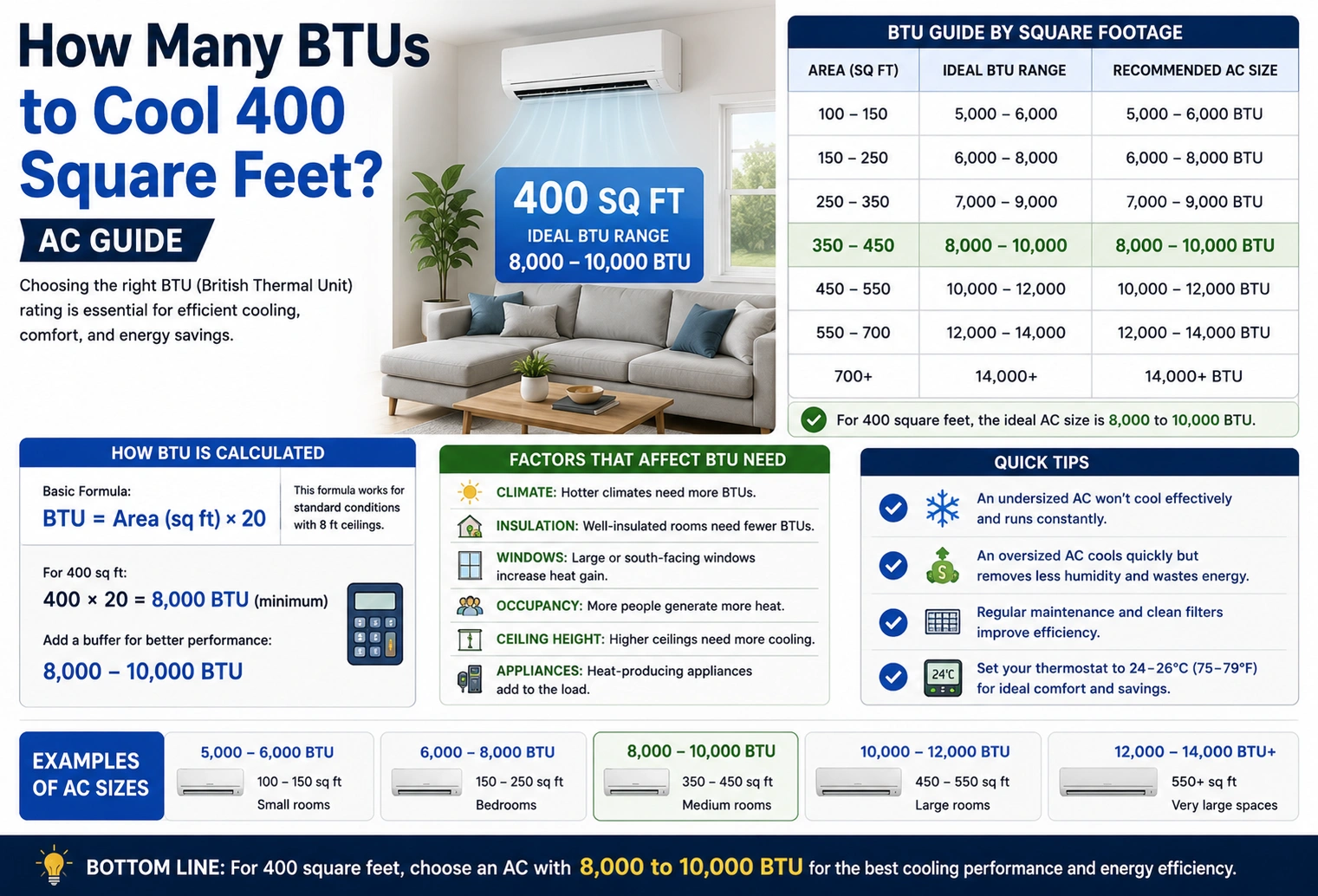
If you’re trying to choose an air conditioner for a 400-square-foot room or living space, one of the most important questions is how many BTUs you need.
For a typical 400-square-foot space, an air conditioner around 9,000 BTUs is often a reasonable starting point. However, the ideal capacity can vary depending on climate, insulation, ceiling height, sunlight, number of occupants, windows, and other heat-producing factors.
A simple square-footage estimate should therefore be treated as a starting point rather than a complete HVAC load calculation.
Quick Answer
For approximately 400 square feet, a cooling capacity of around 9,000 BTUs is commonly used as a starting estimate.
Depending on the room and conditions, you may need somewhat less or more capacity.
For example:
| Space | Approximate Starting BTU Range |
|---|---|
| 300 sq ft | 7,000–8,000 BTUs |
| 400 sq ft | 9,000–10,000 BTUs |
| 500 sq ft | 10,000–12,000 BTUs |
| 600 sq ft | 12,000–14,000 BTUs |
These are general estimates, not substitutes for a professional cooling-load calculation.
What Is a BTU?
BTU stands for British thermal unit.
In air conditioning, BTUs describe the amount of heat an air conditioner can remove from a space over time.
A higher BTU rating generally means greater cooling capacity.
For example:
- 5,000 BTUs — suitable for smaller spaces
- 8,000 BTUs — moderate cooling capacity
- 9,000 BTUs — useful for many spaces around 400 square feet
- 12,000 BTUs — greater cooling capacity for larger or more demanding spaces
- 18,000+ BTUs — designed for substantially larger cooling loads
The correct capacity depends on more than floor area.
How Many BTUs Does 400 Square Feet Need?
A 400-square-foot room is relatively modest in size, but the cooling requirement can vary significantly.
For a typical room with average insulation and ceiling height, approximately 9,000 BTUs can be a reasonable starting point.
A 400-square-foot space with significant sunlight, poor insulation, high ceilings, or several occupants may require more cooling capacity.
Conversely, a well-insulated space with limited sunlight may require less.
The first step is determining the room’s square footage accurately.
For a rectangular room:
Length × Width = Square Feet
For example, a room measuring 20 feet by 20 feet has:
20 × 20 = 400 square feet
Once you know the area, you can use it as the starting point for estimating AC capacity.
Factors That Affect AC Sizing
Square footage is only one part of determining the right BTU rating.
Climate
A room in a hot climate may need more cooling capacity than the same-size room in a mild climate.
Areas with long, hot summers can place a significantly higher cooling demand on an air conditioner.
Insulation
Good insulation helps keep conditioned air inside and outdoor heat outside.
Poor insulation can increase the amount of cooling required.
Windows
Large windows can allow substantial solar heat into a room, especially when they face the sun for much of the day.
Ceiling Height
A 400-square-foot room with an 8-foot ceiling contains less air volume than a 400-square-foot room with a 12-foot ceiling.
Higher ceilings can therefore affect cooling requirements.
Number of People
People generate body heat.
A room regularly occupied by several people may need more cooling than a room occupied by one or two people.
Appliances and Electronics
Computers, televisions, refrigerators, lighting, and other equipment can produce additional heat.
Sun Exposure
A heavily sun-exposed room can become significantly warmer than a shaded room.
Does Climate Change the BTU Requirement?
Yes.
The same 400-square-foot room can require different air-conditioning capacities depending on where it is located.
A room in a hot, humid region may need a larger cooling system than an identical room in a cooler climate.
This is particularly important when choosing an AC for:
- Attics
- Sunrooms
- Garages
- Rooms with large windows
- Poorly insulated spaces
- Rooms with high ceilings
Local weather conditions should be considered alongside square footage.
What Happens If an AC Is Too Small?
An undersized air conditioner may struggle to maintain the desired temperature.
You might notice:
- The AC runs continuously
- The room takes a long time to cool
- The system struggles on hot days
- Energy consumption increases
- The room never reaches the desired temperature
An AC that is too small may therefore provide inadequate comfort.
What Happens If an AC Is Too Large?
A larger AC isn’t automatically better.
An oversized air conditioner can cool a room very quickly but may not run long enough to properly remove humidity.
Potential problems include:
- Uneven temperatures
- Poor humidity control
- Frequent cycling
- Reduced comfort
- Potentially inefficient operation
The goal is to choose an appropriately sized unit rather than simply selecting the highest BTU rating available.
Is 5,000 BTU Enough for 400 Square Feet?
A 5,000-BTU air conditioner is generally intended for a much smaller space than 400 square feet under typical conditions.
For a 400-square-foot room, a unit in the 9,000-BTU range is often a more appropriate starting point.
However, unusual room conditions can change the recommendation.
Is 8,000 BTU Enough for 400 Square Feet?
An 8,000-BTU unit may cool some 400-square-foot spaces, particularly when insulation is good and outdoor temperatures are moderate.
However, it may not provide enough capacity for a poorly insulated or heavily sun-exposed room in a hot climate.
Always consider the conditions of the room rather than relying on square footage alone.
Is 10,000 BTU Too Much for 400 Square Feet?
Not necessarily.
A 10,000-BTU unit may be appropriate for a 400-square-foot room with higher cooling demands.
For example, additional capacity may be useful when the space has:
- Strong afternoon sunlight
- Poor insulation
- High ceilings
- Several occupants
- Significant heat-producing equipment
However, oversized equipment can create humidity and cycling issues, so more BTUs aren’t automatically better.
What Size AC for a 400-Square-Foot Room?
For many typical 400-square-foot rooms, consider approximately:
9,000–10,000 BTUs
as a starting range.
The final choice should take into account the room’s location, insulation, windows, ceiling height, occupancy, and other heat loads.
If you’re installing a permanent HVAC system, a professional load calculation is preferable to a simple square-footage estimate.
Choosing Between Different AC Types
The same general cooling requirement can be provided by different types of air conditioners.
Window AC
Window units are commonly used for individual rooms.
A properly sized window unit can be a practical option for a 400-square-foot space.
Portable AC
Portable units can also cool individual rooms, but their real-world performance depends on the model and installation conditions.
Pay attention to the manufacturer’s cooling-capacity information rather than comparing BTU numbers blindly.
Mini-Split
A mini-split system can be a good option when you want more permanent and efficient room cooling.
The appropriate size depends on the specific cooling load.
Central AC
If the 400-square-foot area is part of a larger home, the appropriate central-air system should be sized for the entire home, not simply that one room.
9. FAQs
1. How many BTUs do I need to cool 400 square feet?
A typical 400-square-foot space may start around 9,000 BTUs, with approximately 9,000–10,000 BTUs being a useful general range. Actual requirements vary based on room conditions and climate.
2. Is 9,000 BTU enough for 400 square feet?
It can be appropriate for many typical 400-square-foot spaces, but hotter climates, poor insulation, high ceilings, and significant sun exposure may increase the required capacity.
3. Is 12,000 BTU too much for 400 square feet?
Not necessarily, but it may be oversized for some 400-square-foot spaces. The appropriate capacity depends on the actual cooling load.
4. What size window AC do I need for 400 square feet?
A window AC around 9,000–10,000 BTUs can be a reasonable starting point for many 400-square-foot rooms, subject to the manufacturer’s sizing guidance and room conditions.
5. Does ceiling height affect AC sizing?
Yes. Higher ceilings increase the volume of air in the room and can affect the required cooling capacity.
6. Does insulation affect BTU requirements?
Yes. Well-insulated rooms generally retain conditioned air better and may require less cooling capacity than poorly insulated spaces.
7. Can I use a 5,000-BTU AC for 400 square feet?
A 5,000-BTU unit is generally intended for smaller spaces and may struggle to cool a typical 400-square-foot room adequately.
8. Should I choose a bigger AC just to be safe?
Not necessarily. An oversized air conditioner can cycle too frequently and may not control humidity effectively. Proper sizing is more important than simply choosing more BTUs.
10. Conclusion
If you’re asking how many BTUs to cool 400 square feet, a reasonable starting point for many typical spaces is around 9,000 BTUs, with 9,000–10,000 BTUs often serving as a general range.
However, square footage alone doesn’t determine the correct AC size. Climate, insulation, ceiling height, windows, sunlight, occupancy, and heat-producing appliances can all affect the cooling requirement.
For a window or portable AC, use the manufacturer’s sizing guidance alongside these estimates. For a permanent HVAC installation, a professional cooling-load calculation provides a more reliable way to determine the correct system size.
Discover More Articles
How Many Feet Is 154 Inches? Exact Conversion Guide