
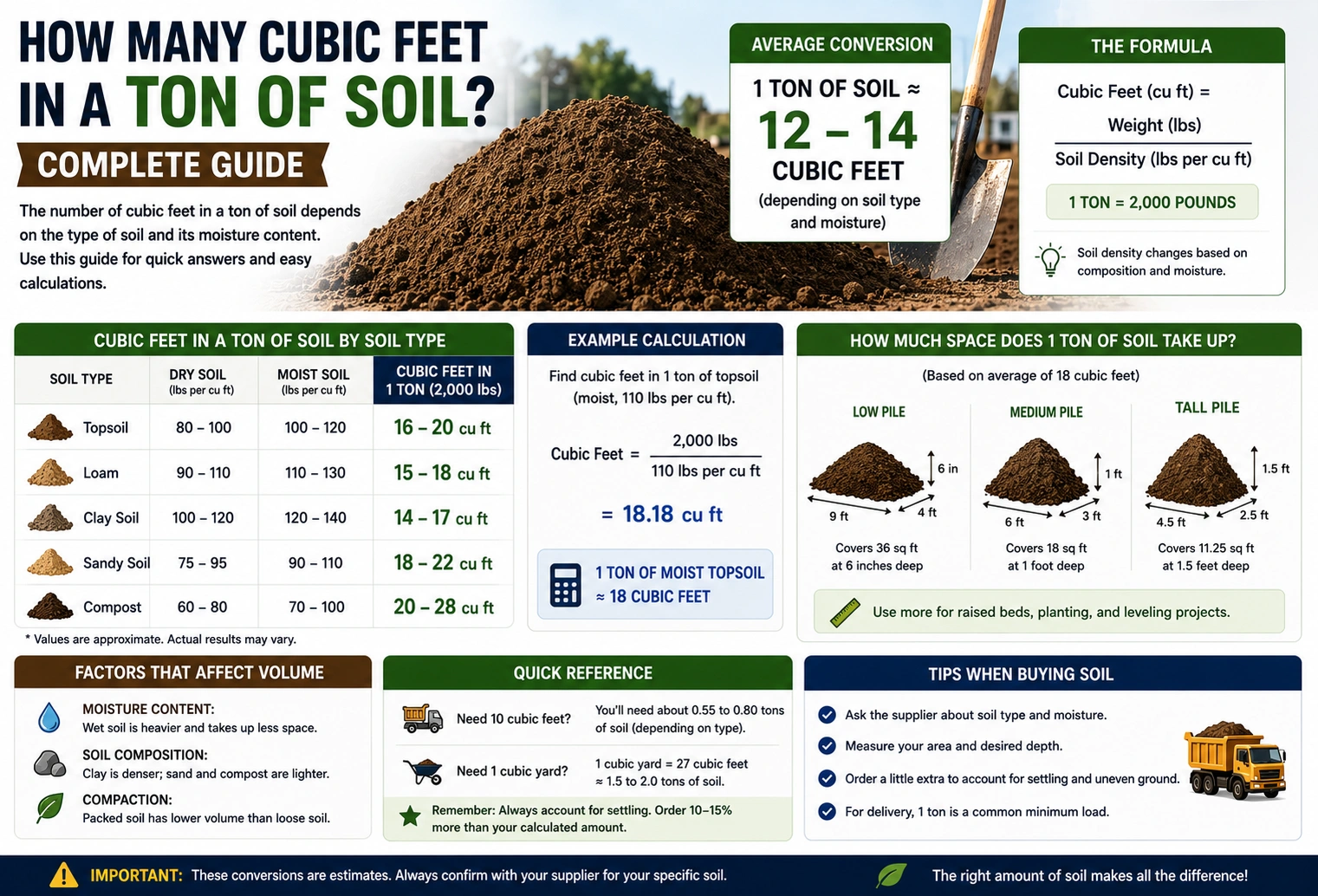
If you’re wondering how many cubic feet are in a ton of soil, there isn’t one exact answer because soil doesn’t have a fixed weight per cubic foot.
As a general estimate, one U.S. short ton of soil may equal approximately 20–27 cubic feet, depending on the type, moisture content, and density of the soil.
A commonly used planning estimate for ordinary topsoil is around 24 cubic feet per ton.
However, the actual amount can vary considerably.
Quick Answer
A reasonable general estimate is:
1 ton of soil ≈ 20–27 cubic feet
For many landscaping calculations, using approximately:
1 ton ≈ 24 cubic feet
can provide a useful starting estimate.
For an accurate conversion, you need to know the soil’s weight per cubic foot.
Why Doesn’t One Ton of Soil Equal a Fixed Number of Cubic Feet?
The reason is density.
A ton measures weight, while cubic feet measure volume.
Different types of soil can weigh different amounts even when they occupy exactly the same volume.
For example, dry, loose soil may weigh less per cubic foot than wet, compacted soil.
Factors that affect soil density include:
- Soil type
- Moisture content
- Compaction
- Organic matter
- Sand content
- Clay content
- Gravel or rock content
Because of these differences, one ton of one type of soil may occupy more or less space than one ton of another type.
How to Convert Tons of Soil to Cubic Feet
To convert soil weight into volume, use the soil’s approximate density.
The basic formula is:
Cubic Feet = Weight in Pounds ÷ Pounds per Cubic Foot
One U.S. short ton contains:
2,000 pounds
So if your soil weighs approximately 80 pounds per cubic foot:
2,000 ÷ 80 = 25 cubic feet
Therefore, one ton would occupy approximately 25 cubic feet.
This illustrates why the soil’s density is necessary for an accurate conversion.
Common Soil Density Estimates
Soil density can vary significantly.
| Approximate Soil Weight | Cubic Feet per Ton |
|---|---|
| 60 lb/cu ft | 33.3 cu ft |
| 70 lb/cu ft | 28.6 cu ft |
| 75 lb/cu ft | 26.7 cu ft |
| 80 lb/cu ft | 25.0 cu ft |
| 85 lb/cu ft | 23.5 cu ft |
| 90 lb/cu ft | 22.2 cu ft |
| 100 lb/cu ft | 20.0 cu ft |
These numbers demonstrate why there isn’t a universal ton-to-cubic-foot conversion for soil.
The heavier the soil is per cubic foot, the fewer cubic feet one ton will occupy.
How Many Cubic Feet Are in a Ton of Topsoil?
Topsoil can have different densities depending on whether it is dry, damp, loose, or compacted.
A general estimate is approximately 20–27 cubic feet per ton.
For simple landscaping estimates, about 24 cubic feet per ton is often a useful approximation.
If you’re purchasing topsoil by the ton, however, check the supplier’s stated weight or volume conversion whenever possible.
How Many Cubic Yards Are in a Ton of Soil?
Since:
1 cubic yard = 27 cubic feet
you can convert the estimated cubic-foot volume into cubic yards.
For example, if one ton of soil occupies 24 cubic feet:
24 ÷ 27 = 0.89 cubic yards
So:
1 ton of soil ≈ 0.89 cubic yards
Using a different soil density will produce a different result.
For example, 20 cubic feet would equal:
20 ÷ 27 ≈ 0.74 cubic yards
While 27 cubic feet equals:
1 cubic yard
How Much Does One Cubic Foot of Soil Weigh?
The answer depends on the soil.
A general range might be approximately 60–100 pounds per cubic foot, although actual values can fall outside this range.
For example, if soil weighs 80 pounds per cubic foot:
1 cubic foot = 80 pounds
Since a ton is 2,000 pounds:
2,000 ÷ 80 = 25 cubic feet
This gives:
1 ton = 25 cubic feet
How Many Cubic Feet Are in 2 Tons of Soil?
If you use the common estimate of 24 cubic feet per ton:
2 × 24 = 48 cubic feet
Therefore:
2 tons ≈ 48 cubic feet
The actual amount could be higher or lower depending on soil density.
Using a range of 20–27 cubic feet per ton gives:
2 tons ≈ 40–54 cubic feet
How Many Cubic Feet Are in 5 Tons of Soil?
Using 24 cubic feet per ton:
5 × 24 = 120 cubic feet
So:
5 tons ≈ 120 cubic feet
Using the broader 20–27 cubic-foot range:
5 tons ≈ 100–135 cubic feet
How Many Cubic Feet Are in 10 Tons of Soil?
Using the 24-cubic-foot estimate:
10 × 24 = 240 cubic feet
Therefore:
10 tons ≈ 240 cubic feet
Depending on density, the actual volume could be approximately 200–270 cubic feet.
How Much Area Can One Ton of Soil Cover?
This depends on the desired depth.
To calculate coverage, first determine the volume of soil available.
For example, if one ton contains approximately 24 cubic feet of soil and you spread it at a depth of 3 inches:
3 inches = 0.25 feet
Then:
24 ÷ 0.25 = 96 square feet
So one ton could cover approximately 96 square feet at a 3-inch depth, using the 24-cubic-foot estimate.
At a 2-inch depth:
2 inches = 1/6 foot
24 ÷ 1/6 = 144 square feet
Therefore, the same ton could cover approximately 144 square feet at 2 inches deep.
Soil Coverage by Depth
Using approximately 24 cubic feet per ton:
| Soil Depth | Approximate Coverage |
| 1 inch | 288 sq ft |
| 2 inches | 144 sq ft |
| 3 inches | 96 sq ft |
| 4 inches | 72 sq ft |
| 6 inches | 48 sq ft |
| 12 inches | 24 sq ft |
These are approximate calculations and assume the full 24 cubic feet is available for spreading.
How to Calculate How Much Soil You Need
If you’re planning a garden bed or landscaping project, calculate the required volume first.
Use:
Length × Width × Depth = Cubic Feet
Make sure all measurements are in feet.
For example, suppose a garden bed is:
- 20 feet long
- 10 feet wide
- 0.25 feet deep
Then:
20 × 10 × 0.25 = 50 cubic feet
If one ton of your soil is approximately 24 cubic feet:
50 ÷ 24 ≈ 2.08 tons
You would need approximately 2.1 tons of soil.
For practical purchasing, you may want to order slightly more to account for settling and variation in the material.
Soil Sold by the Ton vs. Cubic Yard
Bulk soil can be sold by either weight or volume.
When soil is sold by the ton, you’re paying for a specific weight.
When it is sold by the cubic yard, you’re purchasing a specific volume.
This distinction matters because moisture can change soil weight without changing the physical dimensions of the pile by the same proportion.
For large landscaping projects, ask the supplier whether their pricing is based on tons, cubic yards, or another measurement.
Does Wet Soil Weigh More?
Yes.
Water adds weight to soil.
A cubic foot of damp or wet soil can therefore weigh substantially more than a cubic foot of dry soil.
This means that a ton of wet soil may occupy less volume than a ton of dry, loose soil.
This is one reason suppliers may provide approximate rather than exact ton-to-volume conversions.
Frequently Asked Questions
How many cubic feet are in one ton of soil?
A general estimate is approximately 20–27 cubic feet per ton, with about 24 cubic feet often used as a convenient planning estimate.
How many cubic feet are in a ton of topsoil?
Depending on density and moisture, one ton of topsoil may occupy approximately 20–27 cubic feet.
How many cubic yards are in a ton of soil?
Using the approximate 24-cubic-foot estimate:
24 ÷ 27 ≈ 0.89 cubic yards
So one ton of soil is roughly 0.9 cubic yards under that assumption.
How much does one cubic foot of soil weigh?
Soil can weigh roughly 60–100 pounds per cubic foot, depending on type, moisture, and compaction.
How many cubic feet are in 2 tons of soil?
Using 24 cubic feet per ton:
2 tons ≈ 48 cubic feet
How many cubic feet are in 5 tons of soil?
Using the same estimate:
5 tons ≈ 120 cubic feet
How many cubic feet are in a ton of dirt?
“Dirt” varies in density just like soil. A reasonable general estimate is approximately 20–27 cubic feet per ton.
Is a ton of soil the same as a cubic yard?
No. A ton measures weight, while a cubic yard measures volume. Depending on soil density, one ton may be less than, approximately equal to, or close to one cubic yard.
Conclusion
If you’re asking how many cubic feet are in a ton of soil, there isn’t one exact answer because soil density varies.
For general planning, 1 ton of soil is often estimated at approximately 20–27 cubic feet, with about 24 cubic feet per ton being a useful middle estimate.
The most accurate conversion depends on the specific soil’s density and moisture content. If you’re calculating material for a garden, landscaping project, or raised bed, determine the required cubic feet first and then use your supplier’s ton-to-volume information whenever available.
Discover More Articles
How Many BTUs to Cool 400 Square Feet? AC Guide