
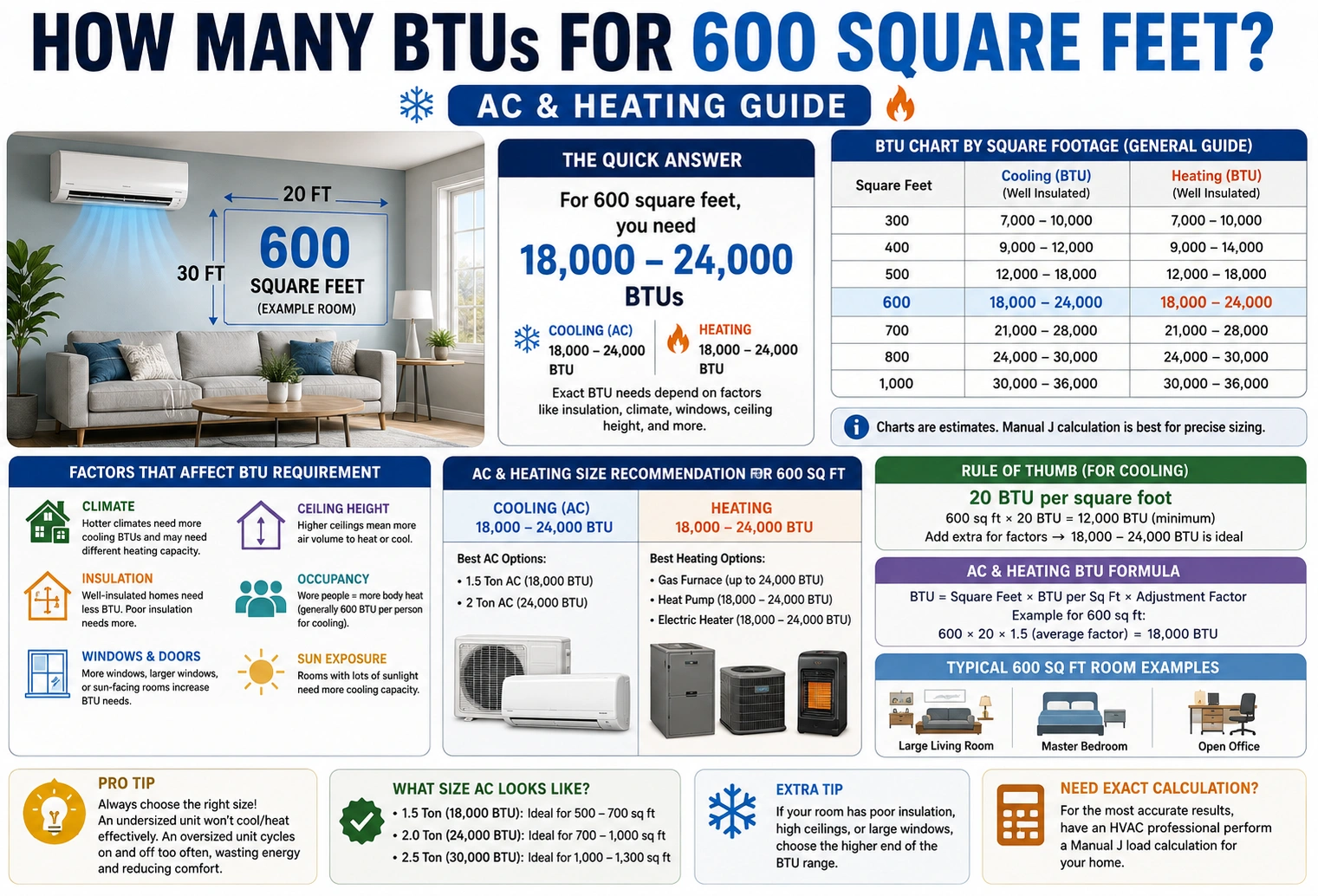
If you’re asking how many BTUs for 600 square feet, a typical room or small space may need around 12,000–15,000 BTUs for air conditioning, depending on insulation, climate, ceiling height, windows, and sunlight.
For a basic estimate, 12,000 BTUs is often a reasonable starting point for 600 square feet in moderate conditions. Hot, sunny, poorly insulated spaces may need more.
| Space Size | Basic AC Estimate | Hot/Sunny Conditions |
|---|---|---|
| 400 sq ft | 8,000–10,000 BTU | 10,000–12,000 BTU |
| 500 sq ft | 10,000–12,000 BTU | 12,000–14,000 BTU |
| 600 sq ft | 12,000 BTU | 14,000–15,000 BTU |
| 700 sq ft | 14,000 BTU | 16,000–18,000 BTU |
| 800 sq ft | 16,000 BTU | 18,000–20,000 BTU |
These are general sizing estimates, not a substitute for a professional load calculation.
What Does BTU Mean?
BTU stands for British thermal unit. It is a measurement of heat energy.
When discussing air conditioners, BTUs indicate how much heat an AC can remove from a space over a given period.
For example:
- 8,000 BTU AC = lower cooling capacity
- 10,000 BTU AC = moderate cooling capacity
- 12,000 BTU AC = higher cooling capacity
- 15,000 BTU AC = still higher capacity
The larger the space, the more cooling capacity is generally needed.
However, square footage alone does not determine the correct AC size.
How Many BTUs for 600 Square Feet?
A common rule of thumb starts with approximately 20 BTUs per square foot for air conditioning.
For 600 square feet:
600 × 20 = 12,000 BTUs
Therefore:
600 square feet × 20 BTU = 12,000 BTUs
This gives a basic estimate of 12,000 BTUs.
But the actual requirement can be higher or lower.
Climate, insulation, windows, ceiling height, occupancy, and heat-producing appliances all affect the cooling load.
600 Square Feet BTU Calculation
Here’s the simple calculation:
Step 1: Determine the Area
600 square feet
Step 2: Use a Basic BTU Factor
20 BTUs per square foot
Step 3: Multiply
600 × 20 = 12,000 BTUs
Estimated Requirement
Approximately 12,000 BTUs
A 12,000-BTU air conditioner is commonly sold as a 1-ton AC unit because:
12,000 BTU = 1 ton of cooling capacity
However, this doesn’t mean every 600-square-foot space should automatically use a 1-ton unit.
BTU Chart for 600 Square Feet
Different room conditions can change the recommended capacity.
| 600-Sq-Ft Space Condition | Approx. BTU Range |
|---|---|
| Well insulated, mild climate | 10,000–12,000 BTU |
| Average insulation | 12,000 BTU |
| Hot climate | 12,000–15,000 BTU |
| Very sunny space | 14,000–16,000 BTU |
| Poor insulation | 14,000–18,000+ BTU |
These ranges are useful for preliminary planning. A professional HVAC calculation can produce a more precise result.
Does Climate Affect How Many BTUs You Need?
Yes.
Climate is one of the biggest factors.
A 600-square-foot room in a mild climate may require less cooling than a 600-square-foot room in a very hot climate.
Mild Climate
A well-insulated 600-square-foot area may work with approximately 10,000–12,000 BTUs.
Hot Climate
A similar space exposed to intense heat may need approximately 12,000–15,000 BTUs or more.
Why?
Hot outdoor temperatures increase the amount of heat entering the building.
The AC must remove:
- Heat entering through windows
- Heat passing through walls and roof
- Heat from occupants
- Heat from appliances
- Solar heat
Therefore, using only a square-foot calculation can sometimes result in an undersized system.
How Many BTUs for 600 Square Feet in a Hot Climate?
If you’re cooling 600 square feet in a hot climate, 12,000 BTUs may be the minimum starting point, while 14,000–15,000 BTUs may be more appropriate for some heavily exposed spaces.
For example, consider two 600-square-foot spaces.
| Factor | Space A | Space B |
|---|---|---|
| Area | 600 sq ft | 600 sq ft |
| Insulation | Good | Poor |
| Windows | Few | Many |
| Sun exposure | Low | High |
| Climate | Moderate | Very hot |
| Possible AC range | ~10,000–12,000 BTU | ~14,000–16,000+ BTU |
Same floor area, different cooling requirements.
How Many Tons of AC for 600 Square Feet?
Air-conditioning capacity is sometimes expressed in tons.
One ton of cooling equals:
12,000 BTUs
So:
| AC Capacity | BTUs |
|---|---|
| 0.5 ton | 6,000 BTU |
| 0.75 ton | 9,000 BTU |
| 1 ton | 12,000 BTU |
| 1.25 ton | 15,000 BTU |
| 1.5 ton | 18,000 BTU |
| 2 tons | 24,000 BTU |
For a basic 600-square-foot estimate, 1 ton (12,000 BTUs) is a useful starting point.
But the correct tonnage depends on the actual cooling load.
Can a 10,000-BTU AC Cool 600 Square Feet?
It might, depending on the space.
A 10,000-BTU unit could work in a well-insulated 600-square-foot area with favorable conditions.
However, it may struggle in:
- Very hot climates
- Rooms with large windows
- Poorly insulated buildings
- High-ceiling spaces
- Rooms with significant sun exposure
If the AC is too small, it may run continuously without adequately cooling the room.
Can a 12,000-BTU AC Cool 600 Square Feet?
A 12,000-BTU AC is often a reasonable starting point for 600 square feet.
It may work particularly well when the space has:
- Average ceiling height
- Reasonable insulation
- Moderate window area
- Limited direct sunlight
- Average occupancy
However, a 12,000-BTU unit can still be undersized for a poorly insulated or extremely hot space.
Is a 15,000-BTU AC Too Big for 600 Square Feet?
Not necessarily.
In a very hot, sunny, poorly insulated space, additional cooling capacity may be justified.
However, choosing a much larger AC simply because it cools faster isn’t always better.
An oversized AC may:
- Cycle on and off too frequently
- Provide less effective dehumidification
- Use energy inefficiently
- Create uneven temperatures
The goal is proper sizing, not simply choosing the highest BTU rating.
How Insulation Affects BTU Requirements
Insulation slows the movement of heat between the inside and outside.
A well-insulated room can therefore require less cooling capacity than a poorly insulated room of the same size.
Well-Insulated 600 Sq Ft
Potential starting range:
10,000–12,000 BTUs
Poorly Insulated 600 Sq Ft
Potential range:
14,000–18,000+ BTUs
These are general planning ranges, not guaranteed requirements.
Roof insulation is particularly important because roofs can receive significant solar heat.
How Windows Affect AC Size
Windows can have a major effect on cooling demand.
Large windows allow sunlight and heat into the room.
A 600-square-foot room with:
- Large south- or west-facing windows
- Little shading
- Single-pane glass
may require more cooling than a room with:
- Smaller windows
- Good glazing
- Exterior shade
- Curtains or blinds
If your 600-square-foot space has extensive glass, don’t rely solely on the basic 12,000-BTU estimate.
How Ceiling Height Changes BTU Requirements
Square footage measures floor area, but cooling equipment ultimately has to condition the volume of air in the room.
For example:
600 sq ft × 8 ft ceiling = 4,800 cubic feet
But:
600 sq ft × 12 ft ceiling = 7,200 cubic feet
That’s a 50% increase in air volume.
High ceilings can therefore affect the cooling load.
For unusually tall ceilings, a professional HVAC load calculation is especially useful.
How Many BTUs for 600 Square Feet With High Ceilings?
A 600-square-foot space with an 8-foot ceiling and one with a 14-foot ceiling don’t necessarily need the same AC capacity.
For example:
| Floor Area | Ceiling | Air Volume |
|---|---|---|
| 600 sq ft | 8 ft | 4,800 cu ft |
| 600 sq ft | 10 ft | 6,000 cu ft |
| 600 sq ft | 12 ft | 7,200 cu ft |
| 600 sq ft | 14 ft | 8,400 cu ft |
The higher ceiling increases the conditioned volume, although HVAC sizing is more complex than simply multiplying cubic feet by a fixed BTU number.
How Many People Can Affect BTU Requirements?
People generate heat.
A 600-square-foot living space occupied by two people may have a different cooling load from the same space hosting 10 people.
This matters especially in:
- Offices
- Classrooms
- Meeting rooms
- Restaurants
- Small event spaces
More occupants generally mean more internal heat.
Appliances Also Add Heat
Some appliances generate significant heat while operating.
Examples include:
- Ovens
- Stoves
- Computers
- Refrigerators
- Lighting
- Televisions
- Commercial equipment
A 600-square-foot kitchen or office may therefore need different cooling capacity than a 600-square-foot bedroom.
How Many BTUs for 600 Square Feet: AC vs. Heater
Be careful when comparing air-conditioning and heating BTUs.
The 12,000-BTU estimate discussed above is for cooling.
Heating requirements are calculated differently and depend heavily on:
- Outdoor winter temperature
- Insulation
- Windows
- Building construction
- Ceiling height
- Desired indoor temperature
- Air leakage
Therefore, don’t assume that a 600-square-foot room automatically needs a 12,000-BTU furnace.
Heating systems can require very different capacities.
Mini-Split Size for 600 Square Feet
A mini-split system is another option for a 600-square-foot space.
A 12,000-BTU mini-split may be suitable for many average 600-square-foot spaces, but conditions still matter.
For a very hot or poorly insulated room, a larger unit may be needed.
| Space Condition | Possible Mini-Split Capacity |
|---|---|
| Efficient, mild conditions | 9,000–12,000 BTU |
| Average 600 sq ft | 12,000 BTU |
| Hot climate | 12,000–15,000 BTU |
| High heat load | 15,000+ BTU |
Always check the manufacturer’s rated capacity and have the system sized for the actual space.
Common Mistakes When Choosing BTUs
Choosing Based Only on Square Footage
Square footage is a starting point, not the complete calculation.
Buying the Biggest Unit
More BTUs aren’t automatically better.
Ignoring Sun Exposure
Direct sunlight can add substantial heat.
Forgetting Insulation
Poor insulation can significantly increase cooling demand.
Ignoring Ceiling Height
A tall space contains more conditioned air.
Using Cooling BTUs for Heating
Heating and cooling loads are different.
Ignoring Humidity
In humid climates, proper sizing and dehumidification are especially important.
How to Choose the Right AC for 600 Square Feet
Before buying an AC, consider these factors:
- Measure the room accurately.
- Check ceiling height.
- Assess insulation.
- Count and measure windows.
- Consider direct sunlight.
- Estimate normal occupancy.
- Consider heat-producing appliances.
- Check the local climate.
- Review the manufacturer’s sizing guidance.
- Use a professional load calculation for a permanent HVAC installation.
For many average 600-square-foot spaces, 12,000 BTUs is a useful starting point, but the final size should reflect the actual conditions.
FAQs
1. How many BTUs do I need for 600 square feet?
A basic estimate is approximately 12,000 BTUs for 600 square feet. Hot climates, poor insulation, high ceilings, or heavy sun exposure may increase the requirement.
2. Is 12,000 BTU enough for 600 square feet?
It can be. A 12,000-BTU AC is often a reasonable starting point for an average 600-square-foot space, but actual requirements depend on the building and climate.
3. How many tons of AC do I need for 600 square feet?
One ton equals 12,000 BTUs, so a basic estimate for 600 square feet is approximately 1 ton of cooling. A load calculation should determine the final size.
4. Can a 10,000-BTU AC cool 600 square feet?
It may work in a well-insulated space with favorable conditions, but it could struggle in a hot climate or poorly insulated room.
5. Is a 15,000-BTU AC too much for 600 square feet?
Not necessarily. A 15,000-BTU system may be appropriate for a 600-square-foot space with a high cooling load. However, oversizing can cause short cycling and poor humidity control.
Conclusion
So, how many BTUs for 600 square feet? A simple rule-of-thumb calculation gives:
600 × 20 BTUs = 12,000 BTUs
That makes 12,000 BTUs, or about 1 ton of cooling, a useful starting point for an average 600-square-foot space.
However, the ideal AC size depends on much more than floor area. Climate, insulation, windows, sunlight, ceiling height, occupancy, and appliances can all change the cooling requirement.
For a typical space, start around 12,000 BTUs, while particularly hot, sunny, or poorly insulated spaces may need 14,000–15,000 BTUs or more. For a permanent HVAC installation, a proper load calculation is the best way to avoid choosing a system that is either too small or unnecessarily large.
Discover More Articles
How Many BTUs for 300 Square Feet? AC Sizing Guide