

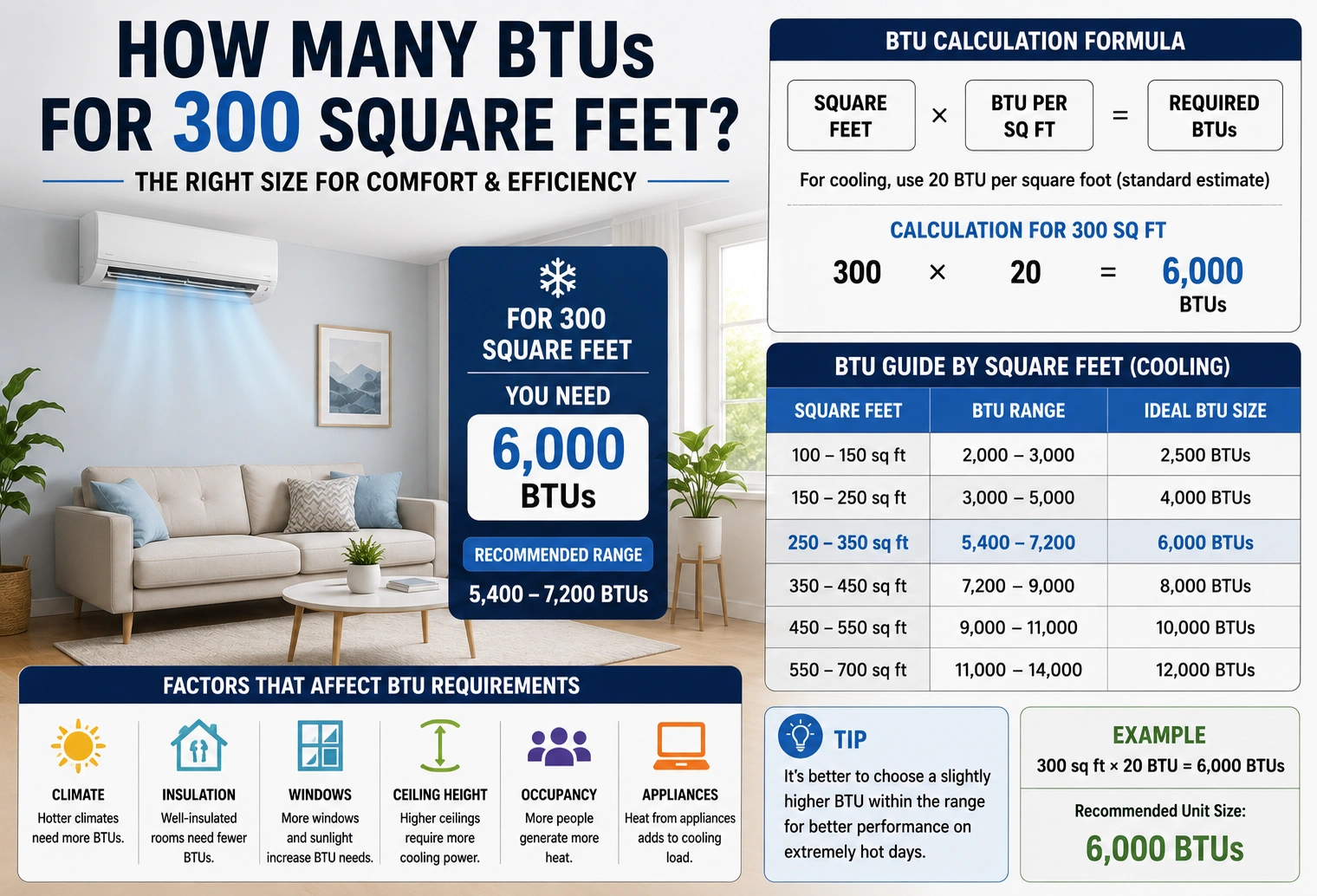
For a 300-square-foot room or space, the BTU requirement depends on whether you are cooling or heating and on factors such as climate, insulation, ceiling height, windows, sunlight, and air leakage.
For a preliminary cooling estimate, 6,000–9,000 BTU per hour may be appropriate for many 300-square-foot spaces, depending on conditions.
A commonly used starting point is approximately 20–30 BTUs per square foot for cooling:
300 × 20 = 6,000 BTU
300 × 25 = 7,500 BTU
300 × 30 = 9,000 BTU
This makes 7,500 BTU a useful midpoint estimate, although actual equipment sizing should be based on the space’s cooling load.
Quick Answer
| Application | Approximate BTU Range |
|---|---|
| Mild cooling conditions | 6,000–7,000 BTU/hr |
| Moderate cooling conditions | 7,000–8,000 BTU/hr |
| Hot cooling conditions | 8,000–9,000+ BTU/hr |
| Mild heating conditions | 6,000–9,000 BTU/hr |
| Moderate heating conditions | 9,000–12,000 BTU/hr |
| Cold heating conditions | 12,000–18,000 BTU/hr |
These figures are rough planning estimates, not a substitute for a professional HVAC load calculation.
How Many BTUs Do I Need to Cool 300 Square Feet?
A simple preliminary calculation for cooling is to multiply the room’s square footage by an estimated BTU-per-square-foot value.
For 300 square feet:
| BTU per Sq Ft | Calculation | Cooling Capacity |
| 20 BTU | 300 × 20 | 6,000 BTU |
| 25 BTU | 300 × 25 | 7,500 BTU |
| 30 BTU | 300 × 30 | 9,000 BTU |
| 35 BTU | 300 × 35 | 10,500 BTU |
A room with average conditions may fall near the middle of this range.
For example:
300 × 25 = 7,500 BTU/hr
So approximately 7,500 BTU/hr is a useful preliminary estimate for moderate conditions.
Is 5,000 BTU Enough for 300 Square Feet?
A 5,000-BTU air conditioner provides:
5,000 ÷ 300 ≈ 16.7 BTU per square foot
That may be enough for a very well-insulated room in a mild climate, but it can be undersized for many 300-square-foot spaces.
If the room receives strong sunlight, has poor insulation, or is located in a hot climate, a larger unit may be necessary.
Is 6,000 BTU Enough for 300 Square Feet?
A 6,000-BTU unit provides:
6,000 ÷ 300 = 20 BTU per square foot
This can be reasonable for some 300-square-foot rooms, particularly under mild conditions.
However, the actual cooling requirement can be higher if the room has significant heat gain.
Is 8,000 BTU Enough for 300 Square Feet?
An 8,000-BTU air conditioner provides:
8,000 ÷ 300 ≈ 26.7 BTU per square foot
This falls within a common preliminary range for a 300-square-foot space.
An 8,000-BTU unit may be suitable for many rooms, but the correct size depends on the actual conditions.
Is 10,000 BTU Too Much for 300 Square Feet?
A 10,000-BTU unit provides:
10,000 ÷ 300 ≈ 33.3 BTU per square foot
This may be more capacity than many 300-square-foot rooms require.
An oversized air conditioner can cool the room quickly but may cycle off before properly removing humidity.
However, a higher-capacity unit may be appropriate if the space has unusually high heat gain or other demanding conditions.
How Many Tons Is 6,000 BTU?
Air-conditioning capacity is commonly expressed in tons.
One ton of cooling equals approximately 12,000 BTU/hr.
Therefore:
6,000 ÷ 12,000 = 0.5 tons
So a 6,000-BTU air conditioner is approximately 0.5 ton.
BTU-to-Tonnage Comparison
| BTU/hr | Approximate Cooling Tonnage |
| 5,000 | 0.42 ton |
| 6,000 | 0.50 ton |
| 7,500 | 0.63 ton |
| 8,000 | 0.67 ton |
| 9,000 | 0.75 ton |
| 10,000 | 0.83 ton |
| 12,000 | 1.00 ton |
For a 300-square-foot room, a full 1-ton system may be more capacity than necessary in many situations, although actual requirements vary.
How Many BTUs Do I Need to Heat 300 Square Feet?
Heating requirements depend heavily on climate, insulation, outdoor temperatures, windows, and air leakage.
A broad preliminary estimate might use approximately 20–60 BTUs per square foot.
For 300 square feet:
300 × 20 = 6,000 BTU
300 × 40 = 12,000 BTU
300 × 60 = 18,000 BTU
This produces a broad range of approximately 6,000–18,000 BTU/hr.
A well-insulated room in a mild climate may need considerably less heating capacity than a poorly insulated room in a cold climate.
Heating BTU Estimates for 300 Square Feet
| Heating Condition | BTU per Sq Ft | Approx. BTUs |
| Mild | 20 | 6,000 |
| Moderate | 30 | 9,000 |
| Moderate-cold | 40 | 12,000 |
| Cold | 50 | 15,000 |
| Very cold | 60 | 18,000 |
These values are preliminary estimates and should not be used as a final furnace-sizing calculation.
What Size Furnace for 300 Square Feet?
A 300-square-foot space generally requires far less heating capacity than an entire large home.
The correct furnace or heater size should be based on the calculated heat loss of the space.
For example, if the calculated heat loss is 10,000 BTU/hr, a heating system should be selected based on its actual output and operating characteristics rather than simply choosing a much larger furnace.
Remember that furnace labels often show input BTU, not the exact amount of heat delivered into the space.
What Factors Affect BTU Requirements for 300 Square Feet?
Square footage is important, but it is not the only factor.
Climate
Hot climates can require more cooling capacity, while cold climates can require more heating capacity.
Insulation
Good insulation reduces heat transfer and can lower both heating and cooling requirements.
Windows
Large windows can increase cooling loads because of solar heat gain. Older windows may also increase heating requirements.
Ceiling Height
A 300-square-foot room with 8-foot ceilings contains:
300 × 8 = 2,400 cubic feet
A room with 10-foot ceilings contains:
300 × 10 = 3,000 cubic feet
The larger volume can affect the heating and cooling requirements.
Sun Exposure
A room with large south- or west-facing windows may become considerably hotter during sunny periods.
Number of Occupants
People generate heat, so a room occupied by several people can require more cooling than an otherwise identical room occupied by one person.
Appliances and Electronics
Computers, televisions, lighting, kitchen appliances, and other equipment can add heat to a room.
Air Leakage
Gaps around windows, doors, and other building components can increase heating and cooling demand.
Why You Should Not Choose an AC Based Only on Square Footage
Two rooms can both measure 300 square feet but have very different cooling requirements.
For example, one might have:
- Excellent insulation
- Energy-efficient windows
- Shade from trees
- 8-foot ceilings
- Mild outdoor temperatures
Another might have:
- Poor insulation
- Large sunny windows
- 10-foot ceilings
- Several occupants
- Hot outdoor temperatures
The second room may require considerably more cooling capacity.
A proper load calculation considers these differences.
Can an AC Be Too Large for 300 Square Feet?
Yes.
An oversized air conditioner may cool the room quickly but can shut off before removing enough moisture from the air.
Potential problems include:
- Short cycling
- Higher humidity
- Uneven temperatures
- Reduced comfort
- Increased mechanical wear
Choosing the largest available unit is not automatically the best approach.
Can an AC Be Too Small for 300 Square Feet?
Yes.
An undersized air conditioner may run continuously while struggling to reach the desired temperature.
This can result in:
- Poor comfort
- Long operating periods
- Increased energy consumption
- Excessive system wear
- Difficulty maintaining the thermostat setting
Proper sizing helps balance comfort, efficiency, and humidity control.
How Many BTUs for a 300-Square-Foot Bedroom?
A 300-square-foot bedroom may need approximately 6,000–9,000 BTU/hr for cooling under common preliminary estimates.
An 8,000-BTU unit provides:
8,000 ÷ 300 ≈ 26.7 BTU per square foot
This may be suitable for many bedrooms, but factors such as sunlight, insulation, ceiling height, and climate should be considered.
How Many BTUs for a 300-Square-Foot Garage?
A garage can have very different insulation and air-sealing characteristics from a finished room.
A poorly insulated garage may require substantially more heating or cooling capacity than a similarly sized insulated bedroom.
For this reason, garage HVAC sizing should account for:
- Insulation
- Garage door construction
- Outdoor temperature
- Ceiling height
- Windows
- How frequently the garage door opens
A simple square-foot estimate may not be sufficient.
Frequently Asked Questions
How many BTUs do I need for 300 square feet?
For cooling, a rough preliminary range is 6,000–9,000 BTU/hr, depending on climate, insulation, windows, ceiling height, and heat gain.
Is 6,000 BTU enough for 300 square feet?
It can be enough under mild conditions. A 6,000-BTU unit provides about 20 BTU per square foot.
Is 8,000 BTU enough for 300 square feet?
An 8,000-BTU unit may be suitable for many 300-square-foot spaces. It provides approximately 26.7 BTU per square foot.
Is 10,000 BTU too much for 300 square feet?
It may be oversized for many 300-square-foot rooms, but the correct capacity depends on the actual cooling load.
How many tons is 6,000 BTU?
6,000 BTU/hr equals approximately 0.5 ton of cooling capacity.
How many BTUs do I need to heat 300 square feet?
A rough heating range can be approximately 6,000–18,000 BTU/hr, depending heavily on climate and insulation.
Does ceiling height affect BTU requirements?
Yes. Higher ceilings increase the volume of air in the room and can affect HVAC requirements.
Does insulation affect how many BTUs I need?
Yes. A well-insulated room generally requires less heating and cooling capacity than a poorly insulated room of the same size.
Can I use a BTU calculator for a 300-square-foot room?
A BTU calculator can provide a useful preliminary estimate, but professional HVAC sizing should use a proper heating or cooling load calculation when accuracy is important.
Conclusion
So, how many BTUs for 300 square feet?
For cooling, a useful preliminary estimate is approximately 6,000–9,000 BTU/hr.
A simple calculation using 25 BTUs per square foot gives:
300 × 25 = 7,500 BTU/hr
This makes 7,500 BTU a useful midpoint estimate for moderate conditions.
For heating, a broad preliminary estimate can range from approximately 6,000–18,000 BTU/hr, depending on climate, insulation, windows, ceiling height, and heat loss.
For cooling, the most important factors beyond square footage include climate, insulation, sunlight, ceiling height, windows, occupancy, and heat-producing appliances.
Use square-foot calculations as a starting point, but rely on an actual HVAC load calculation when selecting permanent heating or cooling equipment.
Discover More Articles
How Many Feet High Is a Story? Building Height Guide