

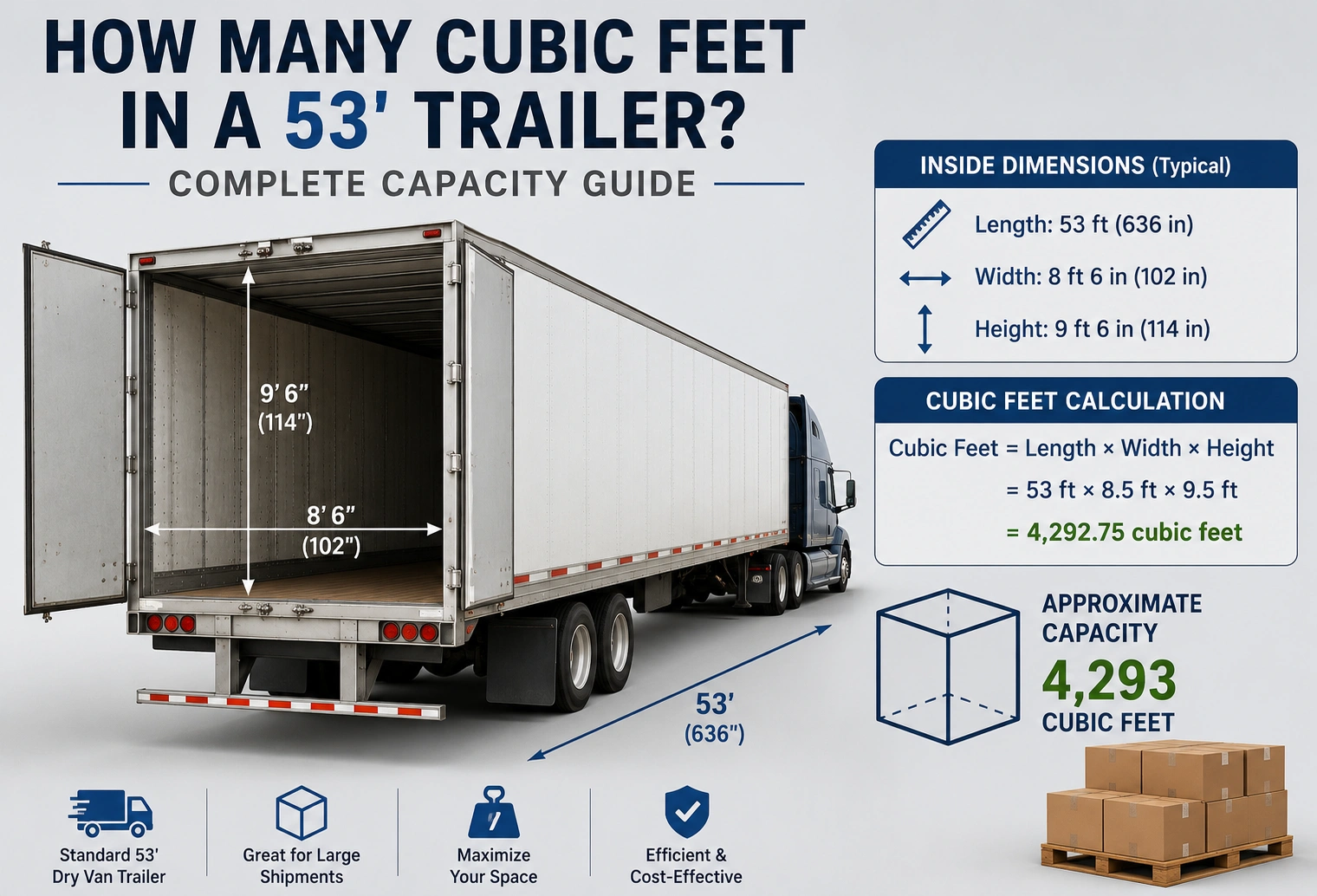
If you’re planning a shipment or estimating freight capacity, you may wonder how many cubic feet are in a 53-foot trailer.
A standard 53-foot dry van trailer provides approximately:
✅ 3,800 to 3,900 cubic feet of cargo space
The exact capacity varies slightly depending on the trailer manufacturer, interior dimensions, wall thickness, and roof design. Most standard dry van trailers used in North America have an interior volume of about 3,850 cubic feet.
Quick Answer
A typical 53-foot dry van trailer offers:
- Length: Approximately 53 feet
- Interior Width: About 8 feet 6 inches (102 inches)
- Interior Height: About 9 feet (108–110 inches)
- Cargo Volume: Approximately 3,800–3,900 cubic feet
Answer:
✅ A standard 53-foot trailer holds about 3,850 cubic feet of cargo space.
Standard 53-Foot Trailer Dimensions
Although dimensions vary slightly by manufacturer, most dry van trailers are close to the following:
| Measurement | Approximate Size |
|---|---|
| Interior Length | 52 ft 6 in–53 ft |
| Interior Width | 100–102 in (8.3–8.5 ft) |
| Interior Height | 108–110 in (9–9.2 ft) |
| Door Width | About 98 in |
| Door Height | About 110 in |
These dimensions determine the trailer’s total usable cargo volume.
How to Calculate Cubic Feet
The formula for calculating trailer volume is:
Length × Width × Height = Cubic Feet
Using typical interior dimensions:
- Length = 53 feet
- Width = 8.5 feet
- Height = 8.5–9 feet
Example calculation:
53 × 8.5 × 8.5 ≈ 3,828 cubic feet
Because interior dimensions vary slightly, most manufacturers list capacities between 3,800 and 3,900 cubic feet.
Typical Cargo Capacity
Besides cubic footage, freight companies also consider weight capacity.
Typical specifications include:
| Specification | Approximate Value |
| Cargo Volume | 3,800–3,900 cu ft |
| Maximum Payload | 43,000–45,000 lbs* |
| Pallet Capacity | 26 standard pallets (48×40 in) |
*Actual legal payload depends on trailer weight, tractor weight, and local transportation regulations.
Pallet Capacity
A standard 53-foot trailer typically holds:
- 26 standard pallets loaded straight.
- Up to 30 pallets in certain pinwheel or optimized loading configurations, depending on pallet size and freight.
Efficient loading helps maximize both space and weight limits.
Factors That Affect Usable Space
The full cubic capacity is not always usable.
Factors that reduce available space include:
- Irregularly shaped cargo
- Stackability limitations
- Weight restrictions
- Interior wall thickness
- Load securement equipment
- Air circulation requirements
For this reason, freight planners often leave a small amount of unused space to ensure safe transportation.
Common Uses for a 53-Foot Trailer
A 53-foot trailer is commonly used to transport:
- Consumer goods
- Furniture
- Appliances
- Food products
- Retail inventory
- Building materials
- Automotive parts
- E-commerce shipments
Its large cargo volume makes it the standard trailer for long-haul freight across North America.
Common Mistakes
Confusing Exterior and Interior Dimensions
A trailer may be 53 feet long on the outside, but the interior cargo space is slightly smaller due to wall construction.
Ignoring Weight Limits
A trailer may have unused cubic space but still reach its legal maximum weight.
Assuming Every Trailer Has the Same Dimensions
Different manufacturers and trailer types can have slightly different interior measurements.
Expert Tips
- Verify interior dimensions with the trailer manufacturer before planning oversized shipments.
- Measure bulky cargo carefully to maximize available space.
- Account for pallet overhang and securement equipment.
- Consider both volume and weight when calculating trailer capacity.
9. FAQs
1. How many cubic feet are in a 53-foot trailer?
A standard 53-foot dry van trailer holds approximately 3,800 to 3,900 cubic feet, with about 3,850 cubic feet being typical.
2. How many pallets fit in a 53-foot trailer?
Most 53-foot dry van trailers hold 26 standard 48×40-inch pallets, although optimized loading can increase this number.
3. What is the interior height of a 53-foot trailer?
Most dry van trailers have an interior height of approximately 108 to 110 inches (about 9 feet).
4. What is the maximum payload of a 53-foot trailer?
Typical payload capacity ranges from 43,000 to 45,000 pounds, depending on equipment and legal weight limits.
5. Why does trailer volume vary?
Interior dimensions differ slightly between manufacturers, trailer designs, insulation thickness, and roof configurations.
10. Conclusion
If you’re asking how many cubic feet in a 53′ trailer, the typical answer is approximately 3,800 to 3,900 cubic feet, with 3,850 cubic feet being a common industry estimate for a standard dry van trailer.
Understanding a trailer’s cubic capacity, dimensions, and weight limits helps shippers, freight brokers, and logistics professionals plan loads more efficiently, maximize cargo space, and avoid costly transportation issues.
Discover More Articles
How Many Cubic Feet in a Bushel of Corn? Complete Conversion Guide