
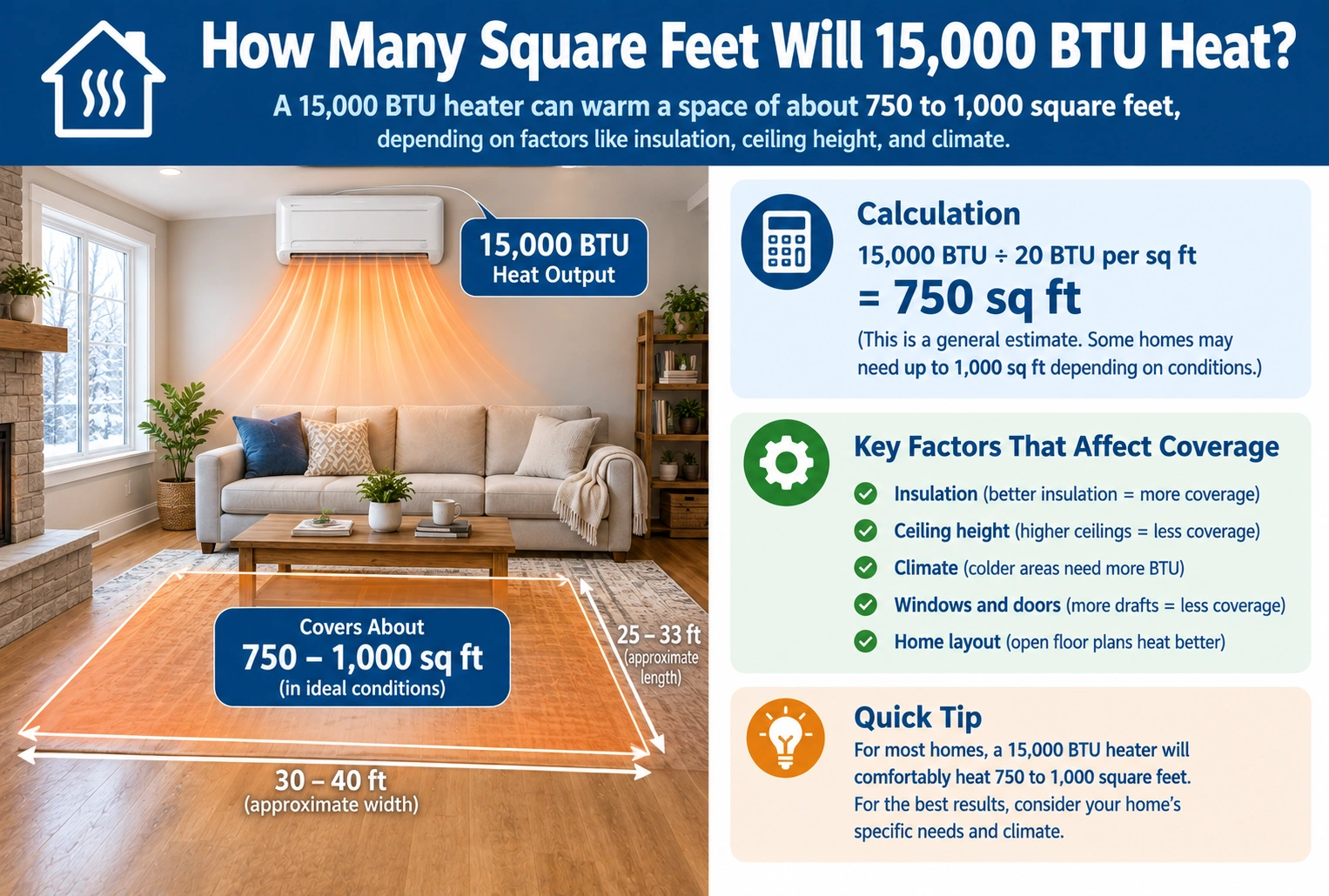
If you’re wondering how many square feet 15,000 BTU will heat, a 15,000 BTU-per-hour heating system can typically heat approximately 500 to 750 square feet under common conditions.
The exact coverage depends on your climate, insulation, ceiling height, windows, air leakage, and the home’s layout.
A basic planning estimate is:
15,000 BTU ÷ 20–30 BTU per square foot = approximately 500–750 square feet
| Heating Conditions | Approx. BTU per Sq Ft | 15,000 BTU Coverage |
|---|---|---|
| Mild climate / well insulated | 20 BTU | 750 sq ft |
| Moderate conditions | 25 BTU | 600 sq ft |
| Cold climate | 30 BTU | 500 sq ft |
| Very cold / poorly insulated | 35+ BTU | 425 sq ft or less |
These are general estimates. A professional heating-load calculation is more accurate for selecting heating equipment.
How Many Square Feet Can 15,000 BTU Heat?
A 15,000 BTU heater can potentially heat around 500–750 square feet, depending on the conditions of the space.
A common rule-of-thumb approach uses approximately 20–30 BTU per square foot.
For example, at 25 BTU per square foot:
15,000 ÷ 25 = 600 square feet
So, under moderate conditions, 15,000 BTU may heat approximately 600 square feet.
| BTU per Sq Ft | Calculation | Approx. Coverage |
|---|---|---|
| 20 | 15,000 ÷ 20 | 750 sq ft |
| 25 | 15,000 ÷ 25 | 600 sq ft |
| 30 | 15,000 ÷ 30 | 500 sq ft |
| 35 | 15,000 ÷ 35 | 429 sq ft |
| 40 | 15,000 ÷ 40 | 375 sq ft |
The lower the building’s heat-loss rate, the greater the area that the same 15,000 BTU capacity can generally heat.
What Does 15,000 BTU Mean?
BTU stands for British thermal unit, a measurement of heat energy.
When a heater is rated at 15,000 BTU per hour, it means the appliance can provide approximately 15,000 BTUs of heat energy per hour under its rated operating conditions.
This rating does not automatically tell you how many square feet the heater can warm.
Two buildings with the same floor area can have very different heating requirements because of differences in insulation, climate, windows, ceilings, and air leakage.
15,000 BTU Heating Coverage by Climate
Climate is one of the most important factors when estimating heating capacity.
A home in a mild climate may require considerably less heat than the same-size home in a region with very cold winters.
| Climate | Approx. Coverage With 15,000 BTU |
|---|---|
| Mild | 600–750 sq ft |
| Moderate | 500–650 sq ft |
| Cold | 400–550 sq ft |
| Very cold | 300–450 sq ft |
These ranges are broad planning estimates rather than guaranteed heating capacities.
For a specific property, the local outdoor design temperature and building characteristics should be considered.
How Insulation Affects 15,000 BTU Coverage
Insulation reduces the rate at which heat escapes from a building.
A well-insulated room may stay warm with less heating capacity, while a poorly insulated space can lose heat rapidly.
| Insulation Condition | Expected 15,000 BTU Coverage |
|---|---|
| Excellent insulation | Up to ~750 sq ft in favorable conditions |
| Good insulation | ~600–700 sq ft |
| Average insulation | ~500–600 sq ft |
| Poor insulation | ~400–500 sq ft |
| Very poor insulation | Less than ~400–450 sq ft |
These are approximate ranges. The actual heating load depends on more than insulation alone.
Can 15,000 BTU Heat 1,000 Square Feet?
In most situations, 15,000 BTU would not be considered enough to reliably heat 1,000 square feet using a basic 20–30 BTU-per-square-foot estimate.
For example:
1,000 × 20 = 20,000 BTU
Even under a relatively favorable 20-BTU-per-square-foot estimate, 1,000 square feet would require approximately 20,000 BTU.
| Area | BTU at 20 BTU/Sq Ft | BTU at 25 BTU/Sq Ft | BTU at 30 BTU/Sq Ft |
|---|---|---|---|
| 300 sq ft | 6,000 | 7,500 | 9,000 |
| 400 sq ft | 8,000 | 10,000 | 12,000 |
| 500 sq ft | 10,000 | 12,500 | 15,000 |
| 600 sq ft | 12,000 | 15,000 | 18,000 |
| 750 sq ft | 15,000 | 18,750 | 22,500 |
| 1,000 sq ft | 20,000 | 25,000 | 30,000 |
A highly efficient building in a mild climate could perform differently, but square footage alone should not be used to assume that 15,000 BTU can heat 1,000 square feet.
Can 15,000 BTU Heat 500 Square Feet?
Yes. 15,000 BTU is generally a reasonable capacity for around 500 square feet under moderate-to-cold conditions, depending on the building.
At 30 BTU per square foot:
500 × 30 = 15,000 BTU
At 25 BTU per square foot:
500 × 25 = 12,500 BTU
This means 15,000 BTU provides a reasonable amount of heating capacity for a 500-square-foot space under many conditions.
| Space | 15,000 BTU Suitability |
|---|---|
| 300 sq ft | Usually ample |
| 400 sq ft | Generally suitable |
| 500 sq ft | Often suitable |
| 600 sq ft | May be suitable |
| 750 sq ft | Depends heavily on conditions |
| 1,000 sq ft | Generally insufficient |
Can 15,000 BTU Heat 600 Square Feet?
A 15,000 BTU heater can potentially heat 600 square feet under moderate conditions.
Using a 25-BTU-per-square-foot estimate:
600 × 25 = 15,000 BTU
So 600 square feet represents a useful middle-ground estimate.
However, a 600-square-foot space with poor insulation and high ceilings may require more heating capacity, while an energy-efficient space in a mild climate may require less.
Can 15,000 BTU Heat 750 Square Feet?
It can potentially heat 750 square feet if the building has relatively low heat loss.
Using 20 BTU per square foot:
750 × 20 = 15,000 BTU
That means 15,000 BTU could theoretically provide 20 BTU per square foot to a 750-square-foot space.
However, in a colder climate or poorly insulated building, 750 square feet may require more than 15,000 BTU.
Ceiling Height and 15,000 BTU Heating
Floor area isn’t the only measurement that affects heating requirements.
Ceiling height changes the total volume of air inside the room.
For example:
| Floor Area | Ceiling Height | Approx. Air Volume |
|---|---|---|
| 500 sq ft | 8 ft | 4,000 cu ft |
| 500 sq ft | 10 ft | 5,000 cu ft |
| 500 sq ft | 12 ft | 6,000 cu ft |
| 750 sq ft | 8 ft | 6,000 cu ft |
| 750 sq ft | 10 ft | 7,500 cu ft |
| 750 sq ft | 12 ft | 9,000 cu ft |
A room with vaulted ceilings or unusually high ceilings can have a higher heating requirement than a standard-height room with the same floor area.
Windows and Doors Affect Heating Capacity
Windows and exterior doors can contribute significantly to heat loss.
Older windows, large glass areas, poorly sealed doors, and drafts can increase the amount of heat needed to maintain a comfortable indoor temperature.
| Feature | Potential Effect |
|---|---|
| Modern insulated windows | Lower heat loss |
| Older single-pane windows | Higher heat loss |
| Well-sealed doors | Lower heat loss |
| Drafty doors | Higher heat loss |
| Large glass areas | Potentially higher heat loss |
| Air leaks | Higher heating demand |
This is why a 15,000 BTU heater can perform differently in two rooms of the same size.
15,000 BTU Compared With Other Heater Sizes
Comparing different heating capacities can help put 15,000 BTU into perspective.
Using a broad 20–30 BTU-per-square-foot planning range:
| Heater Capacity | Approx. Coverage |
|---|---|
| 5,000 BTU | 167–250 sq ft |
| 8,000 BTU | 267–400 sq ft |
| 10,000 BTU | 333–500 sq ft |
| 12,000 BTU | 400–600 sq ft |
| 15,000 BTU | 500–750 sq ft |
| 18,000 BTU | 600–900 sq ft |
| 20,000 BTU | 667–1,000 sq ft |
| 25,000 BTU | 833–1,250 sq ft |
| 30,000 BTU | 1,000–1,500 sq ft |
These figures are intended for general comparison, not final equipment sizing.
How to Calculate BTU Coverage
You can estimate heating coverage using this basic formula:
Square feet = BTU ÷ BTU per square foot
For 15,000 BTU and a 25-BTU-per-square-foot estimate:
15,000 ÷ 25 = 600 square feet
For a lower 20-BTU-per-square-foot estimate:
15,000 ÷ 20 = 750 square feet
For a higher 30-BTU-per-square-foot estimate:
15,000 ÷ 30 = 500 square feet
Therefore, the basic calculation produces a range of approximately 500–750 square feet.
What Type of Space Can 15,000 BTU Heat?
A 15,000 BTU heating capacity may be appropriate for various smaller spaces depending on their construction and climate.
| Space Type | Typical Size Range | 15,000 BTU Potential |
|---|---|---|
| Bedroom | 150–300 sq ft | Generally more than enough |
| Office | 100–250 sq ft | Generally more than enough |
| Small apartment | 400–700 sq ft | Potentially suitable |
| Basement area | 400–700 sq ft | Depends on insulation |
| Garage | 400–600 sq ft | Depends heavily on insulation |
| Workshop | 400–700 sq ft | Depends on construction |
Garages and workshops can require substantially more heat because they often have less insulation and more air leakage than finished living spaces.
Should You Use a 15,000 BTU Heater for Your Space?
The right choice depends on the building’s heat loss rather than square footage alone.
Before choosing a heater, consider:
- Local winter temperatures
- Insulation quality
- Ceiling height
- Window size and efficiency
- Door seals
- Air leakage
- Number of exterior walls
- Room layout
- Desired indoor temperature
A heating-load calculation is the best way to determine the required capacity for a specific space.
Common Mistakes When Estimating 15,000 BTU Coverage
Assuming BTU Always Covers the Same Square Footage
A 15,000 BTU heater does not have a universal square-foot coverage rating. Building conditions change the heating requirement.
Ignoring Climate
Cold outdoor temperatures increase the amount of heat needed to maintain indoor comfort.
Looking Only at Floor Area
Ceiling height, insulation, windows, and air leakage also affect heating demand.
Choosing the Largest Heater
A larger heater is not automatically better. Oversizing can lead to frequent cycling and uneven comfort.
Confusing Heating Capacity With Operating Cost
BTU tells you about heating capacity. Operating cost also depends on the energy source, efficiency, runtime, and local energy prices.
FAQs
How many square feet will 15,000 BTU heat?
A 15,000 BTU heater can generally heat approximately 500–750 square feet, depending on climate, insulation, ceiling height, windows, and other factors.
Can 15,000 BTU heat 500 square feet?
Yes. 15,000 BTU can generally heat 500 square feet under many conditions and may provide additional capacity in a well-insulated space.
Can 15,000 BTU heat 600 square feet?
Yes. At an estimated requirement of 25 BTU per square foot, 15,000 BTU is enough for 600 square feet.
Can 15,000 BTU heat 750 square feet?
It can in a well-insulated building with relatively low heat loss. At 20 BTU per square foot, 15,000 BTU corresponds to 750 square feet.
Can 15,000 BTU heat 1,000 square feet?
Generally, 15,000 BTU is not enough for 1,000 square feet under a typical 20–30 BTU-per-square-foot estimate. A highly efficient home in a mild climate may have different requirements.
How much space does 15,000 BTU heat in a cold climate?
A rough estimate may be around 400–550 square feet, depending on insulation and the local winter design temperature.
Is 15,000 BTU enough for a garage?
It may be enough for a smaller, well-insulated garage, but garages often have higher heat loss than finished living spaces. The size, insulation, doors, and climate all matter.
Is 15,000 BTU too much for a small room?
It can be. For a small, well-insulated room, 15,000 BTU may provide substantially more capacity than needed. Proper sizing helps prevent overheating and frequent cycling.
Conclusion
If you’re asking how many square feet 15,000 BTU will heat, a reasonable general estimate is approximately 500–750 square feet.
At 25 BTU per square foot, 15,000 BTU can heat about 600 square feet. In a mild climate with good insulation, it may cover closer to 750 square feet, while a colder or poorly insulated building may require limiting the coverage to around 500 square feet or less.
| Condition | Approx. 15,000 BTU Coverage |
|---|---|
| Mild climate / efficient space | Up to ~750 sq ft |
| Moderate conditions | ~600 sq ft |
| Cold climate | ~500 sq ft |
| Very cold / poor insulation | ~375–450 sq ft |
For the most accurate answer, consider the home’s insulation, windows, ceiling height, air leakage, climate, and desired indoor temperature rather than relying on square footage alone.
Discover More Articles
How Many Feet Is a 70-Inch TV?