

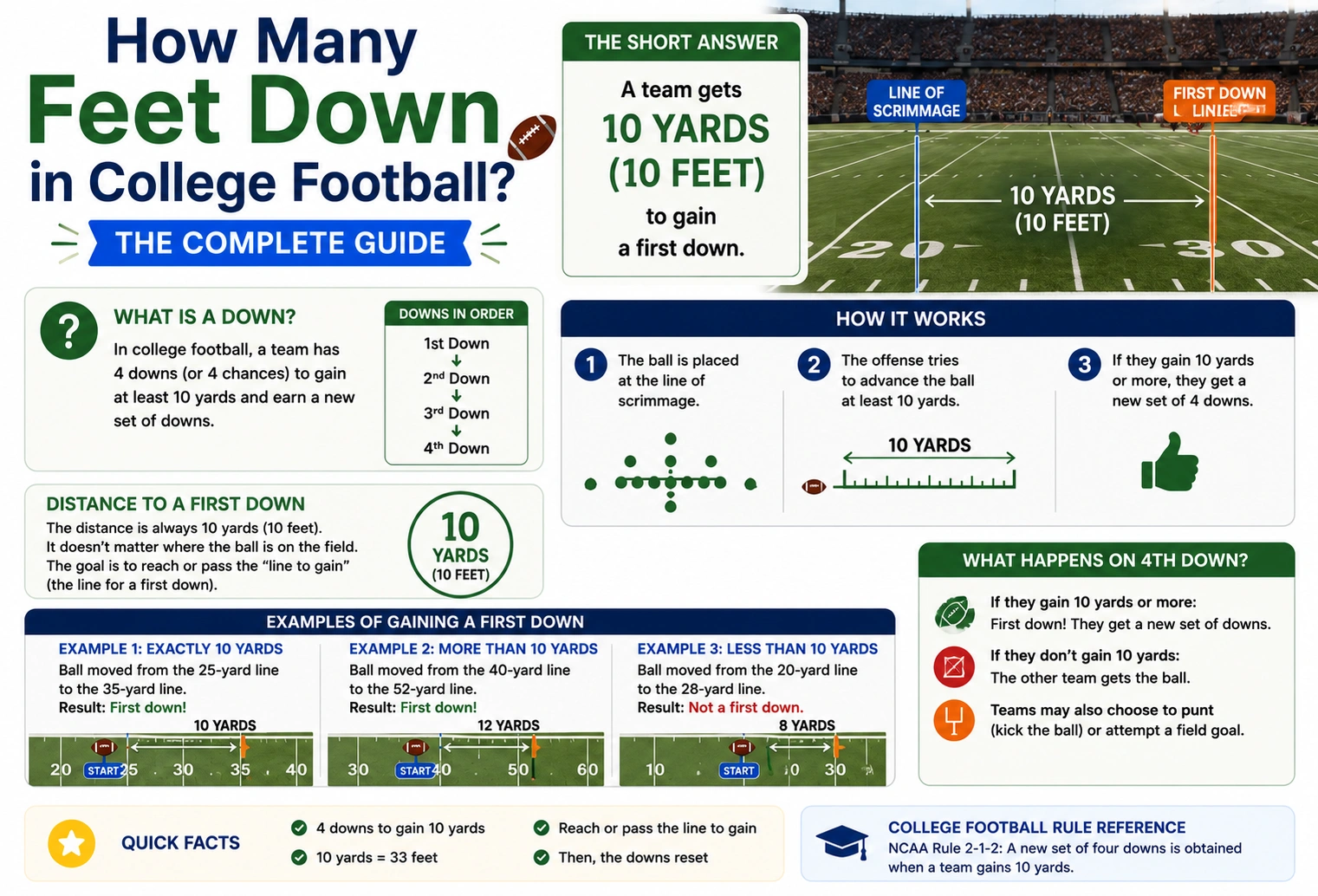
If you’ve ever watched a close sideline catch and wondered how many feet down in college football are required, the answer is simple:
In NCAA college football, a receiver only needs one foot in bounds to complete a catch, provided all other catch requirements are met.
This is one of the biggest differences between college football and the NFL. While NFL players generally need two feet in bounds, college football follows a more forgiving rule that requires only one foot.
Understanding this rule helps fans better follow replay reviews, touchdown decisions, and sideline catches.
Quick Answer
| League | Feet Required for a Catch |
|---|---|
| NCAA College Football | 1 foot in bounds |
| NFL | 2 feet in bounds |
Answer: In college football, one foot in bounds is required for a legal catch, along with control of the ball and completion of the catch process.
NCAA Catch Rule Explained
According to NCAA football rules, a receiver must satisfy several conditions to complete a catch.
The player must:
- Secure control of the football.
- Get at least one foot in bounds.
- Maintain possession long enough to complete the catch.
- Keep control of the ball if going to the ground during the catch.
Simply touching the ball while one foot is down is not enough. The receiver must demonstrate clear possession before stepping out of bounds or losing control.
Why Is Only One Foot Required?
College football uses a different standard from professional football to simplify officiating and allow more exciting offensive plays.
Requiring only one foot:
- Makes sideline catches easier.
- Encourages passing offenses.
- Reduces controversial boundary calls.
- Rewards athletic catches near the sidelines.
Because of this rule, you’ll often see spectacular catches that would be ruled incomplete in the NFL.
What Counts as a Completed Catch?
For a catch to count in college football, the receiver must complete the entire catching process.
The Basic Requirements
A completed catch includes:
- Firm control of the football.
- One foot touching the field of play in bounds.
- Possession maintained through the act of catching.
- Control after contacting the ground, if applicable.
Officials may review close plays to determine whether all these elements were satisfied.
One Foot vs. Two Feet
This is one of the most common questions among football fans.
| Rule | NCAA College Football | NFL |
|---|---|---|
| Feet required in bounds | 1 | 2 |
| Secure possession required | Yes | Yes |
| Maintain control | Yes | Yes |
| Replay reviews | Yes | Yes |
Because the NFL requires two feet, many fans mistakenly think college football follows the same rule.
Examples of Completed Catches
Example 1: Sideline Reception
A receiver catches the football.
He places one foot in bounds while controlling the ball before stepping out.
Result: Completed catch.
Example 2: Jump Ball
A receiver leaps near the sideline.
He controls the ball and lands with one foot touching inside the boundary before falling out of bounds.
Result: Catch is complete.
Example 3: Receiver Falls to the Ground
A player catches the ball and lands on the ground.
If he loses control when hitting the ground, the pass may be ruled incomplete.
Control throughout the catch process is essential.
When Is a Catch Incomplete?
A pass is incomplete if the receiver:
- Never gains control.
- Steps out before getting one foot down.
- Drops the ball during the catch process.
- Lands entirely out of bounds.
- Fails to maintain possession after contacting the ground.
Replay officials often examine slow-motion footage to determine whether the receiver maintained possession.
College Football vs. NFL Rules
Many fans switch between college football and the NFL each weekend, making it easy to confuse the rules.
NCAA
- One foot in bounds.
- Faster-paced offensive game.
- Simpler boundary requirement.
NFL
- Two feet in bounds.
- More difficult sideline catches.
- Stricter completion standards.
This distinction is one of the biggest rule differences between the two levels of football.
Real-World Examples
Touchdown Catch
A wide receiver catches a pass in the end zone.
He taps one foot inside the boundary while controlling the ball.
College football: Touchdown.
NFL: May be incomplete if only one foot touches.
Sideline Reception
A receiver catches the ball near the sideline.
One foot lands in bounds before momentum carries him out.
If possession is secure, the catch counts in NCAA football.
Diving Catch
A player dives forward, catches the ball, and lands in bounds.
If he maintains possession through contact with the ground, the catch is complete.
Why This Rule Matters
Knowing the college football catch rule helps fans:
- Understand replay decisions.
- Follow officiating announcements.
- Appreciate difficult sideline catches.
- Compare NCAA and NFL games.
- Learn the fundamentals of football.
It’s especially useful during close games when every catch can affect the outcome.
Common Misunderstandings
“One Foot Is Always Enough”
Not exactly.
The receiver also needs:
- Control of the football.
- Possession through the catch.
- Compliance with all NCAA catch requirements.
“College Uses NFL Rules”
False.
The NCAA and NFL have different catch rules.
“Touching the Ball Counts”
Simply touching or bobbling the football does not complete a catch.
The player must establish control.
“Replay Only Checks the Feet”
Officials also review:
- Ball control.
- Possession.
- Contact with the ground.
- Whether the player completed the catch process.
Expert Tips
- Watch the receiver’s hands first to confirm control.
- Then check whether one foot lands in bounds.
- If the player falls, continue watching to ensure the ball doesn’t come loose.
- Remember that replay reviews often focus on possession as much as foot placement.
- Keep in mind that college and NFL rules differ, especially on sideline catches.
Quick Comparison Table
| Situation | NCAA Ruling |
|---|---|
| One foot in bounds with control | Catch |
| Two feet in bounds with control | Catch |
| No foot in bounds | Incomplete |
| Loses control while hitting the ground | Usually incomplete |
| Steps out before control | Incomplete |
9. Frequently Asked Questions
1. How many feet must be down in college football?
A receiver needs one foot in bounds while controlling the football to satisfy the boundary requirement for a completed catch.
2. Is one foot enough in NCAA football?
Yes. Unlike the NFL, NCAA football requires only one foot to land in bounds.
3. Does the receiver have to maintain possession?
Yes. The player must keep control of the football throughout the catch process.
4. Why does the NFL require two feet?
The NFL uses a stricter standard for completed catches, making sideline receptions more challenging.
5. Can replay overturn a completed catch?
Yes. Officials can review whether the receiver had control, got a foot in bounds, and completed the catch process.
10. Conclusion
If you’re asking how many feet down in college football are required for a completed catch, the answer is one foot in bounds. However, foot placement alone isn’t enough—the receiver must also secure the ball, maintain possession, and complete the catching process according to NCAA rules.
Understanding this rule makes it easier to follow replay reviews, appreciate athletic sideline catches, and recognize one of the key differences between college football and the NFL. Whether you’re a new fan or a lifelong follower of the game, knowing the NCAA catch rule helps you enjoy every play with greater confidence.
Discover More Articles
How Many Feet Is the Eiffel Tower? Exact Height Guide