

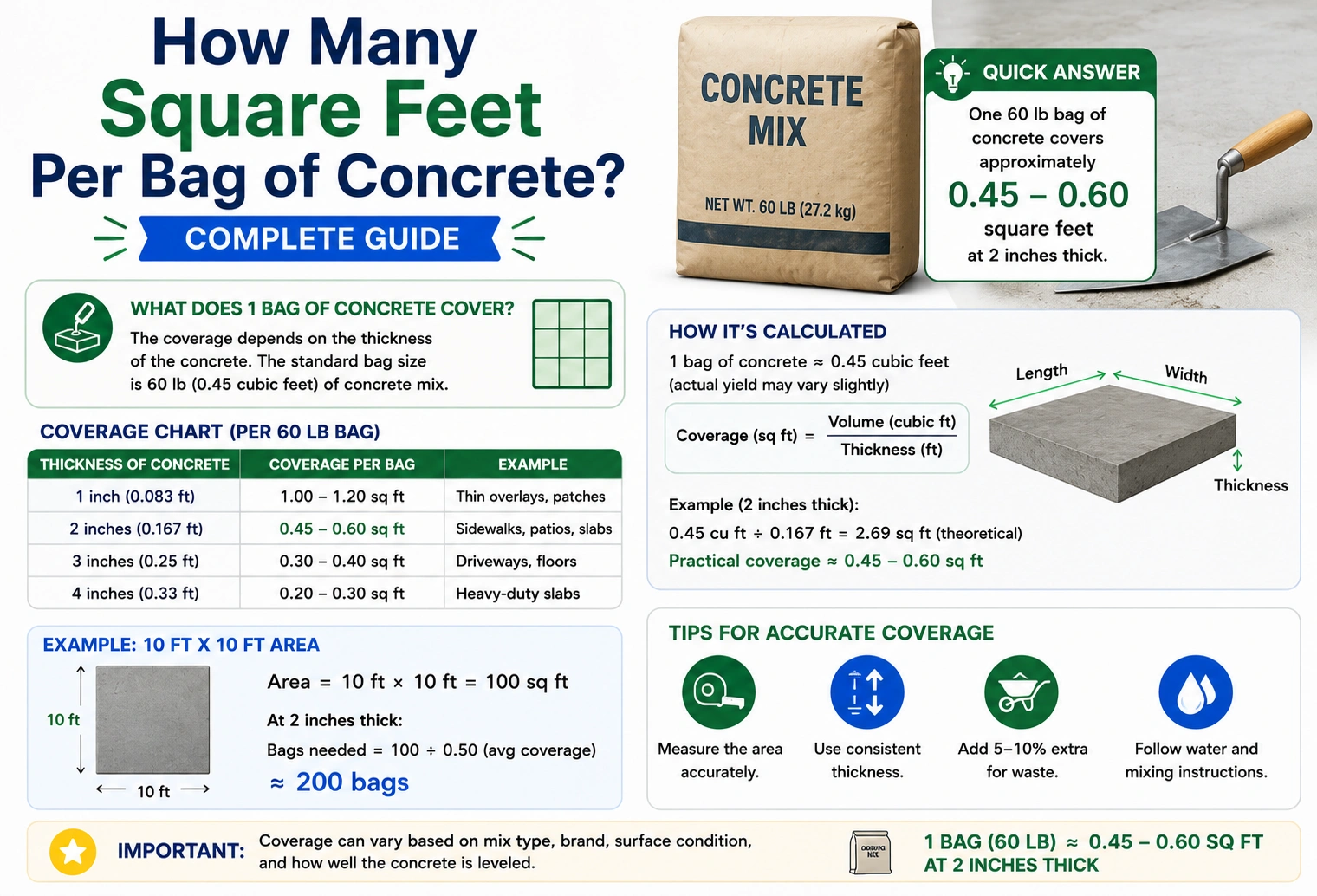
If you’re wondering how many square feet per bag of concrete, the answer depends on two important factors:
- The size of the concrete bag (40 lb, 50 lb, 60 lb, or 80 lb)
- The thickness of the concrete slab
Concrete is measured by volume, while square feet measure area. That means a single bag covers more square feet when poured thin and fewer square feet when poured thick.
For example, an 80-pound bag of concrete covers approximately:
- 4.8 square feet at 2 inches thick
- 3.2 square feet at 3 inches thick
- 2.4 square feet at 4 inches thick
Understanding these coverage rates helps you estimate how many bags you’ll need for patios, sidewalks, shed bases, fence posts, and other projects.
Quick Answer
| Bag Size | Coverage at 2″ | Coverage at 3″ | Coverage at 4″ |
|---|---|---|---|
| 40 lb | 2.4 sq ft | 1.6 sq ft | 1.2 sq ft |
| 50 lb | 3.0 sq ft | 2.0 sq ft | 1.5 sq ft |
| 60 lb | 3.6 sq ft | 2.4 sq ft | 1.8 sq ft |
| 80 lb | 4.8 sq ft | 3.2 sq ft | 2.4 sq ft |
Answer: The square footage covered by one bag of concrete depends on the bag size and slab thickness. An 80-pound bag typically covers about 2.4 square feet at a 4-inch thickness.
Understanding Concrete Coverage
Concrete bags are labeled by weight, but they produce a specific volume once mixed.
Typical yields are:
| Bag Size | Approximate Yield |
|---|---|
| 40 lb | 0.30 cubic feet |
| 50 lb | 0.37 cubic feet |
| 60 lb | 0.45 cubic feet |
| 80 lb | 0.60 cubic feet |
To calculate square footage, you divide the concrete’s volume by the slab thickness (converted to feet).
Why Thickness Matters
The thicker the concrete slab, the fewer square feet each bag can cover.
For example:
- A thin walkway uses less concrete per square foot.
- A driveway or foundation requires a thicker slab and therefore more concrete.
This is why coverage charts always include slab thickness.
How to Calculate Concrete Coverage
The relationship between volume and area is:
Area = Volume ÷ Thickness
V=lwh
V=4×3×2=24
l
l
w
w
h
hl = 4h = 2w = 3
For example, an 80-pound bag yields about 0.60 cubic feet.
If the slab is 4 inches thick, convert inches to feet:
4 inches = 0.333 feet
Then calculate:
0.60 ÷ 0.333 ≈ 1.8 square feet
Manufacturers often round yields and account for mixing conditions, so many practical coverage charts estimate about 2.4 square feet for an 80-pound bag at a 4-inch slab.
Concrete Coverage Chart
40-Pound Bag
| Thickness | Coverage |
|---|---|
| 2 inches | 2.4 sq ft |
| 3 inches | 1.6 sq ft |
| 4 inches | 1.2 sq ft |
60-Pound Bag
| Thickness | Coverage |
|---|---|
| 2 inches | 3.6 sq ft |
| 3 inches | 2.4 sq ft |
| 4 inches | 1.8 sq ft |
80-Pound Bag
| Thickness | Coverage |
|---|---|
| 2 inches | 4.8 sq ft |
| 3 inches | 3.2 sq ft |
| 4 inches | 2.4 sq ft |
These values are approximate and may vary slightly by manufacturer and concrete mix.
Real-World Examples
Example 1: Small Patio
Patio size:
8 ft × 10 ft
Area:
80 square feet
At a 4-inch thickness, using 80-pound bags:
80 ÷ 2.4 ≈ 34 bags
Round up to 35 bags.
Example 2: Sidewalk
Dimensions:
3 ft × 20 ft
Area:
60 square feet
At 4 inches thick:
60 ÷ 2.4 ≈ 25 bags
Example 3: Garden Shed Base
Dimensions:
10 ft × 10 ft
Area:
100 square feet
At 4 inches:
100 ÷ 2.4 ≈ 42 bags
Example 4: Concrete Pad
Dimensions:
6 ft × 8 ft
Area:
48 square feet
At 3 inches thick:
48 ÷ 3.2 ≈ 15 bags
Why Accurate Estimates Matter
Estimating concrete correctly helps you:
- Stay within budget
- Avoid project delays
- Reduce material waste
- Prevent extra trips to the store
- Ensure a consistent slab thickness
Buying a few extra bags is often recommended to account for uneven ground or minor spills.
Common Mistakes
Ignoring Slab Thickness
Thickness greatly affects coverage. A thicker slab requires more concrete.
Confusing Area with Volume
Square feet measure area, while concrete is purchased based on volume.
Forgetting to Round Up
Always round your calculations up to the next whole bag.
Not Measuring the Project Correctly
Accurate length and width measurements are essential for estimating concrete needs.
Expert Tips
- Measure your project twice before buying materials.
- Follow the manufacturer’s mixing instructions for best results.
- Purchase an extra 5–10% of concrete for unexpected needs.
- Reinforce slabs when recommended for structural strength.
- Allow sufficient curing time before placing heavy loads on the concrete.
Quick Reference Table
| Project Area | 80 lb Bags Needed (4″ Thick) |
|---|---|
| 20 sq ft | 9 bags |
| 40 sq ft | 17 bags |
| 60 sq ft | 25 bags |
| 80 sq ft | 34 bags |
| 100 sq ft | 42 bags |
9. Frequently Asked Questions
1. How many square feet does an 80-pound bag of concrete cover?
An 80-pound bag typically covers about 2.4 square feet at a 4-inch thickness, 3.2 square feet at 3 inches, and 4.8 square feet at 2 inches.
2. Does slab thickness affect concrete coverage?
Yes. Thicker slabs require more concrete, so each bag covers fewer square feet.
3. How do I calculate how many bags of concrete I need?
Divide your project’s total square footage by the coverage per bag at your planned slab thickness, then round up to the nearest whole bag.
4. Should I buy extra concrete?
Yes. Purchasing 5–10% extra is recommended to account for waste, uneven surfaces, and minor calculation errors.
5. Is concrete coverage the same for all bag sizes?
No. Larger bags produce more concrete and therefore cover more square feet than smaller bags at the same slab thickness.
10. Conclusion
If you’re asking how many square feet per bag of concrete, the answer depends on the bag size and the thickness of your concrete slab. For example, an 80-pound bag generally covers about 2.4 square feet at a 4-inch thickness, while thinner pours allow the same bag to cover a larger area.
Using the correct coverage chart and calculating your project’s length, width, and slab thickness will help you estimate the number of bags needed accurately. Whether you’re pouring a patio, sidewalk, shed base, or driveway, careful planning ensures you buy the right amount of concrete, minimize waste, and complete your project efficiently.
Discover More Articles
How Many Feet Is the Eiffel Tower? Exact Height Guide