
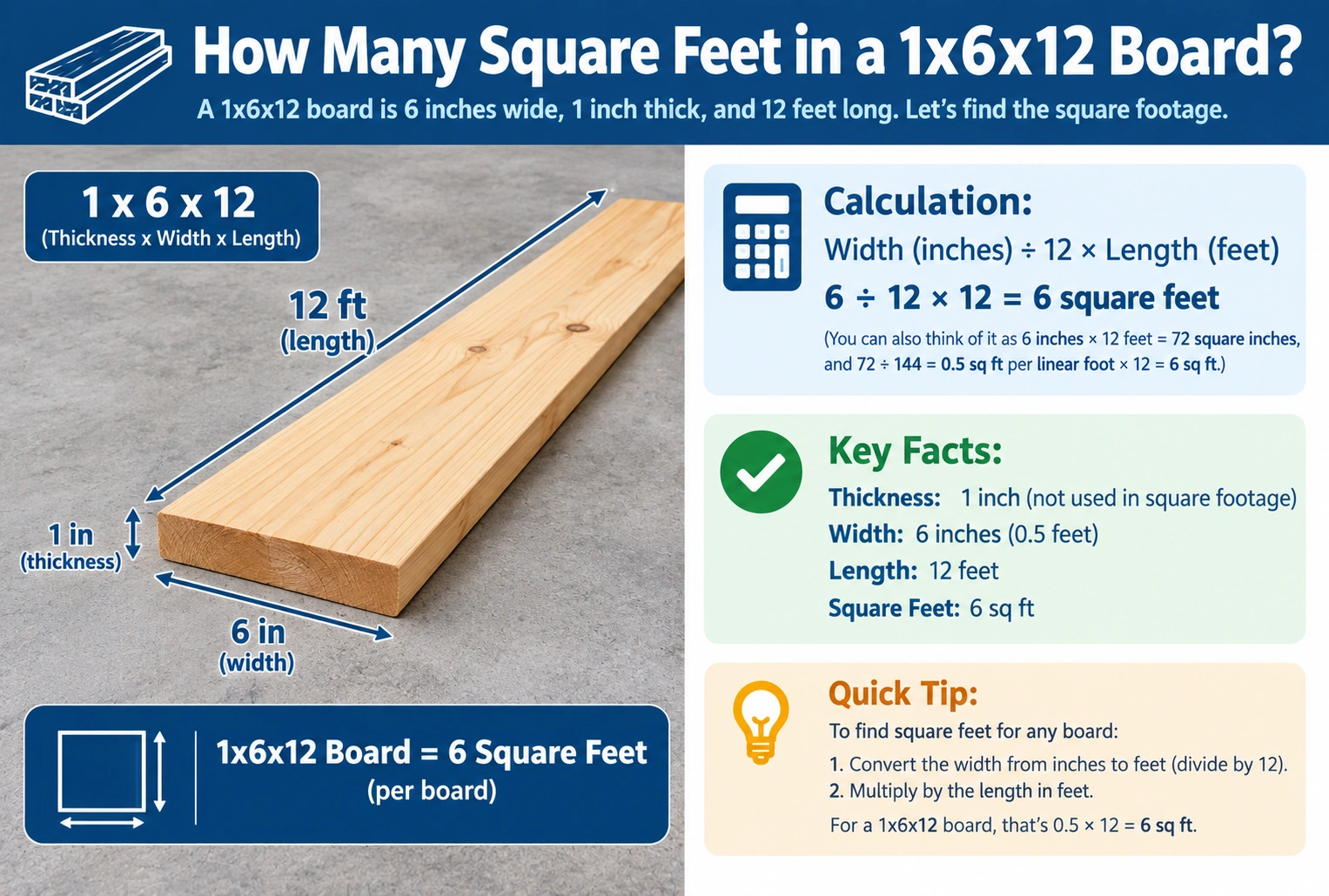
A 1×6×12 board covers 6 square feet when calculating its surface area using its nominal dimensions.
The calculation is simple:
6 inches ÷ 12 = 0.5 feet
0.5 ft × 12 ft = 6 square feet
So, a nominal 1×6×12 board has 6 square feet of face area.
| Board Size | Width in Feet | Length | Surface Area |
|---|---|---|---|
| 1×6×12 | 0.5 ft | 12 ft | 6 sq ft |
What Does 1×6×12 Mean?
A 1×6×12 board is a piece of lumber that is nominally:
- 1 inch thick
- 6 inches wide
- 12 feet long
The numbers describe the board’s nominal dimensions. The actual finished dimensions can be slightly smaller after the lumber is surfaced or planed.
For calculating the board’s approximate face area, however, the nominal 6-inch width and 12-foot length are commonly used.
How Do You Calculate Square Feet in a 1×6×12 Board?
To calculate square footage, use:
Square Feet = Width in feet × Length in feet
The width is given in inches, so first convert 6 inches to feet.
Step 1: Convert 6 Inches to Feet
There are 12 inches in 1 foot.
6 ÷ 12 = 0.5 feet
Step 2: Multiply Width by Length
The board is 12 feet long.
0.5 × 12 = 6 square feet
Therefore:
1×6×12 board = 6 square feet
This calculation gives the approximate face area of one board.
How Much Area Does a 1×6×12 Board Cover?
If you are using the board for a wall, ceiling, siding, fencing, paneling, or another project, its nominal face area is approximately 6 square feet.
| Number of 1×6×12 Boards | Approximate Coverage |
|---|---|
| 1 board | 6 sq ft |
| 2 boards | 12 sq ft |
| 5 boards | 30 sq ft |
| 10 boards | 60 sq ft |
| 20 boards | 120 sq ft |
| 25 boards | 150 sq ft |
| 50 boards | 300 sq ft |
| 100 boards | 600 sq ft |
These figures assume the boards are installed with their full nominal 6-inch width exposed and do not account for gaps, overlap, cuts, or waste.
1×6×12 Board Square Feet Formula
For any board, you can use:
Square Feet = (Width in inches ÷ 12) × Length in feet
For a 1×6×12:
(6 ÷ 12) × 12 = 6 sq ft
Notice that the 1-inch thickness isn’t needed when calculating surface area.
Thickness becomes important for other calculations, such as board feet, volume, structural capacity, and material weight.
1×6×12 Square Feet vs Board Feet
Square feet and board feet measure different things.
Square feet measure surface area.
Board feet measure lumber volume based on thickness, width, and length.
For a nominal 1×6×12 board:
Board Feet = (1 × 6 × 12) ÷ 12 = 6 board feet
So the same board has approximately:
| Measurement | Result |
|---|---|
| Face area | 6 sq ft |
| Board feet | 6 board feet |
| Nominal thickness | 1 in |
| Nominal width | 6 in |
| Nominal length | 12 ft |
The numbers happen to be the same here, but 6 square feet and 6 board feet are not the same measurement.
How Many 1×6×12 Boards Do You Need for a Wall?
You can estimate the number of boards by dividing the wall’s square footage by approximately 6 square feet.
Example: 100-Square-Foot Wall
Suppose a wall has an area of 100 square feet.
100 ÷ 6 = 16.67 boards
You would need to purchase at least 17 boards based on pure coverage.
However, real projects usually require extra material for:
- Cutting
- Damaged boards
- Mistakes
- Door and window cuts
- End trimming
- Installation waste
A practical purchase quantity may therefore be higher than the mathematical minimum.
| Wall Area | Minimum 1×6×12 Boards |
|---|---|
| 50 sq ft | 9 |
| 100 sq ft | 17 |
| 150 sq ft | 25 |
| 200 sq ft | 34 |
| 300 sq ft | 50 |
| 500 sq ft | 84 |
| 1,000 sq ft | 167 |
These numbers are rounded up to whole boards.
How Many Boards Are Needed for 500 Square Feet?
For 500 square feet:
500 ÷ 6 = 83.33
You would need at least 84 1×6×12 boards for 500 square feet if every inch of the nominal board face could be used.
For an actual installation, buying additional boards for waste is usually sensible.
How Many 1×6×12 Boards Cover 1,000 Square Feet?
A 1×6×12 board covers approximately 6 square feet.
Therefore:
1,000 ÷ 6 = 166.67
Round up:
167 boards
So, approximately 167 boards are needed to cover 1,000 square feet before accounting for waste, gaps, or cuts.
Does the 1-Inch Thickness Affect Square Footage?
No.
The 1-inch thickness does not affect the face area.
For example, a board that is:
- 1×6×12
- 2×6×12
would have the same nominal face area because both are 6 inches wide and 12 feet long.
| Board | Nominal Width | Length | Face Area |
|---|---|---|---|
| 1×6×12 | 6 in | 12 ft | 6 sq ft |
| 2×6×12 | 6 in | 12 ft | 6 sq ft |
| 1×8×12 | 8 in | 12 ft | 8 sq ft |
| 1×10×12 | 10 in | 12 ft | 10 sq ft |
| 1×12×12 | 12 in | 12 ft | 12 sq ft |
Thickness matters when calculating volume or board feet, but not the basic face area.
1×6×12 Board vs Other 1×6 Lengths
The width stays the same at 6 inches, so the square footage changes according to the board’s length.
| Board Size | Approximate Face Area |
|---|---|
| 1×6×6 | 3 sq ft |
| 1×6×8 | 4 sq ft |
| 1×6×10 | 5 sq ft |
| 1×6×12 | 6 sq ft |
| 1×6×14 | 7 sq ft |
| 1×6×16 | 8 sq ft |
| 1×6×20 | 10 sq ft |
The simple rule is:
A 6-inch-wide board provides approximately 0.5 square feet of face area for every foot of length.
How Many Square Feet Does a 1×6 Board Cover Per Linear Foot?
A 1×6 board is 6 inches wide.
Convert the width:
6 ÷ 12 = 0.5 feet
Therefore, every linear foot of 1×6 board provides approximately:
0.5 square feet
| Board Length | Approximate Coverage |
|---|---|
| 1 ft | 0.5 sq ft |
| 2 ft | 1 sq ft |
| 4 ft | 2 sq ft |
| 6 ft | 3 sq ft |
| 8 ft | 4 sq ft |
| 10 ft | 5 sq ft |
| 12 ft | 6 sq ft |
This is useful when estimating siding, wall boards, trim, or other linear lumber applications.
Nominal vs Actual 1×6 Dimensions
One important detail is that a 1×6 board usually does not measure exactly 1 inch by 6 inches after finishing.
Common surfaced lumber can have actual dimensions around:
| Dimension | Nominal Size | Common Actual Size |
|---|---|---|
| Thickness | 1 in | About 0.75 in |
| Width | 6 in | About 5.5 in |
| Length | 12 ft | Usually close to 12 ft |
Exact actual dimensions can vary depending on the lumber type, supplier, and manufacturing process.
If the actual width is 5.5 inches instead of 6 inches, the usable face area is smaller.
Using a 5.5-Inch Actual Width
Convert 5.5 inches to feet:
5.5 ÷ 12 = 0.4583 feet
Then multiply by 12 feet:
0.4583 × 12 ≈ 5.5 square feet
So the difference can be important when calculating precise project coverage.
Why Actual Coverage May Be Less Than 6 Square Feet
Even though a nominal 1×6×12 board has about 6 square feet of face area, your finished project may cover less.
Factors include:
- Actual board width
- Gaps between boards
- Overlapping installation
- Cutting
- Defects
- Door and window openings
- End trimming
- Board orientation
For precise material planning, use the actual exposed width rather than assuming the full nominal 6 inches is visible.
How to Calculate Boards for a Project
Use this basic process:
1. Measure the Project Area
Multiply:
Length × Height = Square Feet
For example:
20 ft × 10 ft = 200 sq ft
2. Determine Board Coverage
A nominal 1×6×12 covers approximately:
6 sq ft
3. Divide the Area
200 ÷ 6 = 33.33
Round up:
34 boards
4. Add Waste
For a real project, consider purchasing additional material depending on the complexity of the installation.
This method provides a starting estimate, but actual exposed coverage should be used for a more precise calculation.
Common Uses for 1×6×12 Boards
A 1×6×12 board can be used for many projects.
| Project | How Square Footage Helps |
|---|---|
| Wall paneling | Estimates surface coverage |
| Ceiling boards | Calculates material quantity |
| Siding | Estimates exterior coverage |
| Fencing | Helps estimate board requirements |
| Shelving | Helps calculate surface area |
| Trim | Helps estimate material length |
| DIY furniture | Helps plan lumber quantities |
The appropriate lumber species, grade, thickness, and fastening method depend on the specific project.
Common Mistakes When Calculating Square Feet
Mistake 1: Using Thickness
The 1-inch thickness is not needed for face-area calculations.
Mistake 2: Forgetting to Convert Inches
The 6-inch width must be converted to feet before multiplying by a length measured in feet.
Mistake 3: Assuming Actual Width Is 6 Inches
A nominal 1×6 can have a smaller actual finished width.
Mistake 4: Ignoring Gaps
If boards are installed with gaps, the exposed coverage changes.
Mistake 5: Buying Exactly the Mathematical Quantity
Cuts and waste can leave you short of material.
Frequently Asked Questions
How many square feet are in a 1×6×12 board?
A nominal 1×6×12 board has approximately 6 square feet of face area.
How do you calculate square feet for a 1×6×12?
Convert the 6-inch width to feet and multiply by the 12-foot length:
6 ÷ 12 × 12 = 6 square feet.
Is a 1×6×12 board 6 board feet?
Yes. Using nominal dimensions, a 1×6×12 contains 6 board feet. However, board feet and square feet measure different things.
Does the 1-inch thickness affect square footage?
No. Face-area calculations use the board’s width and length. Thickness is relevant for volume and board-foot calculations.
How many 1×6×12 boards do I need for 100 square feet?
At approximately 6 square feet per board:
100 ÷ 6 = 16.67
So you need at least 17 boards before accounting for waste, cuts, gaps, or actual board dimensions.
Conclusion
So, how many square feet are in a 1×6×12 board? A nominal 1×6×12 board provides approximately 6 square feet of face area.
The calculation is:
6 inches ÷ 12 = 0.5 feet
0.5 × 12 = 6 square feet
For project planning, remember that actual lumber dimensions can be smaller than nominal dimensions. Installation gaps, cuts, waste, and exposed width can also reduce the amount of finished area each board covers.
Discover More Articles
How Many Feet Is a 70-Inch TV?