
If you are planning a concrete project, one of the first questions you may ask is: how many cubic feet in a 60 lb bag of concrete?
Knowing the answer helps you estimate materials, control costs, and avoid running short during a pour. Whether you are building a small patio, setting fence posts, or pouring footings, understanding concrete yield is essential.
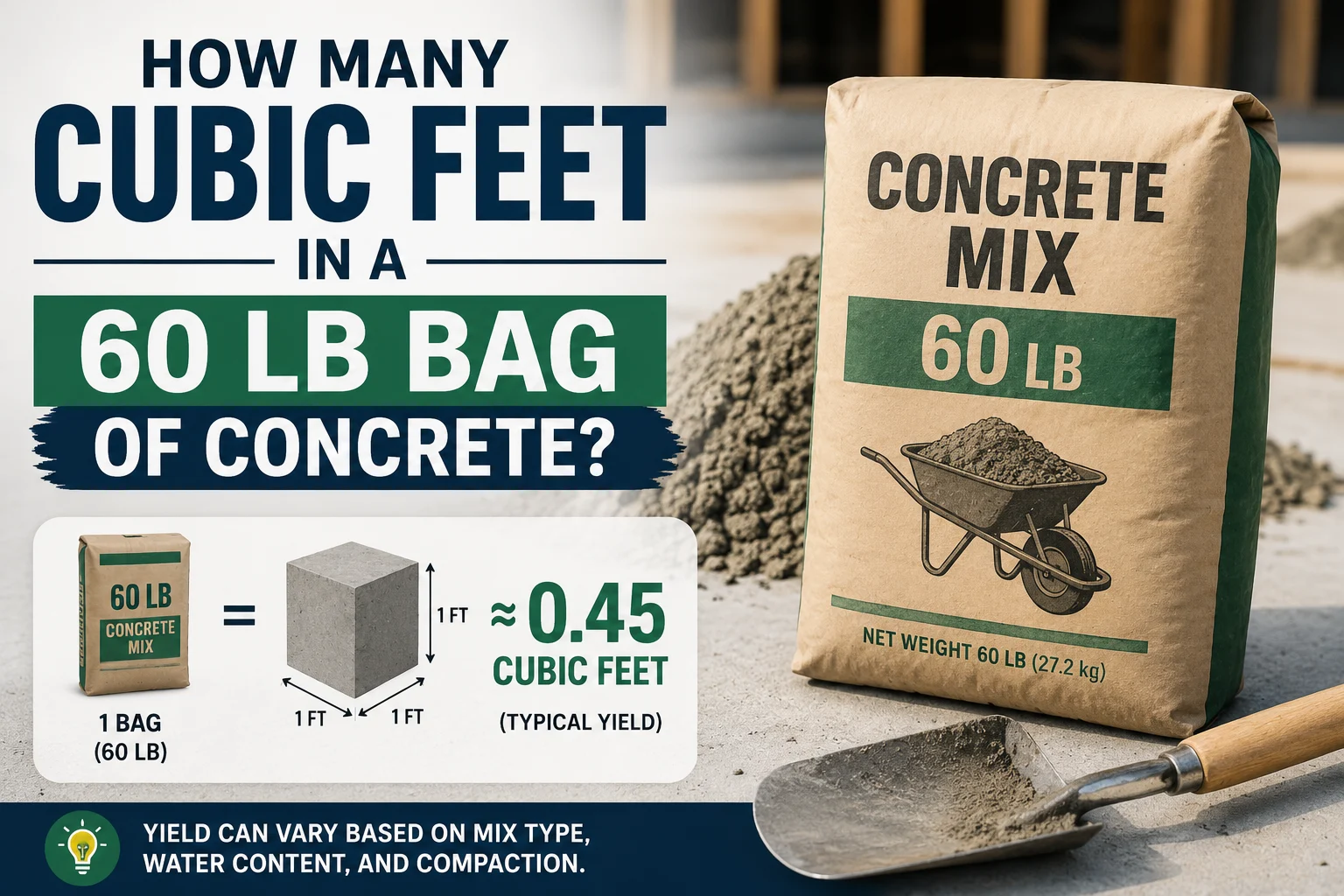
A standard 60 lb bag of concrete yields approximately 0.45 cubic feet when mixed with water. This number can vary slightly depending on the concrete mix and manufacturer, but 0.45 cubic feet is the accepted average for most ready-mix concrete products.
In this guide, you will learn:
- How concrete bag yield works
- Coverage calculations
- Concrete formulas
- Real project examples
- How many bags you need for common jobs
- Mistakes to avoid
By the end, you will be able to estimate concrete like a professional.
Quick Answer
A 60 lb bag of concrete produces about 0.45 cubic feet of cured concrete.
Here is a quick reference:
| Bag Size | Cubic Feet Yield |
|---|---|
| 40 lb bag | 0.30 cubic feet |
| 50 lb bag | 0.375 cubic feet |
| 60 lb bag | 0.45 cubic feet |
| 80 lb bag | 0.60 cubic feet |
This yield refers to the amount of finished concrete after water is added and the mix cures.
Understanding Concrete Bag Yield
Before calculating your project, it helps to understand what “yield” means in concrete terms.
What Is Concrete Yield?
Concrete yield refers to the total volume of concrete produced after mixing a dry concrete bag with water.
Manufacturers measure this volume in:
- Cubic feet
- Cubic yards
- Liters
For residential projects, cubic feet are most common.
A 60 lb bag contains dry cement, sand, and aggregate. Once mixed with water, the final volume expands into usable concrete.
Why Bag Size Matters
Different bag sizes create different amounts of concrete. Using the wrong yield estimate can lead to:
- Buying too little material
- Wasting money on excess bags
- Uneven pours
- Delays during projects
That is why accurate calculations matter.
How Many Cubic Feet in a 60 lb Bag of Concrete?
The standard answer is:
One 60 lb bag of concrete equals approximately 0.45 cubic feet.
This applies to most premixed concrete products sold at hardware stores.
Standard Yield Explained
Manufacturers design ready-mix concrete bags for convenience. A 60 lb bag usually contains enough material for small repairs and DIY jobs.
The final yield depends on:
- Water content
- Aggregate size
- Air pockets
- Mixing quality
However, 0.45 cubic feet is the accepted planning estimate.
Wet vs Dry Volume
Many people assume a 60 lb bag equals 60 pounds of finished concrete volume. That is not how concrete works.
The dry ingredients compact differently once water is added.
As a result:
- Dry mix volume ≠ finished concrete volume
- Water changes density and consistency
- Air gaps affect final output
Always calculate using the manufacturer’s stated yield.
Coverage Chart for a 60 lb Bag of Concrete
Coverage depends on slab thickness.
Here is a practical chart showing how much area one 60 lb bag covers at different depths.
| Thickness | Approximate Coverage |
|---|---|
| 1 inch thick | 5.4 square feet |
| 2 inches thick | 2.7 square feet |
| 3 inches thick | 1.8 square feet |
| 4 inches thick | 1.35 square feet |
These estimates assume a yield of 0.45 cubic feet.
Coverage at 1 Inch Thick
At 1 inch thick, a 60 lb bag covers roughly:
- 5.4 square feet
This works well for:
- Thin resurfacing
- Small repair patches
- Concrete overlays
Coverage at 2 Inches Thick
At 2 inches thick, coverage drops to:
- 2.7 square feet
This thickness is common for:
- Walkway repairs
- Small pads
- Utility areas
Coverage at 4 Inches Thick
A standard patio slab is often 4 inches thick.
At this depth, one bag covers only:
- 1.35 square feet
Larger projects require many bags.
How to Calculate Concrete Needed
Concrete calculations are simpler than most people think.
Use this basic formula:
Concrete Formula
Concrete Volume=Length×Width×Depth
Measure everything in feet for accurate results.
Convert Inches to Feet
Most slab thicknesses are measured in inches.
Use these conversions:
| Inches | Feet |
|---|---|
| 1 inch | 0.083 feet |
| 2 inches | 0.167 feet |
| 4 inches | 0.333 feet |
| 6 inches | 0.5 feet |
Example Calculation
Suppose you want to pour a slab:
- Length: 10 feet
- Width: 10 feet
- Thickness: 4 inches
First convert thickness:
- 4 inches = 0.333 feet
Now calculate volume:
10×10×0.333≈33.3 cubic feet
Since one 60 lb bag yields 0.45 cubic feet:
33.3÷0.45≈74 bags
You would need about 74 bags.
How Many 60 lb Bags Make One Cubic Yard?
Concrete is often sold in cubic yards for larger projects.
One cubic yard equals:
1 cubic yard=27 cubic feet
To determine how many 60 lb bags make one yard:
27÷0.45=60
You need approximately:
- 60 bags of 60 lb concrete
- To produce one cubic yard
This is useful when comparing bagged concrete to ready-mix truck delivery.
Common Concrete Projects and Bag Estimates
Here are common residential projects and approximate bag requirements.
Fence Posts
A typical fence post hole may require:
- 1–2 bags
Depending on:
- Hole diameter
- Depth
- Soil conditions
Sidewalks
A small sidewalk section measuring:
- 3 feet × 10 feet × 4 inches
Requires about:
- 22 bags
Small Patios
A 10 × 10 patio at 4 inches thick requires:
- About 74 bags
At this size, ready-mix delivery may become more practical.
Deck Footings
Deck footings often require:
- 2–4 bags each
Always check local building codes.
60 lb vs 80 lb Bags of Concrete
Many people debate whether to buy 60 lb or 80 lb bags.
Here is a comparison.
| Feature | 60 lb Bag | 80 lb Bag |
|---|---|---|
| Yield | 0.45 cu ft | 0.60 cu ft |
| Weight | Easier to lift | Heavier |
| Best For | DIY projects | Large pours |
| Bags per yard | 60 | 45 |
Yield Comparison
An 80 lb bag produces more concrete.
That means:
- Fewer bags
- Less packaging waste
- Fewer trips to the store
Cost Efficiency
In many cases, 80 lb bags cost less per cubic foot.
However:
- They are harder to carry
- Mixing requires more effort
Which One Should You Choose?
Choose 60 lb bags if:
- You work alone
- You need easier lifting
- You have small repair jobs
Choose 80 lb bags if:
- You are pouring large slabs
- You want fewer bags
- You have mixing equipment
Common Mistakes When Estimating Concrete
Many DIYers underestimate how much concrete they need.
Here are common mistakes to avoid.
Ignoring Waste
Always buy extra concrete.
Experts recommend:
- Adding 5–10% extra
This accounts for:
- Spillage
- Uneven ground
- Mixing errors
Using Wrong Thickness
Even small thickness changes dramatically affect volume.
For example:
- 2-inch slab vs 4-inch slab doubles concrete usage
Forgetting Depth Conversion
Always convert inches into feet before calculating volume.
This is one of the most common math mistakes.
Not Accounting for Soil Conditions
Fence posts and footings may require more concrete in loose soil.
Expert Tips for Mixing and Pouring Concrete
Getting the right amount of concrete is only part of the job.
Here are professional tips for better results.
Mix Consistently
Too much water weakens concrete.
Aim for:
- Thick oatmeal consistency
Work Quickly
Concrete begins setting fast.
Prepare:
- Tools
- Forms
- Reinforcement
Before mixing.
Use Reinforcement When Needed
For slabs and patios, consider:
- Wire mesh
- Rebar
- Fiber reinforcement
This improves durability.
Avoid Hot Weather Pours
High temperatures speed curing.
That can cause:
- Cracking
- Weak surfaces
- Uneven finishes
Buy Extra Bags
Running out during a pour creates weak seams.
Extra bags are cheaper than fixing mistakes later.
FAQs
How many cubic feet in a 60 lb bag of concrete exactly?
Most standard mixes yield approximately 0.45 cubic feet of cured concrete.
How many 60 lb bags of concrete do I need for 1 yard?
You need about 60 bags to make one cubic yard of concrete.
How much area does a 60 lb bag of concrete cover?
Coverage depends on thickness. At 4 inches thick, one bag covers around 1.35 square feet.
Is a 60 lb bag enough for a fence post?
Usually yes for smaller posts, but deeper holes may require 2 bags.
What is the difference between 60 lb and 80 lb concrete bags?
An 80 lb bag yields more concrete — about 0.60 cubic feet — but weighs more and is harder to handle.
Conclusion
So, how many cubic feet in a 60 lb bag of concrete? The standard answer is approximately 0.45 cubic feet of finished concrete.
Knowing this number helps you:
- Estimate materials accurately
- Avoid project delays
- Save money
- Reduce waste
Whether you are pouring a patio, setting fence posts, or repairing a sidewalk, understanding concrete yield makes planning much easier.
Always remember to:
- Measure carefully
- Convert dimensions properly
- Add extra material for waste
- Choose the right bag size for your project
With accurate calculations and proper preparation, your concrete project will go much smoother from start to finish.