

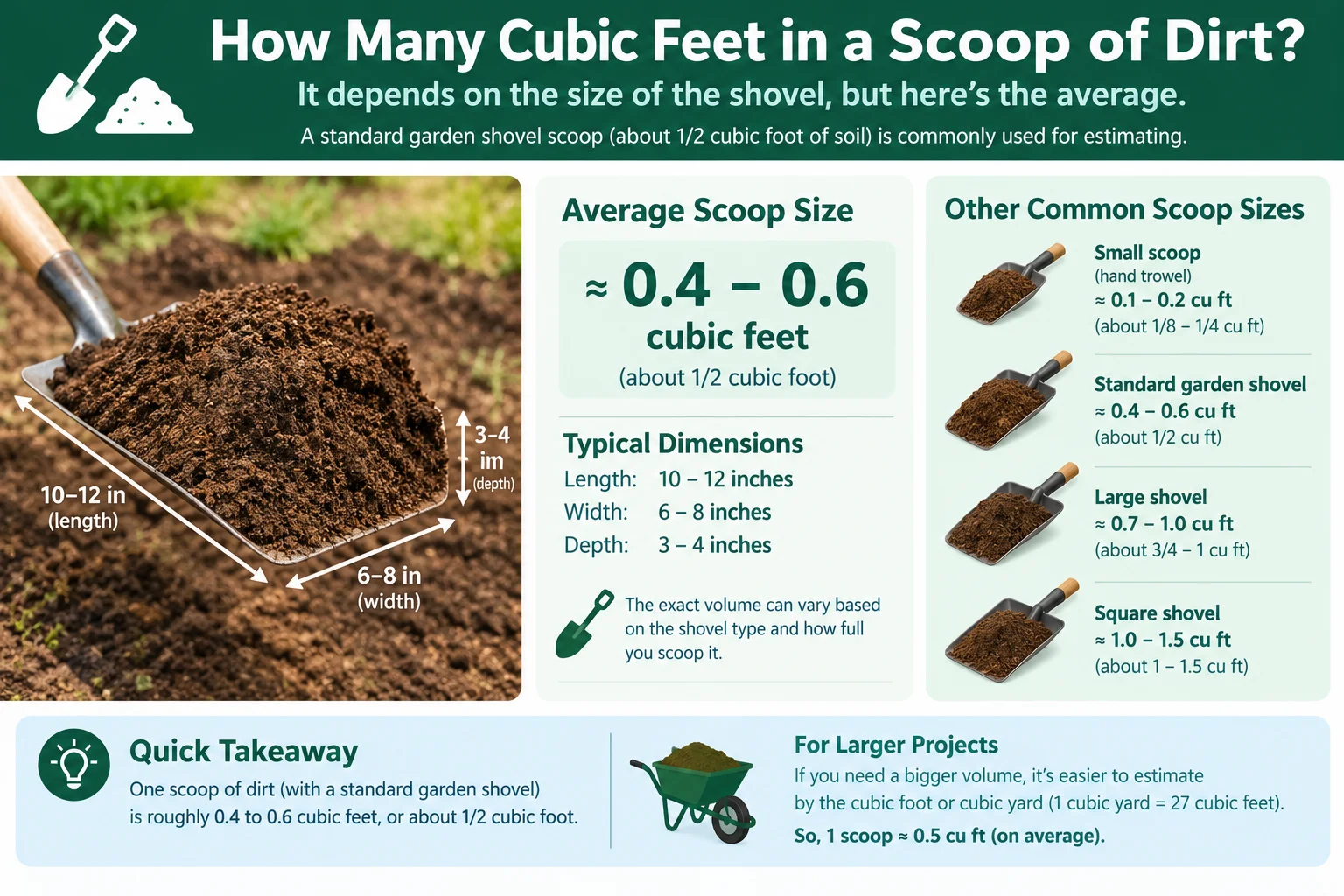
If you’re ordering dirt for a garden, filling a low spot, or planning a landscaping project, knowing how much one scoop holds can help you estimate the amount you need. However, a scoop of dirt does not have one standard volume. Its capacity depends on the bucket or equipment used and how full the bucket is.
Quick Answer
A scoop of dirt can hold anywhere from a few cubic feet to more than a cubic yard, depending on the equipment. For a small loader bucket, a practical estimate might be around 10–20 cubic feet, but larger buckets can hold considerably more.
One cubic yard equals 27 cubic feet. This conversion is useful when comparing a supplier’s scoop with bulk soil sold by the cubic yard.
| Dirt Volume | Equivalent Cubic Feet |
|---|---|
| ¼ cubic yard | 6.75 cu ft |
| ½ cubic yard | 13.5 cu ft |
| ¾ cubic yard | 20.25 cu ft |
| 1 cubic yard | 27 cu ft |
| 1½ cubic yards | 40.5 cu ft |
| 2 cubic yards | 54 cu ft |
These figures describe volume equivalents, not guaranteed bucket capacities. Ask the supplier how much their scoop holds before placing an order.
What Determines the Size of a Scoop of Dirt?
The amount of dirt in a scoop depends mainly on the equipment and the way the material is loaded. A landscaping company might use a compact loader, a skid-steer bucket, or a larger front-end loader. Each can have a different capacity.
Other factors include:
- Bucket size: A larger bucket generally holds more dirt than a smaller one.
- Fill level: A level bucket holds less than one filled above its rim.
- Soil type: Loose topsoil, compacted fill dirt, and wet soil behave differently during loading.
- Loading technique: Whether the bucket is heaped or level changes the amount delivered.
- Supplier practices: Some sellers use “scoop” as an informal unit rather than a guaranteed volume.
For accurate planning, use the equipment’s rated bucket capacity or ask the seller for the approximate cubic feet or cubic yards delivered per scoop.
Cubic Feet in Different Scoop Sizes
Because the term “scoop” is not standardized, the following table compares hypothetical scoop volumes. It can help you estimate quantities when a supplier tells you the approximate size of their bucket.
| Assumed Scoop Volume | Cubic Feet | Fraction of a Cubic Yard |
|---|---|---|
| Small scoop | 5 cu ft | About 0.19 yd³ |
| Medium scoop | 10 cu ft | About 0.37 yd³ |
| Larger scoop | 15 cu ft | About 0.56 yd³ |
| Large scoop | 20 cu ft | About 0.74 yd³ |
| One cubic yard | 27 cu ft | 1 yd³ |
| 1½ cubic yards | 40.5 cu ft | 1.5 yd³ |
Important: The labels “small,” “medium,” and “large” are illustrative descriptions, not industry-wide bucket standards. Actual scoop capacities vary by machine and supplier.
How Many Scoops Make a Cubic Yard?
A cubic yard contains 27 cubic feet. To estimate how many scoops make one cubic yard, divide 27 by the volume of one scoop in cubic feet.
Formula:
Number of scoops = 27 ÷ cubic feet per scoop
For example, if each scoop holds an estimated 9 cubic feet:
27 ÷ 9 = 3 scoops
You would need approximately three such scoops to equal one cubic yard.
| Volume per Scoop | Approximate Scoops per Cubic Yard |
|---|---|
| 3 cu ft | 9 scoops |
| 5 cu ft | 5.4 scoops |
| 9 cu ft | 3 scoops |
| 10 cu ft | 2.7 scoops |
| 13.5 cu ft | 2 scoops |
| 27 cu ft | 1 scoop |
For partial scoops, the table shows mathematical equivalents. In actual deliveries, the supplier may round quantities or charge by a minimum load.
How to Calculate the Volume of Dirt
If you know the dimensions of the area you want to fill, you can calculate the amount of dirt needed without relying on an estimated scoop size.
For a rectangular area, use:
Volume = Length × Width × Depth
Measure all three dimensions in feet. The result will be in cubic feet.
Example: Filling a Garden Bed
Suppose your garden bed is 10 feet long, 4 feet wide, and 1 foot deep.
10 × 4 × 1 = 40 cubic feet
You need 40 cubic feet of soil to fill the bed to that depth, before allowing for settling or other adjustments.
Converting Cubic Feet to Cubic Yards
Bulk dirt is often sold by the cubic yard, so divide the volume in cubic feet by 27.
40 ÷ 27 ≈ 1.48 cubic yards
For this garden bed, you would need approximately 1.48 cubic yards of soil. You may want to order a little extra if the soil will settle or the area is uneven.
| Project Volume | Cubic Feet | Cubic Yards |
|---|---|---|
| Small garden bed | 20 | 0.74 |
| Medium garden bed | 40 | 1.48 |
| Larger garden bed | 54 | 2 |
| Fill area | 81 | 3 |
| Large landscaping area | 135 | 5 |
These are example volumes, not fixed amounts for particular project types.
How Much Dirt Do You Need for a Project?
The amount of dirt you need depends on the area’s length, width, and desired depth. Use the volume formula to calculate your requirements before arranging delivery.
| Project | Example Dimensions | Dirt Needed |
|---|---|---|
| Small planter bed | 4 ft × 3 ft × 0.5 ft deep | 6 cu ft |
| Garden bed | 10 ft × 4 ft × 1 ft deep | 40 cu ft |
| Lawn topdressing | 20 ft × 10 ft × 0.25 ft deep | 50 cu ft |
| Low area to fill | 10 ft × 10 ft × 0.5 ft deep | 50 cu ft |
| Larger planting area | 20 ft × 15 ft × 0.5 ft deep | 150 cu ft |
Actual requirements may be higher if the ground is uneven, the soil settles, or the project requires additional material for grading.
For lawn topdressing, use a shallow layer appropriate for the grass and soil conditions. A half-foot of soil, for example, is much deeper than a typical topdressing application.
Factors That Affect Dirt Volume
Soil Type and Moisture
Loose topsoil, sandy fill, clay-heavy soil, and compost blends can have different densities. Wet soil is generally heavier than dry soil of the same volume, which may affect transport and handling limits. Density does not change the basic cubic-foot measurement, but it matters when estimating weight.
Loose Versus Compacted Soil
Soil may settle after placement or occupy a different volume after compaction. If you are filling an area that must reach a specific finished level, consider the project’s compaction requirements and ask your supplier or contractor how much extra material is appropriate.
Heaped Versus Level Buckets
A bucket filled above its rim may hold more material than its rated level capacity, but a heaped load is not necessarily consistent from one scoop to the next. For reliable ordering, confirm whether the supplier’s stated scoop size refers to a level or heaped bucket.
Delivery and Equipment Limits
The machine’s bucket volume is not the only consideration. The weight of wet or dense soil can limit how much a loader can safely carry. Delivery quantities may also depend on the truck, trailer, or supplier’s pricing policy.
FAQs
1. How many cubic feet are in one scoop of dirt?
There is no universal answer because scoop sizes vary. An assumed 10-cubic-foot scoop contains 10 cubic feet, while a scoop measuring 27 cubic feet equals one cubic yard.
2. How many cubic feet are in a cubic yard of dirt?
One cubic yard equals 27 cubic feet. Multiply cubic yards by 27 to convert to cubic feet.
3. How many scoops of dirt make one cubic yard?
It depends on the size of the scoop. If a scoop holds 9 cubic feet, three scoops equal 27 cubic feet, or one cubic yard.
4. Is a scoop of dirt the same as a cubic yard?
Not necessarily. A scoop is an informal description of a bucketful, while a cubic yard is a defined volume of 27 cubic feet. A scoop equals one cubic yard only when it holds that volume.
5. How can I find out how much dirt a supplier’s scoop holds?
Ask the supplier for the bucket capacity in cubic feet or cubic yards and whether the amount refers to a level or heaped scoop. This is more reliable than assuming all suppliers use the same size.
6. Does wet dirt take up more cubic feet than dry dirt?
Not automatically. A cubic foot remains a cubic foot, but moisture usually increases the weight of the soil. Changes in packing, settling, and handling can also affect the volume delivered.
7. How do I calculate the dirt needed for a garden?
Multiply the garden’s length by its width and the desired soil depth, with all measurements in feet. Divide the result by 27 if you want the volume in cubic yards.
Conclusion
The number of cubic feet in a scoop of dirt depends on the bucket size and how full it is. For a reliable estimate, confirm the supplier’s scoop capacity and remember that one cubic yard equals 27 cubic feet. If you’re filling a garden or landscaping area, calculate its length, width, and depth first to estimate how much soil to order.