

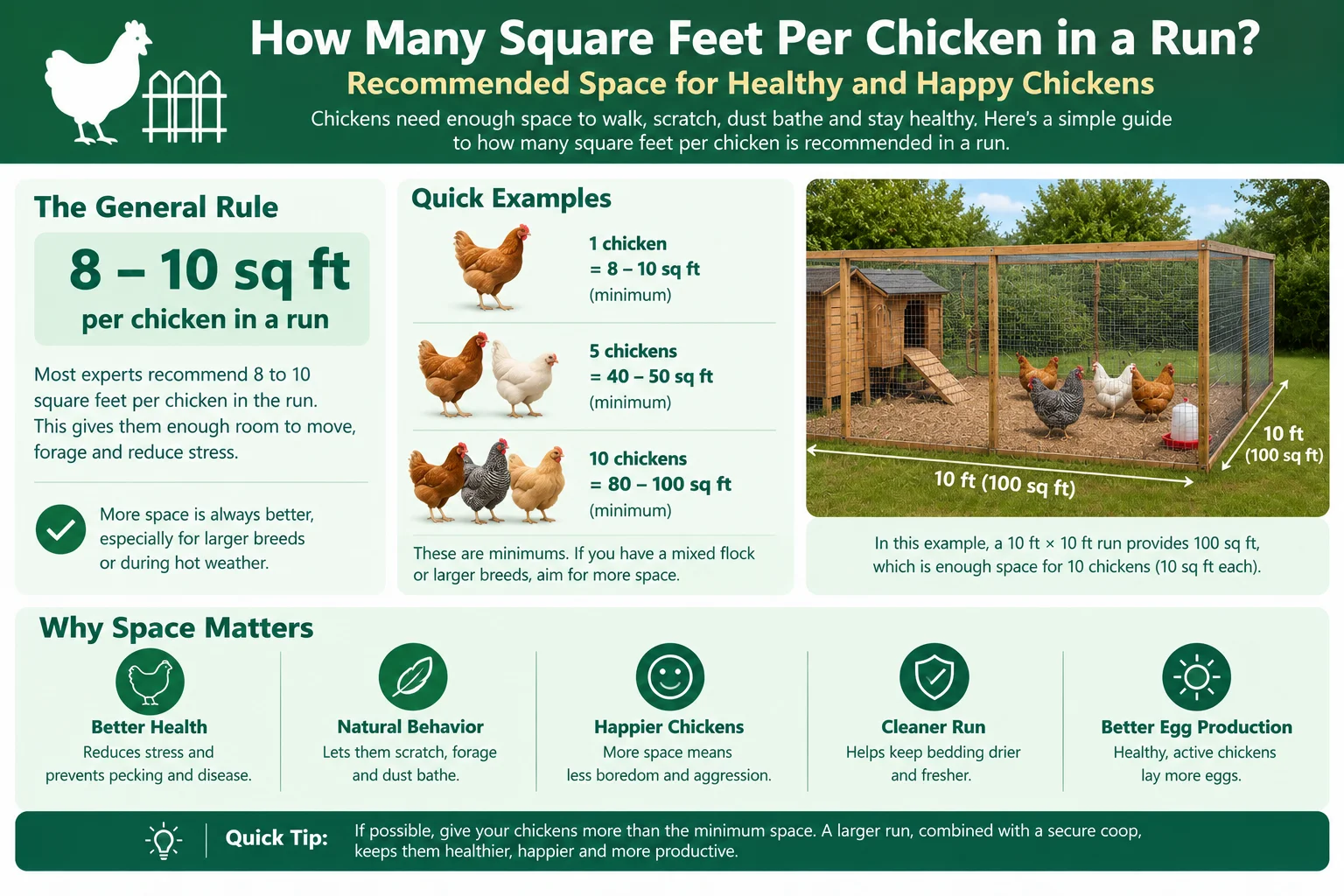
A good starting point is 8–10 square feet of outdoor run space per standard-sized chicken. Providing 10 square feet or more per bird is preferable when possible, especially if chickens spend most of their day in the run rather than free-ranging.
The ideal amount depends on flock size, chicken breed, ground conditions, weather, and how much time the birds spend inside the enclosure.
| Number of Chickens | Run Space at 8 Sq Ft per Bird | Run Space at 10 Sq Ft per Bird |
|---|---|---|
| 2 chickens | 16 sq ft | 20 sq ft |
| 3 chickens | 24 sq ft | 30 sq ft |
| 4 chickens | 32 sq ft | 40 sq ft |
| 5 chickens | 40 sq ft | 50 sq ft |
| 6 chickens | 48 sq ft | 60 sq ft |
| 8 chickens | 64 sq ft | 80 sq ft |
| 10 chickens | 80 sq ft | 100 sq ft |
| 12 chickens | 96 sq ft | 120 sq ft |
| 15 chickens | 120 sq ft | 150 sq ft |
| 20 chickens | 160 sq ft | 200 sq ft |
These are practical planning estimates rather than universal legal minimums. Check applicable local requirements and provide more space when your birds need it.
What Is a Chicken Run?
A chicken run is an enclosed outdoor area where chickens can walk, scratch, dust-bathe, forage, and explore while remaining protected from predators.
Many backyard chicken keepers attach a run directly to a coop. The coop provides shelter, nesting boxes, and nighttime roosting space, while the run provides room for daily activity.
A properly designed run should offer:
- Enough open ground for walking and scratching.
- Protection from predators and opportunities to hide from danger.
- Shade and protection from harsh weather.
- Dry areas for resting and dust-bathing.
- Accessible food and clean water.
- Good drainage and enough space to reduce crowding.
A run is particularly important when chickens cannot roam freely around a larger, securely managed outdoor area.
How Many Square Feet Does Each Chicken Need?
For standard-sized backyard chickens, 8–10 square feet of run space per bird is a commonly used planning range. However, there is no single number that works equally well for every flock.
A larger run generally makes it easier for chickens to move around, avoid one another, and engage in natural behaviors.
Recommended run space by chicken type
| Chicken Type | Practical Starting Point | Important Consideration |
|---|---|---|
| Standard-sized laying hens | 8–10 sq ft per bird | More space is helpful when the run is used all day |
| Large breeds | 10+ sq ft per bird | Larger birds may need additional room to move comfortably |
| Bantam chickens | Around 4–6 sq ft per bird as an initial planning estimate | Breed, activity level, and flock behavior affect the amount needed |
| Mixed-size flock | Plan around the larger birds | Allow enough space for every bird to access food, water, and shelter |
The figures for bantams are estimates, not a guarantee that a smaller run will be suitable. More space can benefit small breeds too, particularly in a permanent enclosure.
If your flock spends most of its time in the run, use the higher end of the range or plan for a larger enclosure.
How to Calculate the Size of a Chicken Run
Calculating the area of a chicken run is straightforward. For a rectangular or square run, multiply the length by the width.
Formula:
Square feet = Length in feet × Width in feet
For example, a run that is 10 feet long and 8 feet wide has:
10 × 8 = 80 square feet
If you keep eight standard-sized chickens, that provides:
80 ÷ 8 = 10 square feet per chicken.
That meets the 10-square-foot planning target for eight birds.
Chicken run size examples
| Run Length | Run Width | Total Area |
|---|---|---|
| 4 ft | 4 ft | 16 sq ft |
| 6 ft | 6 ft | 36 sq ft |
| 8 ft | 8 ft | 64 sq ft |
| 10 ft | 8 ft | 80 sq ft |
| 10 ft | 10 ft | 100 sq ft |
| 12 ft | 10 ft | 120 sq ft |
| 12 ft | 12 ft | 144 sq ft |
| 16 ft | 10 ft | 160 sq ft |
| 20 ft | 10 ft | 200 sq ft |
| 20 ft | 12 ft | 240 sq ft |
These measurements describe the run’s ground area. The coop’s interior floor area should be calculated separately.
How Big Should a Chicken Run Be for Different Flock Sizes?
The right run size depends on how many chickens you keep and how much outdoor space you can provide. The following table uses 10 square feet per standard-sized bird as a convenient planning target.
| Flock Size | Suggested Run Area | Example Dimensions |
|---|---|---|
| 2 chickens | 20 sq ft | 5 × 4 ft |
| 3 chickens | 30 sq ft | 6 × 5 ft |
| 4 chickens | 40 sq ft | 8 × 5 ft |
| 5 chickens | 50 sq ft | 10 × 5 ft |
| 6 chickens | 60 sq ft | 10 × 6 ft |
| 8 chickens | 80 sq ft | 10 × 8 ft |
| 10 chickens | 100 sq ft | 10 × 10 ft |
| 12 chickens | 120 sq ft | 12 × 10 ft |
| 15 chickens | 150 sq ft | 15 × 10 ft |
| 20 chickens | 200 sq ft | 20 × 10 ft |
These are example dimensions, not the only suitable layouts. A longer run can provide useful walking space, while a wider run can make it easier to position feeding areas, shelters, and dust-bathing zones.
Is a 10 × 10 Chicken Run Big Enough?
A 10 × 10 foot chicken run has 100 square feet of ground area. Whether it is big enough depends on the number and size of your chickens.
| Number of Standard Chickens | Space per Chicken in a 100 Sq Ft Run | General Assessment |
|---|---|---|
| 4 | 25 sq ft | Spacious starting point |
| 6 | 16.7 sq ft | More than the 10 sq ft planning target |
| 8 | 12.5 sq ft | Above the planning target |
| 10 | 10 sq ft | Meets the planning target |
| 12 | 8.3 sq ft | Within the lower end of the suggested range |
| 15 | 6.7 sq ft | Below the 8–10 sq ft planning range |
A 10 × 10 foot run may work well for a modest flock, but its suitability also depends on the enclosure’s layout, the birds’ size, and the time they spend inside it.
How Much Space Do Chickens Need in a Coop Versus a Run?
The coop and the run serve different purposes, so their floor areas should not be treated as interchangeable.
A commonly used planning guideline for standard-sized chickens is around 3–4 square feet per bird inside the coop and 8–10 square feet per bird in the outdoor run. More space may be needed depending on breed, climate, ventilation, flock behavior, and local welfare standards.
| Number of Chickens | Coop Space at 4 Sq Ft per Bird | Run Space at 10 Sq Ft per Bird |
|---|---|---|
| 4 | 16 sq ft | 40 sq ft |
| 6 | 24 sq ft | 60 sq ft |
| 8 | 32 sq ft | 80 sq ft |
| 10 | 40 sq ft | 100 sq ft |
| 12 | 48 sq ft | 120 sq ft |
| 15 | 60 sq ft | 150 sq ft |
| 20 | 80 sq ft | 200 sq ft |
For example, a flock of six chickens could be planned around a 24-square-foot coop and a 60-square-foot run using these guidelines.
These figures are starting points. You must also account for roosting bars, nesting boxes, feeders, waterers, and the need for all birds to move around without obstruction.
What Happens If a Chicken Run Is Too Small?
An overcrowded run can make it harder for chickens to behave naturally. It can also increase competition for resources and make maintaining clean, dry ground more difficult.
1. Increased stress and aggression
Chickens need room to move away from dominant birds. When they are crowded, lower-ranking birds may struggle to avoid repeated pecking or competition.
2. Feather pecking and bullying
Crowding, boredom, poor diet, and other management problems can contribute to feather pecking. Adequate space and enrichment help, but increasing run size alone may not solve every behavioral issue.
3. Damaged ground and muddy conditions
Chickens naturally scratch and disturb the ground. A small run used by many birds can quickly become bare, muddy, or dusty.
4. Competition for food and water
If feeders and waterers are limited or poorly positioned, dominant birds may prevent others from accessing them. Additional feeding and drinking stations can help reduce competition.
5. Less room for natural activity
Chickens benefit from scratching, exploring, dust-bathing, and moving around. A larger and more interesting run makes it easier to support these behaviors.
How to Make a Chicken Run More Comfortable
Even a reasonably sized run needs a thoughtful layout. Use the available area to encourage activity and protect the flock from weather and predators.
| Run Feature | Why It Matters | Practical Tip |
|---|---|---|
| Shade | Helps birds escape direct sunlight | Provide natural shade or a secure covered area |
| Dry ground | Reduces muddy conditions | Improve drainage and replace wet bedding or ground cover as needed |
| Dust-bathing area | Supports natural grooming behavior | Provide a suitable, dry area for dust-bathing |
| Perches and platforms | Add opportunities for movement and exploration | Install safe, stable structures without blocking the ground |
| Multiple feeders or waterers | Reduce competition | Position them so several birds can access resources |
| Hiding places and visual barriers | Give birds ways to move out of one another’s line of sight | Use safe structures that do not create traps or dead ends |
| Predator-proof fencing | Helps prevent attacks and escapes | Use secure mesh, a covered top where appropriate, and protected lower edges |
Check the run regularly for damaged fencing, sharp edges, standing water, and areas where predators could dig or reach through.
Does Free-Ranging Mean You Can Use a Smaller Run?
Free-ranging gives chickens access to more outdoor space, but it does not automatically make a small run suitable.
If birds have regular access to a large, secure outdoor area, they may spend less time inside the run. However, they still need enough enclosed space when they are confined by weather, predators, garden restrictions, or other circumstances.
Consider how the run will be used throughout the year. If the flock must stay inside for long periods, plan for the higher end of the space range or provide a larger enclosure.
Free-ranging also requires attention to predators, toxic plants, roads, neighboring properties, and local rules. More outdoor space is beneficial only when it can be used safely.
How to Choose the Right Chicken Run Size
Before building or buying a run, work through these steps:
- Count your chickens. Plan for the number of birds you intend to keep.
- Choose a space target. Use 8–10 square feet per standard-sized chicken as a starting point, and aim for more space where possible.
- Calculate the ground area. Multiply the run’s length by its width.
- Check the layout. Leave clear walking and scratching areas rather than filling the enclosure with equipment.
- Plan for weather. Provide shade, shelter from rain, and protection from harsh conditions.
- Secure the enclosure. Use predator-resistant materials and inspect the perimeter regularly.
- Check local requirements. Rules and welfare recommendations can vary by location and type of poultry keeping.
A well-planned run should remain practical to clean and maintain as well as large enough for the flock.
Frequently Asked Questions
Is 4 square feet per chicken enough for a run?
Four square feet per standard-sized chicken is below the commonly used 8–10-square-foot planning range for an outdoor run. A larger area is generally preferable, especially if the birds spend most of their day inside it.
Is 10 square feet per chicken enough?
Ten square feet per standard-sized chicken is a reasonable planning target for many backyard flocks. More space may be beneficial for larger breeds, active birds, or flocks that have little access to other outdoor areas.
How many chickens can fit in a 100-square-foot run?
Using a planning target of 10 square feet per bird, a 100-square-foot run accommodates about 10 standard-sized chickens. At 8 square feet per bird, the arithmetic allows 12.5 birds, but you should use whole birds and consider whether the flock will have enough practical space. Ten or fewer is a more comfortable starting point for planning at the higher space target.
How many square feet do six chickens need in a run?
At 8 square feet per bird, six chickens need 48 square feet. At 10 square feet per bird, they need 60 square feet. A run of 10 × 6 feet provides 60 square feet.
How many square feet do 10 chickens need?
Ten standard-sized chickens would need 80–100 square feet using the suggested range of 8–10 square feet per bird. A 10 × 10 foot run provides 100 square feet.
Does the chicken coop count toward the run area?
No. Coop floor space and outdoor run space serve different purposes. Calculate each separately to ensure the birds have suitable shelter and enough room for outdoor activity.
Should the run be covered?
A secure cover can help protect chickens from aerial predators and provide shelter from some weather conditions. It should be strong enough for the local environment and designed to prevent predators from entering.
Can too much space be a problem for chickens?
A larger run is generally beneficial when it is secure and well managed. However, a very large area still needs appropriate fencing, shelter, accessible food and water, and protection from predators. Space alone does not replace good flock management.
Conclusion
For standard-sized backyard chickens, 8–10 square feet of outdoor run space per bird is a useful starting point, with 10 square feet or more preferable when possible. A flock of six would need around 48–60 square feet, while 10 chickens would need approximately 80–100 square feet using this planning range.
Calculate the run’s actual ground area, keep coop space separate, and provide shade, enrichment, clean water, and predator protection. A well-designed run gives chickens more room to move naturally and helps support a healthier, more comfortable flock.