
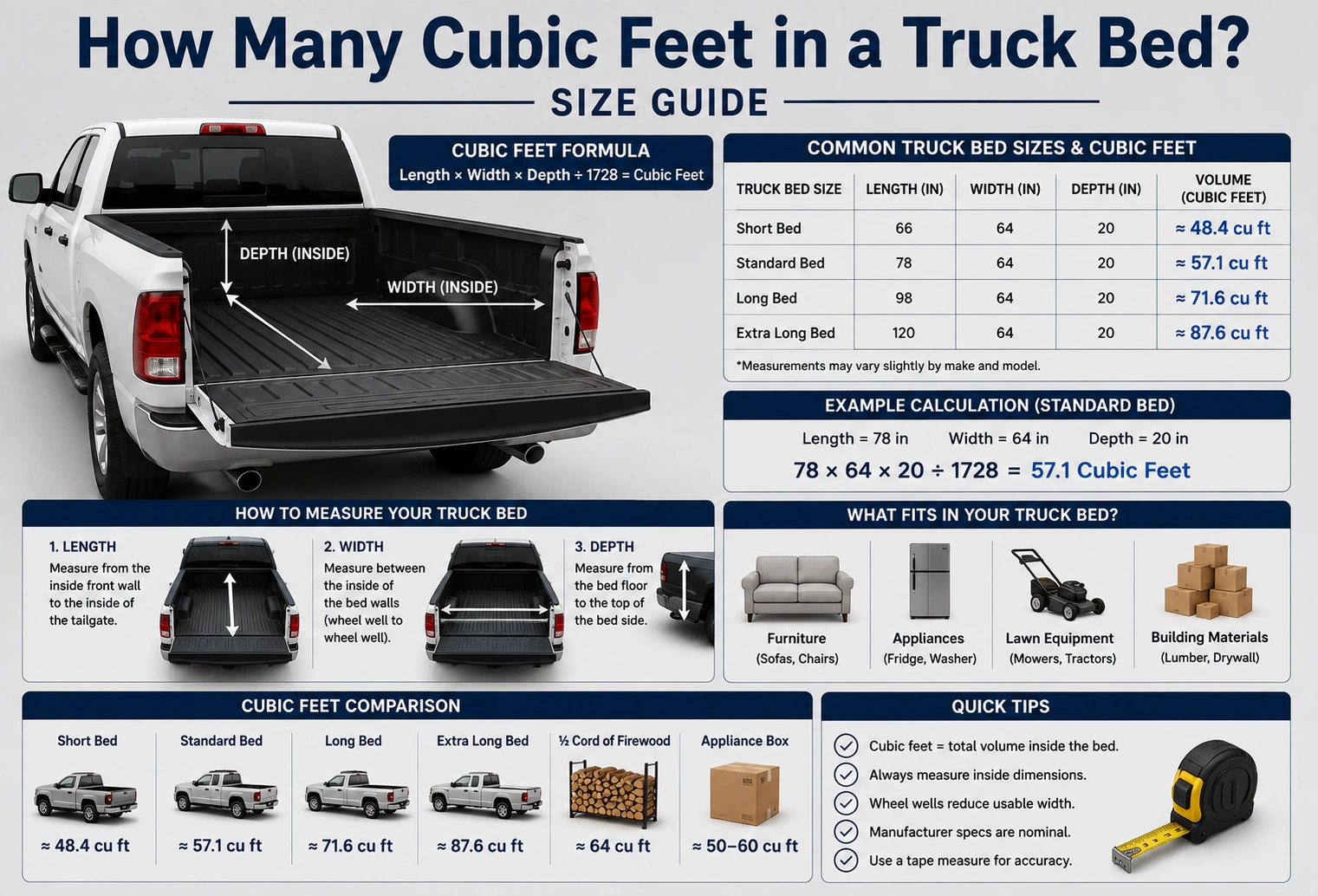
A typical full-size pickup truck bed holds approximately 50 to 70 cubic feet of volume, depending on the bed’s length, width, and depth.
There is no single cubic-foot capacity for every truck bed because pickup beds come in different sizes. A short bed may hold around 45 to 55 cubic feet, while a standard or long bed may provide approximately 55 to 70 cubic feet.
For example, a truck bed measuring approximately 6.5 feet long, 5.5 feet wide, and 1.5 feet deep would have a theoretical volume of:
6.5 × 5.5 × 1.5 = 53.625 cubic feet
Actual usable volume can be lower because truck beds are not always perfect rectangles, and wheel wells take up space.
Quick Answer
| Truck Bed Type | Typical Length | Approximate Volume |
|---|---|---|
| Short bed | 5–5.5 ft | 45–55 cu ft |
| Standard bed | 6–6.5 ft | 50–60 cu ft |
| Long bed | 8 ft | 60–70+ cu ft |
| Compact pickup bed | 5–6 ft | 35–50 cu ft |
Answer: A typical full-size truck bed contains roughly 50–70 cubic feet of theoretical volume, depending on its dimensions.
For an exact figure, measure the inside length, width, and depth of your specific truck bed.
How Do You Calculate the Cubic Feet in a Truck Bed?
The basic volume formula for a rectangular space is:
Volume = Length × Width × Depth
Make sure all three measurements are in feet before multiplying.
For example, suppose a truck bed measures:
- Length: 6.5 feet
- Width: 5.5 feet
- Depth: 1.5 feet
Calculate:
6.5 × 5.5 × 1.5 = 53.625 cubic feet
The theoretical volume is therefore approximately 53.6 cubic feet.
If your measurements are in inches, convert them to feet first by dividing each measurement by 12.
How Many Cubic Feet Is a 5.5-Foot Truck Bed?
A 5.5-foot truck bed typically provides around 45 to 55 cubic feet of theoretical volume, depending on its width and depth.
For example, using dimensions of 5.5 feet long, 5.5 feet wide, and 1.5 feet deep:
5.5 × 5.5 × 1.5 = 45.375 cubic feet
That gives approximately 45.4 cubic feet of theoretical volume.
The actual usable capacity may be lower because of wheel wells and the shape of the bed.
How Many Cubic Feet Is a 6-Foot Truck Bed?
A 6-foot truck bed can hold approximately 50 to 60 cubic feet, depending on its interior dimensions.
For example, using a width of 5.5 feet and depth of 1.5 feet:
6 × 5.5 × 1.5 = 49.5 cubic feet
So the theoretical volume is approximately 49.5 cubic feet.
The exact capacity depends on the truck’s actual interior measurements.
How Many Cubic Feet Is a 6.5-Foot Truck Bed?
A 6.5-foot bed often provides around 50 to 60 cubic feet of theoretical volume.
For example:
6.5 × 5.5 × 1.5 = 53.625 cubic feet
So a bed with those dimensions would contain approximately 53.6 cubic feet.
This is one reason a 6.5-foot bed is a common choice for owners who need a balance between passenger space and hauling capacity.
How Many Cubic Feet Is an 8-Foot Truck Bed?
An 8-foot truck bed generally provides approximately 60 to 70 or more cubic feet of theoretical volume, depending on width and depth.
Using an example width of 5.5 feet and depth of 1.5 feet:
8 × 5.5 × 1.5 = 66 cubic feet
So the theoretical volume would be 66 cubic feet.
Long beds are useful when carrying bulky materials that need additional floor length.
Truck Bed Cubic Feet Comparison
Different bed lengths produce different theoretical volumes.
| Bed Length | Example Width | Example Depth | Theoretical Volume |
|---|---|---|---|
| 5.5 ft | 5.5 ft | 1.5 ft | 45.4 cu ft |
| 6 ft | 5.5 ft | 1.5 ft | 49.5 cu ft |
| 6.5 ft | 5.5 ft | 1.5 ft | 53.6 cu ft |
| 7 ft | 5.5 ft | 1.5 ft | 57.8 cu ft |
| 8 ft | 5.5 ft | 1.5 ft | 66 cu ft |
These are example calculations using the same width and depth. Actual truck-bed dimensions vary by vehicle.
Does Truck Bed Volume Equal Payload Capacity?
No.
Cubic feet measures volume, while payload capacity measures weight.
A truck bed could have enough physical space for a large quantity of material but still exceed the truck’s safe payload rating.
For example, materials such as:
- Soil
- Gravel
- Sand
- Concrete
- Mulch
can become extremely heavy when a truck bed is filled.
Before loading heavy materials, check the truck’s payload rating and the weight of the material.
How Many Cubic Feet of Mulch Fit in a Truck Bed?
If a truck bed has approximately 50 cubic feet of theoretical volume, it could hold roughly:
50 cubic feet ÷ 27 = 1.85 cubic yards
because one cubic yard equals 27 cubic feet.
However, you should not automatically fill a truck bed with heavy materials such as wet mulch, soil, gravel, or sand without considering payload limits.
| Truck Bed Volume | Approx. Cubic Yards |
|---|---|
| 40 cu ft | 1.48 cu yd |
| 50 cu ft | 1.85 cu yd |
| 60 cu ft | 2.22 cu yd |
| 70 cu ft | 2.59 cu yd |
These are volume conversions only and do not indicate how much weight the truck can safely carry.
How Many Cubic Feet of Soil Fit in a Truck Bed?
The theoretical volume may be around 50 to 70 cubic feet for many full-size truck beds, but soil is heavy.
A cubic yard of soil contains 27 cubic feet. Therefore:
- 50 cubic feet ≈ 1.85 cubic yards
- 60 cubic feet ≈ 2.22 cubic yards
- 70 cubic feet ≈ 2.59 cubic yards
The truck’s payload capacity must be checked before loading soil.
Wet soil can weigh considerably more than dry soil, so filling the entire bed may exceed the vehicle’s safe payload even when the material physically fits.
How Many Cubic Feet of Gravel Fit in a Truck Bed?
Gravel is another heavy material where volume and weight must be considered separately.
A truck bed may physically hold 50 or more cubic feet, but the vehicle may reach its payload limit long before the bed is completely full.
For heavy bulk materials, calculate both:
Volume = Length × Width × Depth
and
Total Weight = Volume × Material Weight per Cubic Foot
Then compare the resulting weight with the truck’s rated payload capacity.
Why Actual Truck Bed Volume May Be Lower
A simple length × width × depth calculation assumes the bed is a perfect rectangular box.
Real pickup beds may have:
- Wheel wells
- Curved side walls
- Angled corners
- Raised sections
- Uneven floor shapes
- Tailgate differences
These features reduce the actual usable volume.
For a more accurate estimate, measure the usable interior area around the wheel wells and other obstructions.
How Much Can a Truck Bed Hold?
Truck-bed capacity depends on both space and weight.
For lightweight materials, volume may be the main limitation.
For heavy materials, payload capacity may be the limiting factor.
For example, a truck bed might physically hold around 2 cubic yards of material, but the truck may not be rated to carry 2 cubic yards of dense soil or gravel.
This distinction is particularly important for landscaping and construction materials.
Cubic Feet to Cubic Yards
If you know your truck bed’s cubic-foot volume and want to convert it to cubic yards, divide by 27.
Cubic Yards = Cubic Feet ÷ 27
For example:
54 ÷ 27 = 2 cubic yards
So a theoretical 54-cubic-foot truck bed holds approximately 2 cubic yards by volume.
| Cubic Feet | Cubic Yards |
|---|---|
| 27 cu ft | 1 cu yd |
| 40 cu ft | 1.48 cu yd |
| 50 cu ft | 1.85 cu yd |
| 54 cu ft | 2 cu yd |
| 60 cu ft | 2.22 cu yd |
| 70 cu ft | 2.59 cu yd |
How to Measure Your Truck Bed
For a basic volume estimate:
- Measure the inside length from the front wall to the tailgate.
- Measure the usable inside width.
- Measure the average inside depth.
- Convert all measurements to feet.
- Multiply length × width × depth.
If the bed has significant wheel-well intrusion, use the usable width rather than the maximum width.
For irregular beds, dividing the space into smaller rectangular sections can produce a more accurate estimate.
Common Mistakes When Calculating Truck Bed Volume
Using Exterior Dimensions
Exterior truck dimensions may be larger than the usable interior bed dimensions.
Use the inside measurements when calculating cargo volume.
Ignoring Wheel Wells
Wheel wells take up space and can reduce usable volume.
Confusing Cubic Feet With Cubic Yards
One cubic yard equals 27 cubic feet, not 9 cubic feet.
Ignoring Payload Capacity
A material can fit physically but still be too heavy for the truck.
Assuming Every Truck Bed Is the Same
Short, standard, and long beds have different dimensions, and even beds with the same advertised length can differ in width and depth.
Frequently Asked Questions
How many cubic feet are in a truck bed?
A typical full-size pickup bed may contain approximately 50 to 70 cubic feet of theoretical volume, depending on its dimensions.
How many cubic feet does a 6.5-foot truck bed hold?
A 6.5-foot truck bed may provide roughly 50 to 60 cubic feet of theoretical volume. Exact capacity depends on width and depth.
How many cubic feet does an 8-foot truck bed hold?
An 8-foot bed may provide approximately 60 to 70 or more cubic feet of theoretical volume, depending on its dimensions.
How many cubic yards are in a truck bed?
Many full-size truck beds have a theoretical volume of roughly 2 to 2.6 cubic yards, but the safe amount of material depends heavily on its weight and the truck’s payload rating.
How many cubic feet are in a 5.5-foot truck bed?
A 5.5-foot bed may hold around 45 to 55 cubic feet depending on its width and depth.
How do I calculate truck bed cubic feet?
Multiply the interior length, width, and depth in feet:
Length × Width × Depth = Cubic Feet
Does a truck bed hold one cubic yard?
It can, depending on the truck. One cubic yard equals 27 cubic feet, which is well below the theoretical volume of many full-size truck beds.
However, whether a truck can safely carry a full cubic yard depends on the material’s weight and the vehicle’s payload rating.
Can I put 2 cubic yards of soil in a pickup truck?
Two cubic yards equals 54 cubic feet, so it may physically fit in some full-size beds. However, soil can be heavy enough that 2 cubic yards may exceed the truck’s payload capacity.
Always check the vehicle’s payload rating before hauling heavy materials.
How many cubic feet is a half truck bed?
If the entire truck bed has approximately 60 cubic feet of volume, half the bed would be roughly 30 cubic feet, assuming the material is evenly distributed and the bed shape is approximately uniform.
Does the tailgate increase truck bed volume?
A lowered tailgate can extend the available loading area for some cargo, but it should not automatically be counted as additional enclosed bed volume. Whether cargo can safely extend onto the tailgate depends on the vehicle, load, and applicable requirements.
Conclusion
So, how many cubic feet are in a truck bed?
A typical full-size pickup truck bed has roughly 50 to 70 cubic feet of theoretical volume, although the exact amount depends on the bed’s length, width, depth, and shape.
| Truck Bed | Approximate Volume |
|---|---|
| 5.5-foot bed | 45–55 cu ft |
| 6-foot bed | 48–55 cu ft |
| 6.5-foot bed | 50–60 cu ft |
| 8-foot bed | 60–70+ cu ft |
To calculate the volume of your own truck bed, measure the usable interior length, width, and depth in feet and multiply them together.
Remember that cubic-foot capacity is not the same as payload capacity. Lightweight materials may be limited by available space, while soil, gravel, sand, and other dense materials may reach the truck’s weight limit before the bed is full.
For the most accurate estimate, use your specific truck’s interior dimensions and check its manufacturer’s payload rating before hauling heavy materials.
Discover More Articles
How Many Square Feet Will One Quart of Paint Cover?