
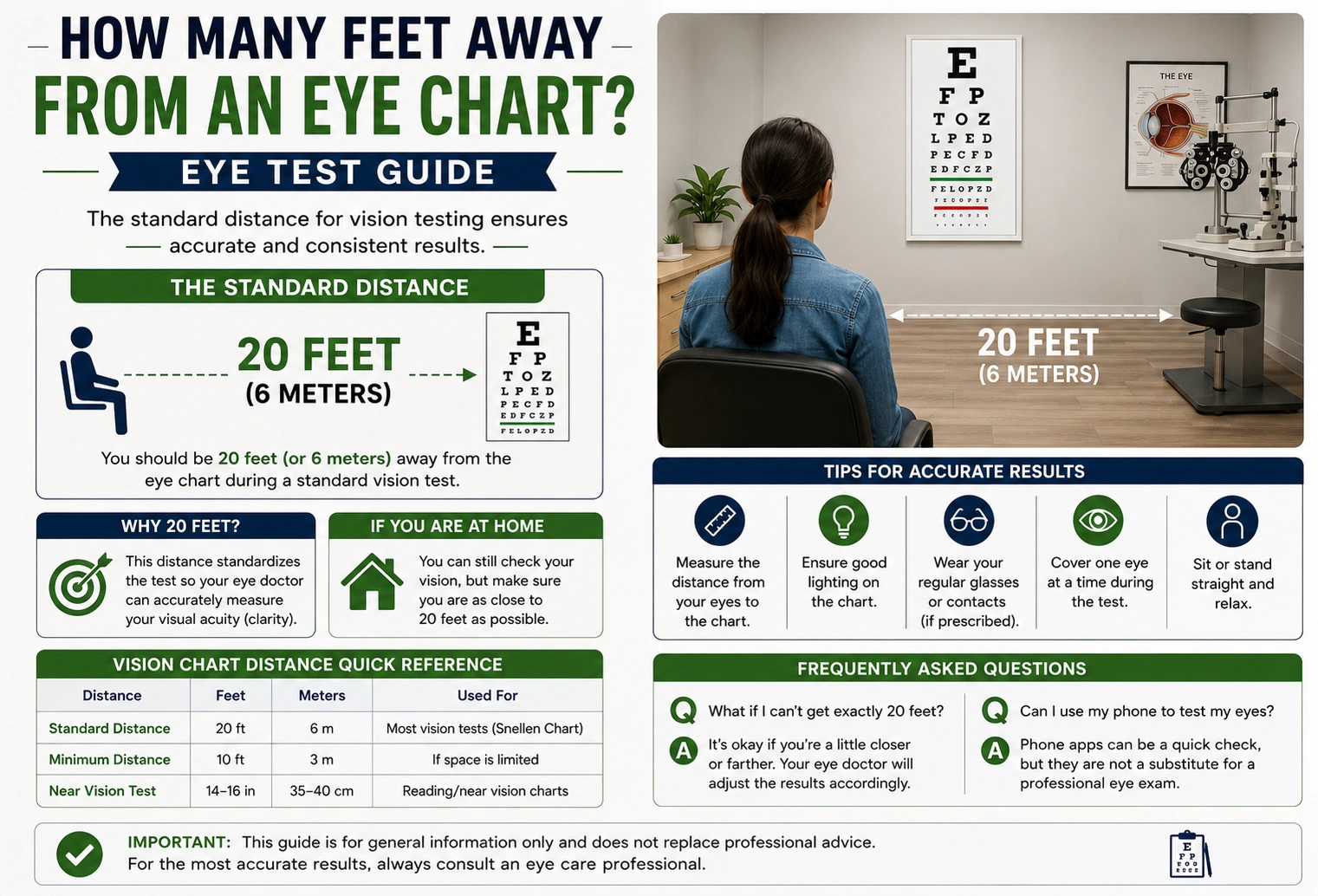
For a traditional Snellen eye chart, the standard testing distance is generally 20 feet.
That means the person taking the test stands or sits approximately 20 feet away from the eye chart while reading the letters.
The 20-foot distance is commonly used for standard visual-acuity testing because the chart is designed around that viewing distance.
However, not every eye chart or vision test uses exactly 20 feet. Some charts are designed for shorter distances, particularly in clinics where the available room is limited.
Quick Answer
| Eye-Chart Setup | Typical Testing Distance |
|---|---|
| Traditional Snellen chart | 20 ft |
| Short-distance vision chart | Often 10 ft |
| Some pediatric charts | Varies |
| Digital/clinical equipment | Manufacturer-specific |
| Home printable chart | Follow chart instructions |
Answer: A traditional Snellen eye chart is typically viewed from 20 feet away.
If you’re using a printable or digital chart at home, check the instructions that came with that specific chart because some are designed for a different testing distance.
Why Are Eye Charts 20 Feet Away?
The traditional Snellen chart is associated with the 20-foot testing distance used for visual-acuity measurement.
At 20 feet, the chart allows clinicians to evaluate how clearly a person can distinguish standardized letters and symbols at a specified visual angle.
The familiar term 20/20 vision comes from this testing system.
The first number refers to the testing distance, while the second number describes the distance at which a person with standard visual acuity can see the same line.
For example, 20/20 indicates that a person can see at 20 feet what is considered standard at that testing distance.
How Far Away Is 20 Feet From an Eye Chart?
Twenty feet is equal to:
| Unit | 20 Feet Equals |
|---|---|
| Feet | 20 ft |
| Yards | 6.67 yd |
| Inches | 240 in |
| Meters | 6.096 m |
| Centimeters | 609.6 cm |
So if you’re setting up a traditional eye chart, the viewing position should be approximately 6.1 meters or 20 feet from the chart.
How Do You Measure 20 Feet for an Eye Chart?
The easiest way is to use a tape measure.
Measure a straight-line distance from the position where the person’s eyes will be located to the eye chart.
For example:
20 feet × 12 inches = 240 inches
So the testing distance is 240 inches.
Place a chair, floor marker, or other reference point at the correct distance so the person remains in the same position during testing.
Can You Test Your Vision From Less Than 20 Feet?
Yes, but only if the eye chart is specifically designed for a shorter testing distance or the testing procedure accounts for the shorter distance.
You should not simply move a standard 20-foot Snellen chart closer and assume the results will be equivalent.
Different charts use different letter sizes and calibration methods.
| Testing Distance | Use |
|---|---|
| 20 ft | Traditional Snellen testing |
| 10 ft | Some short-distance charts |
| 6 m | Common metric equivalent |
| Other distances | Depends on chart and testing system |
Always follow the instructions for the specific chart being used.
How Far Away Should You Stand From a Printable Eye Chart?
The answer depends on the printable chart.
Some printable charts are designed for 10 feet, while others are designed for 20 feet. The chart’s letter sizes are calibrated to work at the specified distance.
Before printing or using one, check:
- Recommended viewing distance
- Print size
- Page scaling
- Letter dimensions
- Whether the chart is intended for screening or clinical use
Do not use a browser’s “fit to page” setting if it changes the chart dimensions unless the chart instructions specifically allow it.
Can You Use an Eye Chart at Home?
A properly prepared eye chart can be useful for a basic vision screening, but a home test is not a substitute for a comprehensive eye examination.
For a home screening:
- Place the chart at the recommended height.
- Measure the required viewing distance.
- Make sure the room has adequate lighting.
- Cover one eye without pressing on it.
- Read the chart with the uncovered eye.
- Repeat with the other eye.
- Follow the chart’s specific scoring instructions.
If the result is concerning or your vision has changed, an eye-care professional can perform a more complete assessment.
What Is the Correct Height for an Eye Chart?
The chart should generally be positioned so the line being tested is appropriately aligned with the person’s eye level according to the testing instructions.
In a clinical setting, the examiner controls positioning carefully.
For a home setup, avoid placing the chart too high or too low because head position and viewing angle can affect the test.
The exact setup can vary depending on the chart design.
What Does 20/20 Vision Mean?
20/20 vision describes a level of visual acuity measured at the standard testing distance.
It does not mean that a person’s eyes are perfect in every respect.
Someone can have 20/20 visual acuity and still have other eye or vision issues that require evaluation.
Visual acuity is only one part of a comprehensive eye examination.
What Does 20/40 Vision Mean?
A result of 20/40 means that the person can see at 20 feet what a person with standard 20/20 visual acuity can see at 40 feet.
In general terms, the second number indicates the distance at which the corresponding line is considered standard for the visual-acuity chart.
The result should be interpreted according to the specific chart and testing procedure.
Eye Chart Distance Compared With Common Room Sizes
Twenty feet is longer than many residential rooms.
| Distance | Approximate Length |
|---|---|
| 8 ft | Small room |
| 10 ft | Short testing distance |
| 12 ft | Moderate room length |
| 15 ft | Larger room |
| 20 ft | Traditional eye-chart distance |
| 25 ft | Large room/hallway |
If your room does not have 20 feet of clear space, a standard 20-foot chart may not be practical without using a chart designed for a shorter distance.
Why Does Lighting Matter During an Eye-Chart Test?
Lighting can affect how easily the letters can be seen.
The chart should be clearly illuminated without excessive glare.
Poor lighting can make letters harder to read and may affect a screening result.
At the same time, extremely bright light or glare on a glossy chart can also interfere with visibility.
For the most reliable assessment, professional vision testing uses controlled conditions.
What Happens If You Stand Too Close to the Eye Chart?
Standing closer than the chart’s specified testing distance can make the test invalid.
For example, if a chart is designed for 20 feet and you stand at 10 feet, you are only half the intended distance.
That changes the visual angle at which you see the letters and can make the results appear different from a properly conducted 20-foot test.
Always use the distance specified for the chart.
What Happens If You Stand Too Far Away?
Standing farther away can also affect the result.
If a chart is designed for 20 feet and you stand 25 feet away, the letters subtend a smaller visual angle than intended.
This means the test is no longer being performed under the chart’s calibrated conditions.
Accuracy therefore depends on maintaining the correct distance.
Common Mistakes When Using an Eye Chart
Guessing the Distance
Don’t estimate 20 feet by eye. Use a tape measure when possible.
Using the Wrong Chart Distance
A chart designed for 10 feet should not automatically be used at 20 feet.
Resizing a Printable Chart
Changing the print scale can change the letter dimensions and invalidate the intended testing distance.
Testing in Poor Lighting
Make sure the chart is sufficiently and evenly illuminated.
Covering the Eye Incorrectly
Avoid pressing on the covered eye because pressure can temporarily affect vision.
Treating a Home Screening as a Diagnosis
A home eye chart can provide a basic screening result but cannot replace a professional eye examination.
Frequently Asked Questions
How many feet away from an eye chart should you stand?
For a traditional Snellen eye chart, the standard distance is generally 20 feet.
Is an eye chart always 20 feet away?
No. Some charts are designed for shorter distances, such as 10 feet, while clinical equipment may use other standardized distances.
How many feet is 20 feet in meters?
Twenty feet equals 6.096 meters, commonly rounded to about 6.1 meters.
How many inches away from an eye chart is 20 feet?
Twenty feet equals 240 inches.
Can I use an eye chart at home?
Yes, you can use a properly calibrated chart for basic screening, but home testing should not be considered a replacement for a professional eye examination.
How far away should a printable Snellen chart be?
Follow the instructions for that specific chart. Traditional Snellen testing commonly uses 20 feet, but some printable charts are designed for shorter distances.
What distance is used for 20/20 vision?
Traditional visual-acuity testing commonly uses a 20-foot viewing distance in the United States.
What happens if I stand closer than 20 feet?
If the chart is calibrated for 20 feet, standing closer changes the testing conditions and can make the result unreliable.
What is the metric equivalent of 20 feet?
Twenty feet equals 6.096 meters, usually expressed as approximately 6 meters in clinical contexts.
Does room size matter for an eye-chart test?
Yes. You need enough clear space to maintain the chart’s specified testing distance. If you do not have 20 feet, use a chart and procedure specifically designed for the available distance.
Does lighting affect an eye-chart test?
Yes. Poor lighting or glare can make letters harder to see and affect a screening result.
Is 20/20 vision perfect vision?
Not necessarily. 20/20 describes visual acuity at a specified distance. A comprehensive eye examination evaluates many other aspects of eye health and vision.
Conclusion
So, how many feet away from an eye chart should you stand?
For a traditional Snellen eye chart, the standard testing distance is generally 20 feet.
| Measurement | Equivalent |
|---|---|
| Standard distance | 20 ft |
| Yards | 6.67 yd |
| Inches | 240 in |
| Meters | 6.096 m |
| Centimeters | 609.6 cm |
The important point is to use the distance specified by the chart. While 20 feet is the familiar standard for traditional Snellen testing, some charts are specifically designed for 10 feet or another distance.
For a home screening, measure the distance rather than estimating it, keep the chart properly scaled and illuminated, and remember that a home eye-chart test is only a screening tool. Changes in vision, difficulty seeing clearly, or concerns about eye health should be evaluated by an eye-care professional.
Discover More Articles
How Many Cubic Feet in a Truck Bed? Size Guide