

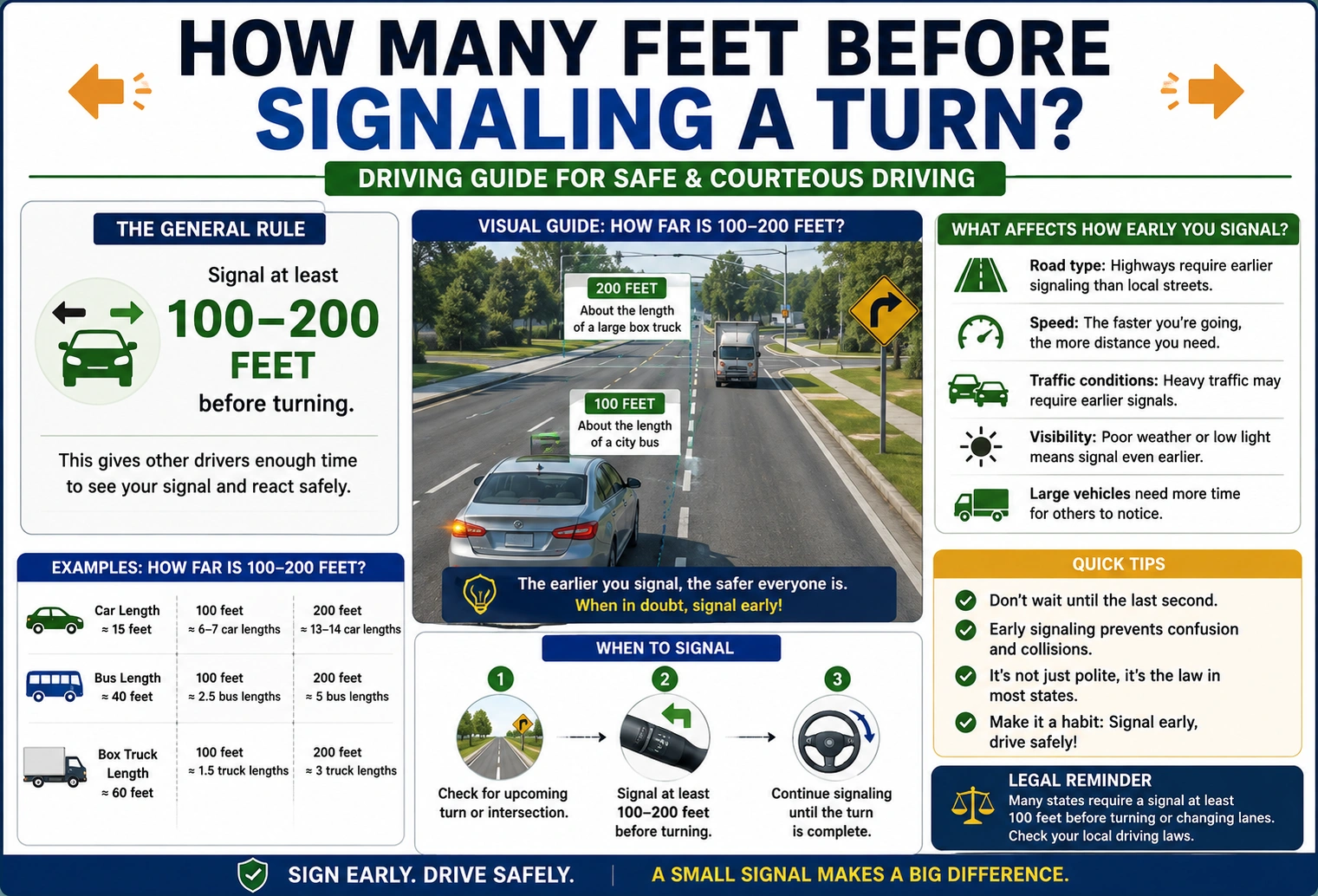
If you’re wondering how many feet before signaling a turn, a commonly used rule in the United States is to signal approximately 100 feet before making a turn.
However, the exact legal requirement can vary by state or jurisdiction. Some states specify a particular distance, while others use wording such as signaling continuously for a certain distance before turning.
For many everyday driving situations, 100 feet before the turn is a useful general guideline.
Quick Answer
Signal about 100 feet before a turn unless your local traffic law requires a different distance.
The purpose of signaling is to give other drivers, cyclists, and pedestrians enough time to understand your intention and react safely.
For example, if you are approaching a right turn, activate your turn signal well before reaching the intersection rather than waiting until you are already beginning the turn.
Why Should You Signal Before a Turn?
A turn signal communicates your intended movement to other road users.
Signaling early can help:
- Drivers behind you anticipate your movement
- Oncoming drivers understand that you intend to turn
- Pedestrians recognize that you may cross their path
- Other vehicles adjust their speed
- Traffic flow remain predictable
A signal is most useful when it provides enough warning without being activated so early that other drivers become confused about which turn you intend to make.
The goal is to provide clear and timely notice.
Is 100 Feet the Standard Signaling Distance?
The 100-foot rule is common, but it is not a universal legal requirement across every U.S. jurisdiction.
Traffic laws are established at the state or local level, so drivers should follow the law applicable where they are driving.
A general comparison looks like this:
| Signaling Distance | Common Use |
|---|---|
| 50 feet | Required in some jurisdictions or specific situations |
| 100 feet | Common requirement and general driving guideline |
| 200 feet | Required in some jurisdictions or circumstances |
| Longer distance | May apply to certain high-speed roads or special situations |
Because traffic laws can change and requirements differ, drivers should check their state’s current driver’s manual or traffic code for the exact legal distance.
Why Do Signaling Rules Differ?
Different jurisdictions establish their own traffic laws.
A state may require drivers to signal for a specific number of feet before turning, while another may use a different distance or require signaling continuously before the movement.
Road type can also affect how a driver should signal.
For example, signaling on a low-speed residential street may look different from signaling on a high-speed roadway where vehicles need more time to react.
This is why the safest approach is to understand both the legal requirement and the practical purpose of signaling.
How Far Before a Right Turn Should You Signal?
For a typical turn, a driver should activate the right turn signal sufficiently before the intersection to provide clear warning.
If the applicable rule is 100 feet, the signal should generally be activated approximately 100 feet before the turn.
Do not wait until you are at the intersection.
For example, if you are approaching a right turn from a normal city street, activate the signal while you are still traveling toward the intersection, check your surroundings, reduce speed appropriately, and then make the turn when safe.
How Far Before a Left Turn Should You Signal?
The same basic principle applies to a left turn.
If your jurisdiction uses a 100-foot signaling requirement, signal approximately 100 feet before the intended turn.
A left turn may require additional awareness because you could be crossing traffic lanes or entering the path of oncoming vehicles.
Before turning, you should:
- Activate the left signal.
- Check mirrors.
- Check surrounding traffic.
- Move into the appropriate lane when safe.
- Reduce speed appropriately.
- Check for pedestrians and cyclists.
- Complete the turn when safe.
The signal communicates your intention, but it does not give you the automatic right-of-way.
Should You Signal Before Changing Lanes?
Yes. Turn signals are also used to communicate lane changes.
The exact legal requirement for signaling before a lane change can differ from the requirement for making a turn.
A safe lane-change process is:
Signal → Check mirrors → Check blind spot → Confirm the lane is clear → Move smoothly.
Do not assume that activating your turn signal means another vehicle must let you move over.
The signal is a communication tool, not permission to change lanes.
Should You Signal at a Traffic Light?
Yes. If you are turning at a traffic light, you should normally activate the appropriate turn signal before reaching the intersection.
For example, if you’re approaching a traffic light and intend to turn left, activate your left signal early enough to give surrounding traffic adequate notice.
Waiting until the light turns green and then activating the signal at the last moment may not provide sufficient warning.
What If You Are Already in a Turn-Only Lane?
You should generally still use your turn signal when making the indicated movement.
Being in a designated turn lane does not necessarily eliminate the need to communicate your intention.
Other road users may still benefit from knowing that you intend to make the turn.
The applicable traffic law should always be followed.
Can You Signal Too Early?
Yes.
Signaling too early can sometimes create confusion, especially when there are multiple intersections, driveways, or side roads close together.
For example, if you activate your signal several hundred feet before your intended turn and pass another road before reaching the actual intersection, another driver may mistakenly believe you intend to turn earlier.
The best practice is to signal with enough advance notice to comply with the law and communicate clearly without creating ambiguity.
What Happens If You Signal Too Late?
Signaling too late gives other road users less time to react.
For example, activating your signal immediately before turning may not give a driver behind you enough time to slow down.
Late signaling can increase the risk of:
- Rear-end collisions
- Sudden braking
- Confusion at intersections
- Conflicts with pedestrians
- Unsafe lane changes
A timely signal helps make your driving more predictable.
Turn Signal Distance Comparison
The following examples show why the distance matters:
| Situation | Better Practice |
| Turning at a normal intersection | Signal well before the intersection |
| 100-foot legal requirement | Signal at least the required distance in advance |
| Changing lanes | Signal before moving into the next lane |
| Turning at a traffic light | Signal before reaching the intersection |
| Heavy traffic | Signal early enough for surrounding drivers to react |
| Multiple nearby intersections | Avoid signaling so early that your intended turn becomes unclear |
| Emergency or unexpected obstacle | Prioritize immediate safety and follow applicable traffic rules |
Does Speed Affect How Early You Should Signal?
Speed can affect how much time other road users need to react.
At higher speeds, vehicles travel a greater distance in a shorter period of time.
For example, a car traveling 60 mph covers approximately 88 feet every second.
That means signaling only a very short time before a maneuver may provide insufficient warning at highway speeds.
The legal signaling distance should still be followed, but drivers should also consider the surrounding traffic and road conditions.
Does Signaling Give You the Right of Way?
No.
Activating a turn signal does not automatically give you the right-of-way.
You still need to yield when required by traffic laws.
For example, if you’re turning left across oncoming traffic, signaling your intention does not mean oncoming vehicles must stop for you.
Likewise, a driver signaling a lane change must still make sure the destination lane is clear before moving.
Think of a turn signal as communication, not permission.
Common Turn-Signal Mistakes
One common mistake is waiting until the vehicle is already at the intersection before activating the signal.
Another is forgetting to cancel the signal after completing the turn. A continuously flashing signal can mislead other drivers into thinking you intend to turn again.
Drivers also sometimes signal but fail to check their blind spots before changing lanes.
Another mistake is assuming that because another driver can see the signal, they automatically understand exactly what you intend to do.
Good signaling should be combined with proper observation, positioning, speed control, and right-of-way rules.
Frequently Asked Questions
How many feet before a turn should you signal?
A commonly used guideline is 100 feet before the turn, but the exact legal requirement depends on the state or jurisdiction where you are driving.
Is signaling 100 feet before a turn required everywhere?
No. Signaling requirements vary by jurisdiction. Some locations use different distances or wording in their traffic laws.
Should I signal before a right turn?
Yes. Activate your right turn signal sufficiently before the turn to give other road users adequate warning and comply with local law.
Should I signal before a left turn?
Yes. Signal before making a left turn and continue to follow applicable right-of-way rules.
How many feet before a lane change should you signal?
The exact legal requirement varies, but you should activate your signal before beginning the lane change, allowing enough time for surrounding drivers to recognize your intention.
Can I signal too early?
Yes. Signaling excessively early can create confusion if there are other roads or intersections before your intended turn.
Can I signal too late?
Yes. A signal activated immediately before a turn may not provide sufficient warning for other road users to react safely.
Does a turn signal mean I have the right of way?
No. A turn signal communicates your intention but does not automatically give you the right of way.
Should I signal if I am already in a turn-only lane?
Generally, yes. You should still communicate your intended movement and follow the traffic laws applicable in your jurisdiction.
What is the safest way to signal before turning?
Signal early enough to provide clear warning, check mirrors and blind spots, position your vehicle correctly, obey speed and right-of-way rules, and make the turn only when it is safe.
Conclusion
If you’re asking “how many feet before signaling a turn?”, 100 feet is a common rule and practical guideline in the United States, but the exact legal requirement depends on the jurisdiction.
The important principle is to signal early enough to clearly communicate your intention without signaling so early that your intended turn becomes confusing.
Always check your local traffic laws for the specific required distance. Most importantly, remember that signaling is only one part of safe driving: you must also check your surroundings, obey right-of-way rules, control your speed, and make sure the maneuver is safe before turning or changing lanes.
Discover More Articles
How Many Gallons of Soil Is 2 Cubic Feet?