
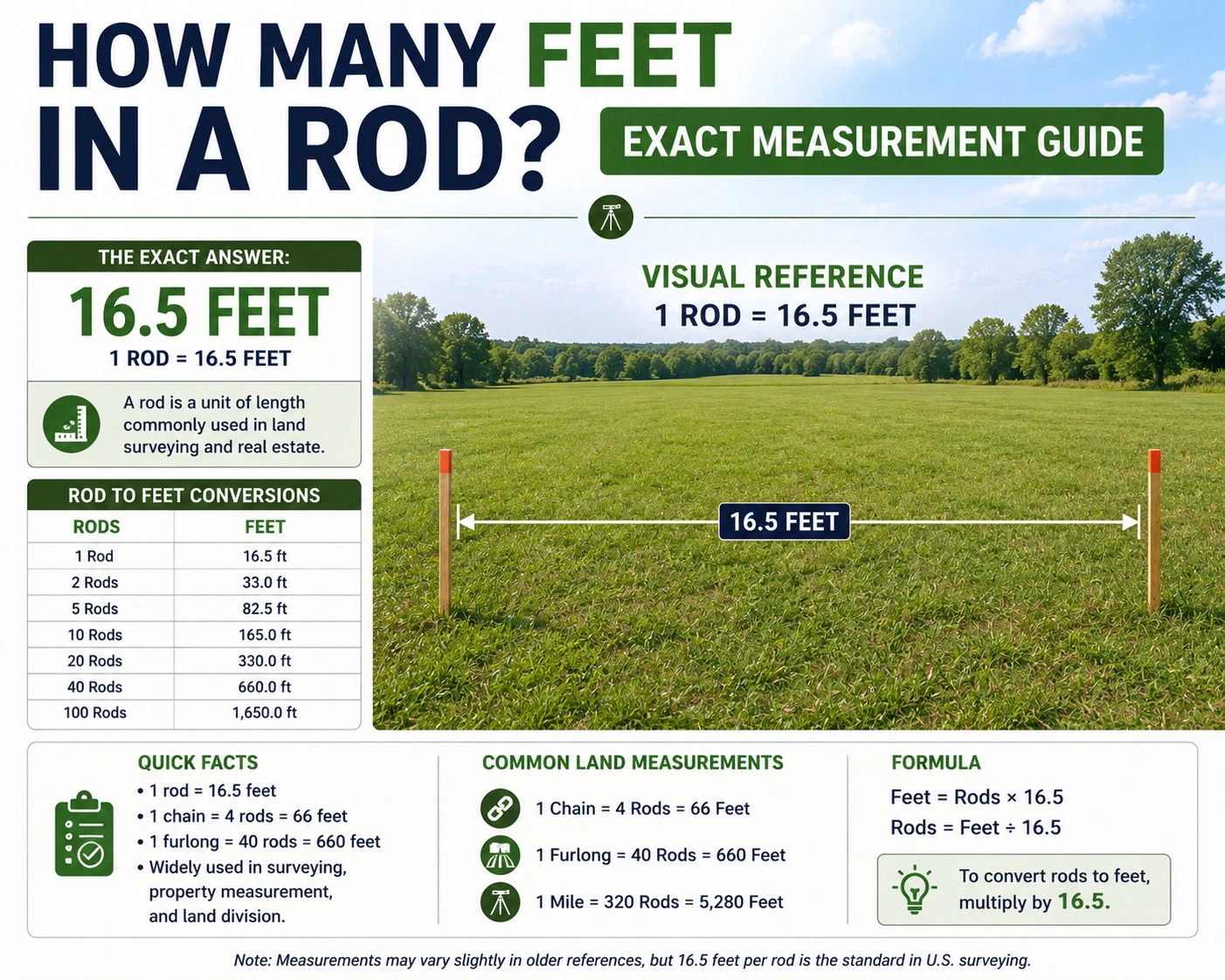
If you are wondering “how many feet in a rod,” the exact answer is:
1 rod=16.5 feet
A rod is a traditional unit of length primarily used in:
- Land surveying
- Farming
- Historical property measurements
Although rods are not commonly used today, they still appear in:
- Property records
- Surveying documents
- Historical land descriptions
Understanding rod measurements helps people interpret older land records and measurement systems more accurately.
In this complete guide, you will learn:
- How many feet are in a rod
- The history of rod measurements
- Rod conversion formulas
- Real-world examples
- Helpful conversion charts
- Common conversion mistakes
Let’s begin.
Quick Answer About Rod Measurements
The exact conversion is:
- 1 rod = 16.5 feet
The formula is:
Feet=Rods×16.5
This means:
- 2 rods = 33 feet
- 4 rods = 66 feet
Rods are mainly associated with:
- Surveying
- Agriculture
- Historical land divisions
What Is a Rod?
Before understanding the conversion, it helps to know what a rod actually is.
Definition of a Rod
A rod is a unit of linear measurement in the imperial system.
It is also known as:
- Pole
- Perch
One rod always equals:
16.5 feet
History of the Rod
The rod originated centuries ago in England.
Historically, it was based on:
- Agricultural measurements
- Land surveying practices
Farmers and surveyors used rods because they simplified measuring fields and property boundaries.
Why Rods Were Used
Rods became popular because they fit well into larger land measurement systems.
For example:
- 320 rods = 1 mile
- 160 square rods = 1 acre
This made calculations easier before modern measuring tools existed.
How Many Feet Are in a Rod?
The conversion is straightforward.
Exact Conversion Formula
Use this formula:
Feet=Rods×16.5
Step-by-Step Explanation
Suppose you want to convert:
- 3 rods into feet
Step 1:
3×16.5
Step 2:
49.5 feet
Final answer:
- 3 rods = 49.5 feet
Rod Measurement Breakdown
Here is another way to understand a rod.
| Measurement | Equivalent |
|---|---|
| 1 rod | 16.5 feet |
| 1 rod | 5.5 yards |
| 1 rod | 0.25 chain |
These relationships were commonly used in surveying.
Rod Compared to Other Measurements
Comparisons help make rod measurements easier to understand.
Rod vs Yard
Since:
- 1 yard = 3 feet
Then:
16.5÷3=5.5 yards
So:
- 1 rod = 5.5 yards
Rod vs Chain
Surveyors often used chains.
One chain equals:
- 66 feet
Therefore:
66÷16.5=4 rods
So:
- 4 rods = 1 chain
Rod vs Meter
One rod equals approximately:
16.5 feet≈5.03 meters
Real-World Examples of a Rod
Although uncommon today, rods still appear in some fields.
Land Surveying
Historical property records often use rods to describe:
- Boundaries
- Distances
- Lot sizes
Farming Applications
Older farms were frequently measured using rods.
Historical Property Measurements
Land deeds and colonial-era documents often contain rod measurements.
Understanding rods helps interpret these records accurately.
Rod to Feet Conversion Chart
Here is a quick reference chart.
| Rods | Feet |
|---|---|
| 1 rod | 16.5 ft |
| 2 rods | 33 ft |
| 3 rods | 49.5 ft |
| 4 rods | 66 ft |
| 10 rods | 165 ft |
This chart simplifies conversions.
Why Rod Measurements Matter
Rod measurements still have practical value today.
Property Boundaries
Older property surveys may use rods.
Historical Research
Researchers studying historical land records often encounter rods.
Surveying Systems
Traditional surveying systems relied heavily on rods and chains.
Legal Documents
Some older deeds and legal records still reference rod measurements.
Common Mistakes When Converting Rods
Measurement confusion is common with older units.
Mixing Rods With Yards
A rod is not the same as a yard.
Remember:
- 1 rod = 5.5 yards
Decimal Confusion
16.5 feet includes a half-foot value.
Using Incorrect Conversion Factors
Always remember:
1 rod=16.5 feet
Ignoring Historical Context
Older measurements may differ slightly depending on regional standards.
Expert Tips for Understanding Rod Measurements
These tips simplify traditional measurements.
Memorize the Core Conversion
Remember:
- 1 rod = 16.5 feet
This solves most rod conversion problems.
Learn Related Surveying Units
Understanding:
- Chains
- Acres
- Yards
Makes rods easier to visualize.
Use Modern Conversion Tools
Online calculators simplify old land measurement conversions.
Check Historical Documents Carefully
Old property records may use abbreviations like:
- rd
- pole
- perch
For rods.
Practical Situations Where Rods Appear
Rod measurements still exist in some contexts.
Historical Land Surveys
Older surveys frequently use rods instead of feet.
Agricultural Records
Some farming records still reference rods.
Colonial Property Documents
Colonial-era deeds commonly used rods and chains.
Educational Materials
Students studying historical measurements often learn about rods.
FAQs
How many feet are in one rod?
One rod equals exactly 16.5 feet.
Why is a rod 16.5 feet long?
The rod developed historically from agricultural and surveying systems in England.
Is a rod still used today?
Rods are rarely used today but still appear in:
- Historical records
- Surveying documents
- Legal property descriptions
How many rods are in a mile?
There are:
- 320 rods in one mile
What is another name for a rod?
A rod is also called:
- Pole
- Perch
Conclusion
So, how many feet in a rod?
The exact answer is:
- 1 rod = 16.5 feet
1 rod=16.5 feet
Understanding rod measurements helps with:
- Reading historical land records
- Surveying calculations
- Agricultural measurements
- Property research
- Traditional measurement systems
Once you understand the rod-to-feet conversion, interpreting older measurement systems becomes much easier and more accurate.
Discover More Articles
How Many Square Feet Are in an Acre?