
If you’re wondering how many feet is 35 meters, the answer is simple once you know the standard conversion factor.
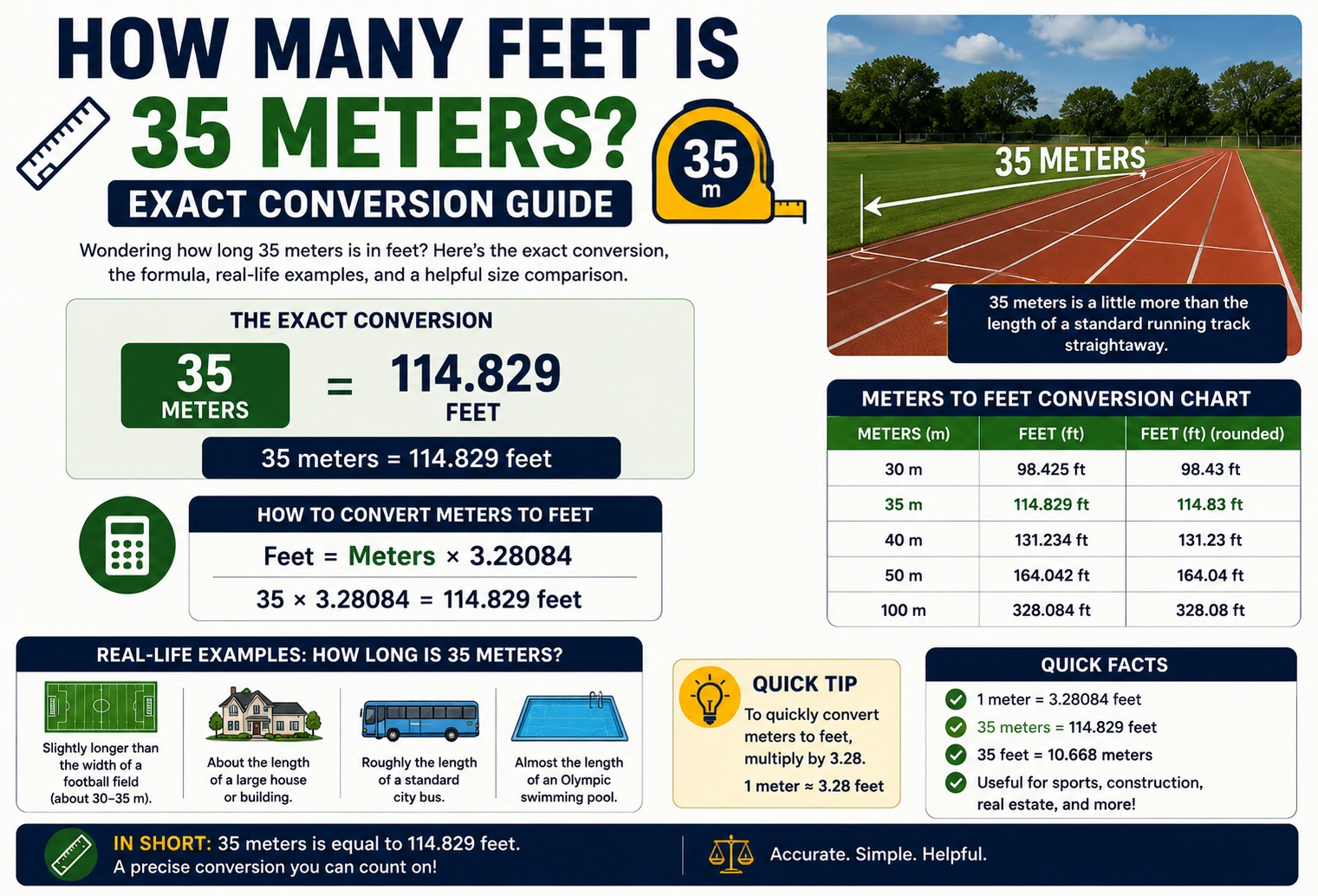
35 meters equals approximately 114.83 feet.
To convert meters into feet, multiply the number of meters by 3.28084, since one meter is equal to 3.28084 feet.
35 × 3.28084 = 114.8294 feet
Rounded to two decimal places, 35 meters equals 114.83 feet.
This conversion is useful in construction, engineering, sports, education, travel, and everyday measurements. In this guide, you’ll learn the formula, explore conversion charts, and discover practical examples that make it easier to understand this distance.
Quick Answer
| Meters | Feet |
|---|---|
| 35 meters | 114.83 feet |
Answer: 35 meters is equal to approximately 114.83 feet.
Understanding Meters and Feet
Meters and feet are both units used to measure length, but they belong to different measurement systems.
- Meter (m): Part of the metric system and used in most countries worldwide.
- Foot (ft): Part of the U.S. customary and imperial systems, commonly used in the United States.
The standard conversion is:
- 1 meter = 3.28084 feet
- 1 foot = 0.3048 meters
Knowing this conversion makes it easy to switch between the two systems.
How to Convert 35 Meters to Feet
Converting meters into feet requires only one multiplication.
Step 1
Use the conversion factor:
1 meter = 3.28084 feet
Step 2
Multiply:
35 × 3.28084
Step 3
Calculate:
114.8294 feet
Final Answer
35 meters = 114.83 feet (rounded)
Meters to Feet Conversion Formula
Use this simple formula:
Feet = Meters × 3.28084
Example:
35 × 3.28084 = 114.83 feet
This formula works for any metric measurement.
Meters to Feet Conversion Chart
| Meters | Feet |
|---|---|
| 5 | 16.40 |
| 10 | 32.81 |
| 15 | 49.21 |
| 20 | 65.62 |
| 25 | 82.02 |
| 30 | 98.43 |
| 35 | 114.83 |
| 40 | 131.23 |
| 50 | 164.04 |
| 100 | 328.08 |
This chart provides quick reference for common conversions.
What Does 35 Meters Look Like?
Visualizing 35 meters (114.83 feet) can help you better understand the distance.
It is approximately:
- The height of an 11-story building, depending on floor-to-floor height.
- Slightly longer than the length of three standard school buses parked end to end.
- About one-third of the length of a soccer field.
- Around 38.3 yards.
These comparisons make it easier to picture the measurement in everyday life.
Real-World Examples
Construction
A building wall measuring 35 meters is approximately 114.83 feet long.
Running Track
A sprint of 35 meters equals 114.83 feet, a distance commonly used in athletic training drills.
Engineering
Project plans created in meters often need to be converted into feet for use in countries that follow imperial measurements.
Landscaping
A garden or pathway measuring 35 meters extends approximately 114.83 feet.
Common Uses for This Conversion
Knowing how to convert 35 meters to feet is useful in many situations.
Construction
Architects and contractors frequently convert plans between metric and imperial systems.
Sports
Track and field events, training drills, and playing field measurements often involve both meters and feet.
Travel
Visitors traveling between countries may encounter both measurement systems.
Education
Students often solve meter-to-foot conversion problems in science and mathematics classes.
Home Improvement
DIY projects sometimes require converting imported product dimensions into familiar units.
Why Accurate Conversions Matter
Accurate measurements help you:
- Avoid construction errors
- Order the correct materials
- Compare international product sizes
- Read engineering drawings
- Complete school assignments
- Plan landscaping projects
Even a small mistake in unit conversion can lead to costly errors in professional projects.
Common Conversion Mistakes
Using the Wrong Conversion Factor
Always remember:
1 meter = 3.28084 feet
Rounding Too Early
Perform the full calculation before rounding the final answer.
Mixing Measurement Systems
Don’t confuse meters with yards or feet when reading plans.
Decimal Errors
Ensure the decimal point is placed correctly to avoid significant mistakes.
Expert Tips
- Memorize the conversion factor 3.28084 for quick calculations.
- Use a calculator for decimal conversions.
- Round only when precision is not critical.
- Label all units clearly to prevent confusion.
- Double-check conversions in construction or engineering projects.
Quick Conversion Reference
| Meters | Feet |
|---|---|
| 10 | 32.81 |
| 20 | 65.62 |
| 25 | 82.02 |
| 30 | 98.43 |
| 35 | 114.83 |
| 40 | 131.23 |
| 50 | 164.04 |
9. Frequently Asked Questions
1. How many feet is 35 meters?
35 meters equals approximately 114.83 feet.
2. How do you convert 35 meters into feet?
Multiply 35 by 3.28084:
35 × 3.28084 = 114.83 feet
3. Is 35 meters more than 100 feet?
Yes. 35 meters equals approximately 114.83 feet, which is about 14.83 feet more than 100 feet.
4. What is 35 meters in yards?
Thirty-five meters equals approximately 38.28 yards.
5. Why is the conversion factor 3.28084?
The meter and foot are defined using international measurement standards. Based on these definitions, 1 meter equals exactly 3.28084 feet.
10. Conclusion
If you’re asking how many feet is 35 meters, the exact conversion is 114.83 feet. Simply multiply 35 meters by 3.28084 to convert from the metric system to the imperial system.
Understanding this conversion is useful in construction, engineering, education, sports, and everyday life. Whether you’re reading international plans, measuring a property, or solving a math problem, knowing that 35 meters equals approximately 114.83 feet helps you work accurately and confidently across different measurement systems.
Discover More Articles
How Many Feet Is .4 Miles? Easy Conversion Guide