
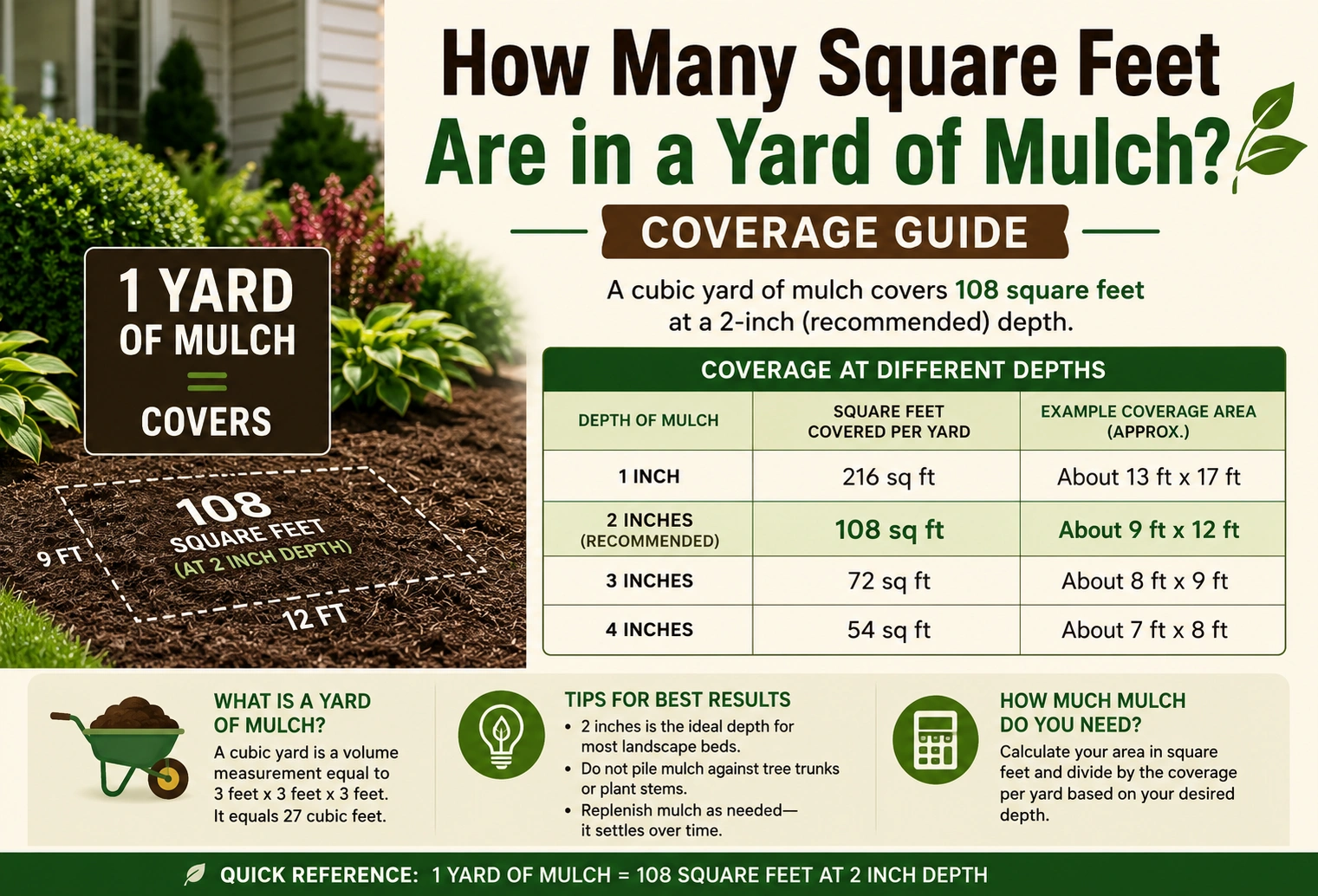
If you’re planning a landscaping project, one of the most common questions is how many square feet are in a yard of mulch. The answer depends on how deep you spread the mulch. A cubic yard of mulch always has the same volume, but its coverage area changes as the mulch layer becomes thicker or thinner.
A cubic yard of mulch contains 27 cubic feet of material. At the commonly recommended depth of 3 inches, one cubic yard covers approximately 108 square feet. If you spread the mulch at 2 inches, the same yard covers about 162 square feet.
Knowing these coverage estimates helps you purchase the correct amount of mulch, reduce waste, and stay within your landscaping budget.
In this guide, you’ll learn how mulch coverage works, how to calculate the amount you need, and which mulch depth is best for different landscaping projects.
Quick Answer
The coverage of one cubic yard of mulch depends on the depth of application.
| Mulch Depth | Coverage Per Cubic Yard |
|---|---|
| 1 inch | 324 sq ft |
| 2 inches | 162 sq ft |
| 3 inches | 108 sq ft |
| 4 inches | 81 sq ft |
| 5 inches | 65 sq ft |
| 6 inches | 54 sq ft |
For most flower beds, trees, and landscaping projects, a 3-inch layer is recommended because it helps retain moisture while suppressing weeds.
What Is a Cubic Yard of Mulch?
Mulch is usually sold by cubic yard, which is a unit of volume rather than area.
A cubic yard measures:
- 3 feet long
- 3 feet wide
- 3 feet high
This equals:
- 27 cubic feet
Because mulch is spread across the ground, the area it covers depends entirely on how thick you apply it.
Why Mulch Depth Changes Coverage
The same amount of mulch can cover different areas depending on the depth.
For example:
- A thin layer covers more square feet.
- A thicker layer covers fewer square feet but provides better weed control and moisture retention.
Most landscaping professionals recommend spreading mulch 2–4 inches deep, with 3 inches being the standard for most gardens and flower beds.
How to Calculate Mulch Coverage
To estimate how much mulch you need, measure the length and width of the area to determine its square footage.
For rectangular areas, use:
Area = Length × Width
For example:
- Length = 12 feet
- Width = 9 feet
Calculation:
12 × 9 = 108 square feet
At a depth of 3 inches, you’ll need approximately 1 cubic yard of mulch to cover this area.
Coverage Examples
Here are some practical examples.
Example 1: Flower Bed
Flower bed size:
- 12 ft × 9 ft
Area:
108 square feet
Mulch needed at 3-inch depth:
1 cubic yard
Example 2: Garden Bed
Garden dimensions:
- 18 ft × 9 ft
Area:
162 square feet
At 2 inches deep, you’ll need approximately:
1 cubic yard of mulch
Example 3: Landscape Border
Landscape border:
- 27 ft × 4 ft
Area:
108 square feet
With a 3-inch mulch layer, one cubic yard provides sufficient coverage.
Recommended Mulch Depths
Different landscaping applications benefit from different mulch depths.
| Application | Recommended Depth |
| Flower Beds | 2–3 inches |
| Vegetable Gardens | 2 inches |
| Trees | 3–4 inches |
| Shrubs | 3 inches |
| Play Areas | 4–6 inches |
| Sloped Areas | 3–4 inches |
Applying too little mulch reduces its effectiveness, while applying too much can limit airflow and trap excessive moisture around plant roots.
Types of Mulch
Several mulch materials are commonly available.
Wood Mulch
A popular choice for landscaping because it improves appearance and helps retain soil moisture.
Bark Mulch
Made from tree bark, this mulch decomposes slowly and provides long-lasting coverage.
Pine Straw
Lightweight and commonly used around trees, shrubs, and garden beds.
Compost Mulch
Organic compost improves soil quality while also helping retain moisture and suppress weeds.
Benefits of Mulching
Using mulch offers several advantages for your landscape.
Moisture Retention
Mulch slows water evaporation, helping the soil stay moist for longer periods.
Weed Control
A properly applied mulch layer blocks sunlight, reducing weed growth.
Temperature Regulation
Mulch helps keep soil cooler during summer and provides insulation during colder months.
Improved Appearance
Fresh mulch gives flower beds, trees, and landscaping a clean, finished look.
Reduced Soil Erosion
Mulch helps protect soil from heavy rain and wind, minimizing erosion.
Mulch Coverage Calculator Examples
Once you know the square footage of your landscaping area, estimating the amount of mulch becomes much easier.
Here are a few common examples.
Example 1: 100 Square Feet
Garden size:
100 square feet
Recommended mulch depth:
3 inches
Mulch needed:
About 0.93 cubic yards
Most homeowners purchase 1 cubic yard to ensure complete coverage.
Example 2: 200 Square Feet
Landscape area:
200 square feet
Mulch depth:
3 inches
Mulch required:
About 1.85 cubic yards
Rounding up, you should purchase 2 cubic yards.
Example 3: 500 Square Feet
Large flower bed:
500 square feet
Mulch depth:
3 inches
Mulch required:
About 4.63 cubic yards
Most suppliers would recommend ordering 5 cubic yards.
Mulch Bag to Cubic Yard Conversion
Many home improvement stores sell mulch in bags instead of bulk cubic yards.
The number of bags needed depends on the size of each bag.
| Bag Size | Bags Per Cubic Yard |
|---|---|
| 1 cubic foot | 27 bags |
| 1.5 cubic feet | 18 bags |
| 2 cubic feet | 13.5 bags (about 14 bags) |
| 3 cubic feet | 9 bags |
If you’re buying bagged mulch, checking the bag volume helps you estimate the total number required.
Bulk Mulch vs. Bagged Mulch
Both options have advantages depending on the size of your project.
Bulk Mulch
Best for:
- Large landscapes
- Multiple flower beds
- Commercial properties
- Extensive garden projects
Advantages:
- Usually costs less per cubic yard
- Less packaging waste
- Ideal for covering large areas
Bagged Mulch
Best for:
- Small landscaping projects
- Spot repairs
- Raised garden beds
- Container gardens
Advantages:
- Easy to transport
- Convenient to store
- Cleaner handling
- Readily available at garden centers
Common Mistakes When Buying Mulch
Forgetting to Measure the Area
Estimating by sight often leads to buying too much or too little mulch.
Measure the length and width of every bed before purchasing.
Ignoring Mulch Depth
Coverage changes significantly depending on thickness.
For example:
- 2 inches = 162 square feet
- 3 inches = 108 square feet
- 4 inches = 81 square feet
Always choose the depth before calculating the quantity.
Applying Mulch Too Thick
A layer deeper than 4 inches can reduce airflow and trap excessive moisture around plant roots.
Piling Mulch Against Tree Trunks
Avoid creating “mulch volcanoes.”
Keep mulch a few inches away from tree trunks to help prevent rot, pests, and disease.
Buying the Exact Amount
Ordering a small extra amount is often helpful for filling low spots or replacing mulch that settles after watering.
Expert Landscaping Tips
Measure Carefully
Take accurate measurements of every planting bed before placing your order.
Choose the Right Depth
For most landscapes, 2–3 inches provides excellent moisture retention and weed suppression.
Refresh Mulch Annually
Organic mulch naturally decomposes over time. Adding a fresh layer each year helps maintain its appearance and effectiveness.
Water Before Mulching
Moistening the soil before applying mulch helps retain water where plants need it most.
Leave Space Around Plants
Keep mulch a few inches away from tree trunks, shrubs, and plant stems to improve air circulation and reduce the risk of disease.
Frequently Asked Questions
How many square feet does one yard of mulch cover?
At a 3-inch depth, one cubic yard of mulch covers approximately 108 square feet. At 2 inches, it covers about 162 square feet.
How many cubic feet are in a cubic yard of mulch?
One cubic yard contains 27 cubic feet of mulch.
What is the best mulch depth?
For most flower beds and landscaped areas, 2–3 inches is recommended. Around trees and shrubs, 3–4 inches is often appropriate.
How many bags of mulch equal one cubic yard?
It depends on the bag size. For example, 2-cubic-foot bags require approximately 14 bags to equal one cubic yard.
Should I buy extra mulch?
Yes. Purchasing a little extra mulch allows for settling, uneven ground, and future touch-ups without needing another trip to the store.
Conclusion
If you’re wondering how many square feet are in a yard of mulch, the answer depends on the depth at which it is spread. A cubic yard of mulch contains 27 cubic feet and typically covers 108 square feet at a 3-inch depth, 162 square feet at a 2-inch depth, or 81 square feet at a 4-inch depth. Understanding these coverage rates helps you estimate the right amount of mulch for flower beds, gardens, trees, and other landscaping projects.
By measuring your landscape accurately, choosing the proper mulch depth, and allowing a little extra for settling and waste, you can avoid overbuying or running short. Whether you purchase bulk mulch or bagged mulch, calculating coverage in advance makes your project more efficient and helps create a healthy, attractive landscape.
Discover More Articles
How Many Feet Is 157 In? Exact Conversion Guide