
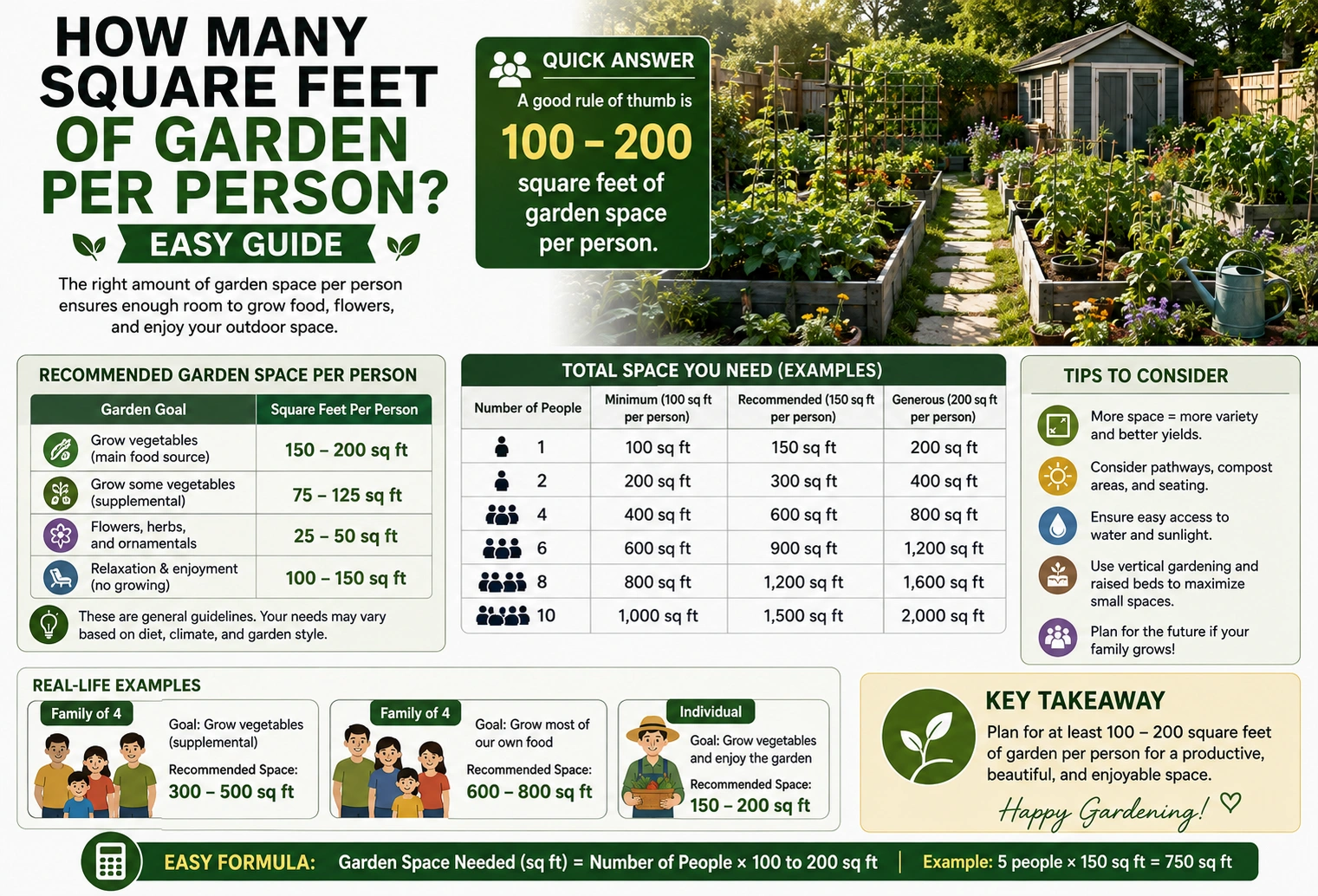
For a general vegetable garden, a useful planning range is about 100–200 square feet of garden space per person if you want a meaningful supply of fresh vegetables.
However, the exact amount depends heavily on what you grow, your climate, planting methods, and whether the garden is meant to provide a few fresh vegetables or a large share of your food.
| Garden Goal | Approx. Space Per Person |
|---|---|
| Small fresh-produce garden | 50–100 sq ft |
| Moderate vegetable garden | 100–200 sq ft |
| Large home food garden | 200–400 sq ft |
| Intensive food production | 400+ sq ft |
For beginners, 100–200 square feet per person is a practical starting point.
For example, a family of four could start with approximately 400–800 square feet of productive garden space.
How Many Square Feet of Garden Per Person?
The answer to how many square feet of garden per person depends on your goal.
If you only want a few fresh vegetables during the growing season, you can garden in a surprisingly small area.
If you want enough vegetables to make up a large part of your household’s diet, you’ll need considerably more space.
A simple starting estimate is:
100–200 square feet per person
For one person:
100–200 sq ft
For two people:
200–400 sq ft
For four people:
400–800 sq ft
For six people:
600–1,200 sq ft
These figures are planning estimates rather than strict rules.
Garden Size Per Person Chart
The following chart provides a quick starting point.
| Number of People | Small Garden | Moderate Garden | Large Garden |
|---|---|---|---|
| 1 | 50–100 sq ft | 100–200 sq ft | 200–400 sq ft |
| 2 | 100–200 sq ft | 200–400 sq ft | 400–800 sq ft |
| 3 | 150–300 sq ft | 300–600 sq ft | 600–1,200 sq ft |
| 4 | 200–400 sq ft | 400–800 sq ft | 800–1,600 sq ft |
| 5 | 250–500 sq ft | 500–1,000 sq ft | 1,000–2,000 sq ft |
| 6 | 300–600 sq ft | 600–1,200 sq ft | 1,200–2,400 sq ft |
The moderate column is a useful starting point for households that want a productive vegetable garden without trying to grow nearly everything they eat.
How Much Garden Space Does One Person Need?
For one person, a 100–200-square-foot garden can provide a useful amount of fresh produce.
For example, a garden measuring:
10 ft × 10 ft = 100 sq ft
provides 100 square feet of growing area.
A larger:
10 ft × 20 ft = 200 sq ft
provides twice as much growing space.
You don’t necessarily need a large traditional garden. Raised beds, containers, trellises, and intensive planting can increase the amount of food produced in a limited area.
What Do You Want Your Garden to Provide?
Before deciding how many square feet you need, define your goal.
Small Fresh-Produce Garden
If you mainly want lettuce, herbs, tomatoes, peppers, and a few other vegetables, 50–100 square feet per person may be enough to create a useful garden.
Moderate Food Garden
If you want a wider range of vegetables throughout the growing season, 100–200 square feet per person is a reasonable starting range.
Large Food Garden
If you want to grow substantial amounts of vegetables for fresh eating, preservation, freezing, or storage, you may need 200–400+ square feet per person.
Food-Self-Sufficiency
Trying to grow most of a person’s annual food supply requires much more than a simple vegetable garden.
You may need additional space for:
- Staple crops
- Fruit
- Herbs
- Storage crops
- Animal feed
- Paths
- Compost
- Pollinator plants
Therefore, there is no single garden size that guarantees complete food self-sufficiency.
Garden Size for a Family of Four
A family of four might start with approximately:
400–800 square feet
of productive vegetable-growing space.
For example:
20 ft × 20 ft = 400 sq ft
or:
20 ft × 40 ft = 800 sq ft
Both could work, depending on the family’s goals and gardening method.
| Family Size | Moderate Garden Range |
|---|---|
| 1 person | 100–200 sq ft |
| 2 people | 200–400 sq ft |
| 3 people | 300–600 sq ft |
| 4 people | 400–800 sq ft |
| 5 people | 500–1,000 sq ft |
| 6 people | 600–1,200 sq ft |
Remember that these figures refer to productive growing space. If you have wide paths, sheds, seating areas, or other non-growing areas, your total garden footprint will be larger.
Space Needed for Different Vegetables
Not all vegetables require the same amount of garden space.
Some plants are compact, while others spread widely.
| Crop | General Space Requirement |
|---|---|
| Radishes | Very low |
| Carrots | Low |
| Lettuce | Low |
| Spinach | Low |
| Onions | Low to moderate |
| Beets | Low to moderate |
| Bush beans | Moderate |
| Peppers | Moderate |
| Tomatoes | Moderate to high |
| Cucumbers | Moderate |
| Zucchini | High |
| Winter squash | Very high |
| Melons | High |
This is one reason a simple “square feet per person” number can only be an estimate.
Growing mostly compact crops allows you to produce more food in less space.
Why Crop Choice Matters
Consider two gardeners with exactly 200 square feet.
The first grows:
- Lettuce
- Radishes
- Carrots
- Spinach
- Herbs
The second grows:
- Corn
- Pumpkins
- Winter squash
- Melons
The two gardens may produce very different amounts of food.
Large spreading plants require more space per plant, while many leafy greens and root vegetables can be grown more densely.
How Much Space Does a Tomato Plant Need?
Tomatoes can require considerably more space than small crops.
Depending on the variety and support system, plants may need roughly 2–4 square feet or more.
Indeterminate tomatoes can become large and benefit from vertical support.
Using cages, stakes, or trellises can help keep plants organized and improve airflow.
Always follow the spacing recommendations for the specific variety you’re growing.
How Much Space Do You Need for Herbs?
Herbs are generally efficient crops for small gardens.
Examples include:
- Basil
- Parsley
- Cilantro
- Chives
- Thyme
- Oregano
- Mint
Because many herbs can be harvested repeatedly, a relatively small area can supply a household with fresh herbs.
Small Garden vs. Large Garden
You don’t need hundreds of square feet to begin gardening.
Small Garden: 50–100 Sq Ft
Pros:
- Easier to manage
- Lower startup cost
- Less watering
- Less weeding
- Good for beginners
Cons:
- Limited crop variety
- Less room for large plants
- Smaller harvests
Moderate Garden: 100–400 Sq Ft
Pros:
- More crop variety
- Larger harvests
- Space for succession planting
- Good balance of effort and production
Cons:
- More maintenance
- More watering
- More planning required
Large Garden: 400+ Sq Ft
Pros:
- High production potential
- More room for storage crops
- Better for preserving food
- More crop variety
Cons:
- More labor
- Greater water needs
- Higher material costs
- More planning
How to Calculate Your Garden Size
If you already know how much space you have, calculating the area is easy.
Use:
Length × Width = Square Feet
For example:
20 ft × 20 ft = 400 sq ft
If your garden is 20 feet long and 20 feet wide, you have 400 square feet of total area.
If only half the space is planted because of paths:
400 × 0.50 = 200 sq ft
Your actual growing area would be approximately 200 square feet.
How Much Garden Space Do You Need for a Family?
A simple planning formula is:
Number of people × desired square feet per person = garden area
For example, if you choose 150 square feet per person:
4 × 150 = 600 square feet
So a family of four would plan for approximately 600 square feet of growing space.
| People | At 100 sq ft/person | At 150 sq ft/person | At 200 sq ft/person |
|---|---|---|---|
| 1 | 100 sq ft | 150 sq ft | 200 sq ft |
| 2 | 200 sq ft | 300 sq ft | 400 sq ft |
| 3 | 300 sq ft | 450 sq ft | 600 sq ft |
| 4 | 400 sq ft | 600 sq ft | 800 sq ft |
| 5 | 500 sq ft | 750 sq ft | 1,000 sq ft |
| 6 | 600 sq ft | 900 sq ft | 1,200 sq ft |
This is a planning tool rather than a guarantee of harvest size.
Ways to Grow More Food in Less Space
If you don’t have much land, you can still produce a surprising amount of food.
Use Raised Beds
Raised beds can make planting, watering, and maintenance easier.
Grow Vertically
Trellises can help crops such as:
- Cucumbers
- Peas
- Pole beans
- Some tomatoes
grow upward instead of spreading across the ground.
Practice Succession Planting
After harvesting one crop, plant another crop in the same space.
For example:
Spring lettuce → summer beans → fall greens
This allows the same square footage to produce multiple harvests.
Choose Compact Varieties
Bush varieties and compact cultivars can be useful when space is limited.
Use Intensive Planting
Some crops can be planted closer together than traditional row-garden spacing, provided their specific growing requirements are met.
Garden Space vs. Total Yard Space
One common mistake is confusing garden area with the entire space required for the garden.
For example, you may have a 600-square-foot garden area, but you may also need room for:
- Walking paths
- Water access
- Compost
- Tool storage
- Fencing
- Garden beds
If your growing beds occupy only 70% of the total garden footprint, you’ll need more overall yard space.
For example:
600 ÷ 0.70 ≈ 857 sq ft
So approximately 857 square feet of total garden footprint may be required to provide 600 square feet of actual growing area.
Common Garden Planning Mistakes
Mistake 1: Assuming One Number Works for Everyone
A 100-square-foot garden may be excellent for one person but too small for another.
Diet, crop selection, climate, and gardening skill all matter.
Mistake 2: Forgetting Paths
Paths take up space but are necessary for access and maintenance.
Mistake 3: Growing Too Many Large Crops
Pumpkins, squash, and melons can take up substantial room.
Mistake 4: Ignoring the Growing Season
A long growing season can allow multiple crops in the same space.
Mistake 5: Planting Everything at Once
Succession planting can increase production without increasing garden size.
Mistake 6: Ignoring Sunlight
A large garden in poor sunlight may produce less than a smaller garden in a well-lit location.
Expert Tips for Planning a Garden Per Person
For the best results:
- Start with a manageable garden.
- Choose vegetables your household actually eats.
- Check crop-specific spacing requirements.
- Use vertical supports when appropriate.
- Plan paths before planting.
- Consider succession planting.
- Keep records of what grows well.
- Increase the garden size gradually each season.
If you’re new to gardening, starting smaller is often better than creating a huge garden that becomes difficult to maintain.
FAQs
1. How many square feet of garden do you need per person?
A useful starting range is 100–200 square feet per person for a productive home vegetable garden. The actual amount depends on crops, climate, gardening methods, and how much food you want to grow.
2. How much garden space does one person need?
For a modest vegetable garden, 100–200 square feet can provide meaningful fresh produce. A smaller garden can work if you grow compact, high-yield crops.
3. How many square feet of garden do I need for a family of four?
A family of four could start with approximately 400–800 square feet of productive growing space. Around 600 square feet is a useful middle-ground estimate.
4. Can 100 square feet feed one person?
A 100-square-foot garden can provide fresh vegetables for one person, but it is unlikely to supply all of that person’s food needs throughout the year. Crop selection and growing conditions make a major difference.
5. How can I grow more food in a small garden?
Use raised beds, vertical trellises, succession planting, compact varieties, and efficient crop spacing. These methods can increase production without requiring a larger garden.
Conclusion
So, how many square feet of garden per person do you need?
For a general home vegetable garden, 100–200 square feet per person is a practical starting range. A family of four could therefore plan for approximately 400–800 square feet of productive growing space.
However, there is no universal number. Your ideal garden size depends on what you grow, how much your household eats, your climate, available sunlight, planting methods, and whether you want a small supply of fresh vegetables or a much larger harvest.
For beginners, starting with 100–200 square feet per person and expanding as you gain experience is often a practical approach.
Discover More Articles
How Many Square Feet in 4×8? Easy Area Calculation Guide