

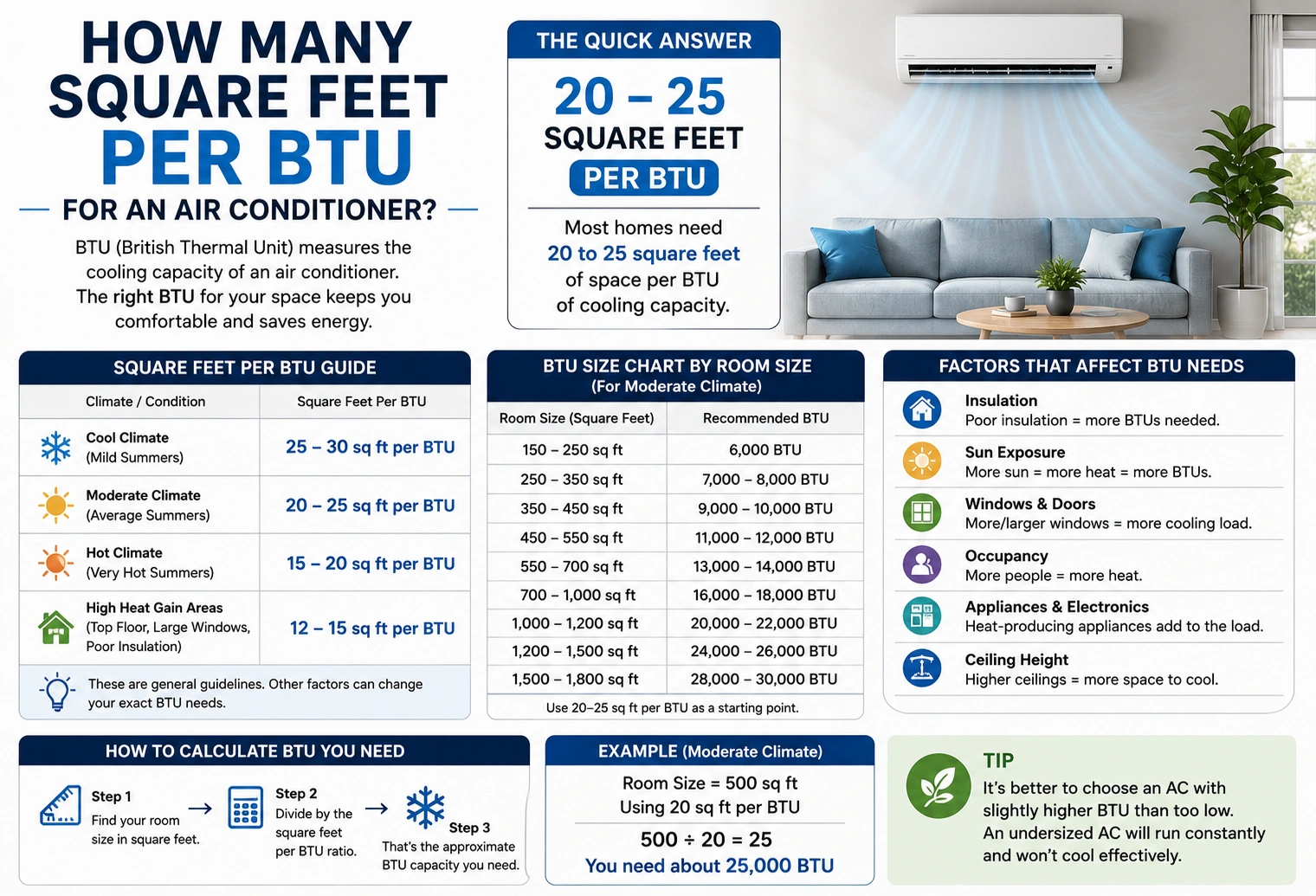
There is no single number of square feet that every BTU of air-conditioning capacity can cool. As a rough starting point, many residential cooling estimates use approximately 20–25 BTUs per square foot.
Using that range, 1 BTU does not directly equal a fixed number of square feet because the required BTU capacity depends on the building and climate.
For example, using 20 BTUs per square foot:
1,000 square feet × 20 = 20,000 BTU
Using 25 BTUs per square foot:
1,000 × 25 = 25,000 BTU
So a 1,000-square-foot space might have a rough cooling estimate of 20,000–25,000 BTU/hour before other factors are considered.
Quick Answer
A rough residential estimate is around 20–25 BTUs per square foot.
That means approximately:
| AC Capacity | Rough Coverage at 20 BTU/sq ft | Rough Coverage at 25 BTU/sq ft |
|---|---|---|
| 6,000 BTU | 300 sq ft | 240 sq ft |
| 9,000 BTU | 450 sq ft | 360 sq ft |
| 12,000 BTU | 600 sq ft | 480 sq ft |
| 18,000 BTU | 900 sq ft | 720 sq ft |
| 24,000 BTU | 1,200 sq ft | 960 sq ft |
| 30,000 BTU | 1,500 sq ft | 1,200 sq ft |
| 36,000 BTU | 1,800 sq ft | 1,440 sq ft |
| 48,000 BTU | 2,400 sq ft | 1,920 sq ft |
| 60,000 BTU | 3,000 sq ft | 2,400 sq ft |
These are rough estimating figures, not guaranteed coverage ratings. Actual AC requirements can vary substantially.
How Do You Calculate BTUs per Square Foot?
The basic estimating formula is:
Required BTUs = Room or Home Square Feet × BTUs per Square Foot
For example, suppose you have a 1,500-square-foot space and use 20 BTUs per square foot:
1,500 × 20 = 30,000 BTU
At 25 BTUs per square foot:
1,500 × 25 = 37,500 BTU
The estimated range would therefore be approximately 30,000–37,500 BTU/hour.
However, this simple calculation does not account for factors such as climate, insulation, windows, ceiling height, occupancy, or sunlight.
How Many Square Feet Does a 12,000 BTU AC Cool?
A 12,000 BTU air conditioner may roughly cover 480–600 square feet when using a 20–25 BTU-per-square-foot estimate.
The calculations are:
12,000 ÷ 20 = 600 square feet
12,000 ÷ 25 = 480 square feet
Therefore, a rough planning range is 480–600 square feet.
Actual performance can be different depending on the room and local conditions.
How Many Square Feet Does an 18,000 BTU AC Cool?
Using the same rough estimate:
18,000 ÷ 20 = 900 square feet
18,000 ÷ 25 = 720 square feet
An 18,000 BTU air conditioner could therefore be estimated at approximately 720–900 square feet.
How Many Square Feet Does a 24,000 BTU AC Cool?
For a 24,000 BTU air conditioner:
24,000 ÷ 20 = 1,200 square feet
24,000 ÷ 25 = 960 square feet
This gives a rough range of approximately 960–1,200 square feet.
How Many Square Feet Does a 36,000 BTU AC Cool?
A 36,000 BTU system gives:
36,000 ÷ 20 = 1,800 square feet
36,000 ÷ 25 = 1,440 square feet
So a rough estimate is 1,440–1,800 square feet.
A 36,000 BTU system is also commonly described as a 3-ton air conditioner, because one ton of cooling equals 12,000 BTU/hour.
What Factors Change How Many Square Feet an AC Can Cool?
Square footage is only one part of AC sizing. Two homes with exactly the same floor area may need different cooling capacities.
Important factors include:
Climate: Hotter outdoor temperatures generally increase cooling requirements.
Insulation: Well-insulated walls and ceilings reduce heat entering the building.
Windows: Large or poorly insulated windows can add substantial solar heat.
Ceiling height: Higher ceilings increase the volume of air and can affect cooling requirements.
Sun exposure: Rooms receiving strong direct sunlight may need more cooling.
Occupancy: People generate heat, so heavily occupied spaces may require additional capacity.
Appliances and electronics: Lighting, cooking equipment, computers, televisions, and other devices can add internal heat.
Air leakage: Gaps around doors, windows, and other parts of the building envelope can increase the cooling load.
Because of these variables, BTU-per-square-foot rules should be treated as preliminary estimates.
Does Climate Change the BTUs Needed per Square Foot?
Yes.
A building in a mild climate may require less cooling capacity than a similar building in a very hot climate.
For example, two rooms with the same 500-square-foot area could have different AC requirements if one has excellent insulation and limited sun exposure while the other has poor insulation and large windows facing direct sunlight.
This is why local climate and the home’s construction characteristics should be considered before purchasing an AC.
Does a Small Room Need the Same BTUs per Square Foot?
Not necessarily.
A small room with significant sun exposure, poor insulation, or several heat-producing appliances can have a higher cooling requirement per square foot than a shaded, well-insulated room.
Similarly, an interior room with little heat gain may require less cooling.
The BTU-per-square-foot figure is therefore best viewed as a starting point, not an exact rule.
What Happens If an Air Conditioner Is Too Small?
An undersized air conditioner may run for long periods without reaching the desired temperature.
Possible problems include:
- Difficulty maintaining the thermostat setting
- Longer operating cycles
- Reduced comfort
- Higher energy consumption
- Poor performance during very hot weather
- Inadequate humidity control in some conditions
The system may simply not have enough capacity to remove heat as quickly as it enters the space.
What Happens If an Air Conditioner Is Too Large?
A larger AC is not always better.
An oversized system can cool the air quickly but cycle off before running long enough to adequately remove humidity.
Potential problems include:
- Short cycling
- Uneven temperatures
- Poor humidity control
- Increased wear
- Reduced comfort
Proper sizing helps the system operate for appropriate cycles rather than simply maximizing BTU capacity.
Common AC BTU and Square-Footage Estimates
| Air Conditioner Size | Approx. Tonnage | Rough Coverage Range* |
| 6,000 BTU | 0.5 ton | 240–300 sq ft |
| 9,000 BTU | 0.75 ton | 360–450 sq ft |
| 12,000 BTU | 1 ton | 480–600 sq ft |
| 18,000 BTU | 1.5 tons | 720–900 sq ft |
| 24,000 BTU | 2 tons | 960–1,200 sq ft |
| 30,000 BTU | 2.5 tons | 1,200–1,500 sq ft |
| 36,000 BTU | 3 tons | 1,440–1,800 sq ft |
| 48,000 BTU | 4 tons | 1,920–2,400 sq ft |
| 60,000 BTU | 5 tons | 2,400–3,000 sq ft |
*Ranges use a rough 20–25 BTU-per-square-foot estimate and are intended for preliminary planning only.
How Many BTUs Do I Need for My Room?
First, measure the room’s length and width.
For a rectangular room:
Square Feet = Length × Width
Then multiply the square footage by a preliminary BTU-per-square-foot estimate.
For example, a room measuring 15 × 20 feet has:
15 × 20 = 300 square feet
Using 20–25 BTUs per square foot:
300 × 20 = 6,000 BTU
300 × 25 = 7,500 BTU
A rough estimate would therefore be 6,000–7,500 BTU/hour.
The actual AC size should account for the room’s climate, insulation, windows, ceiling height, and other heat sources.
Frequently Asked Questions
How many square feet does 1 BTU cool?
There is no fixed coverage amount for 1 BTU. A rough residential estimate of 20–25 BTUs per square foot means approximately 1 BTU per 0.04–0.05 square feet, but actual cooling requirements vary.
How many BTUs per square foot should I use for AC?
A common rough estimate is approximately 20–25 BTUs per square foot, although climate and building characteristics can change the requirement.
How many square feet does a 12,000 BTU AC cool?
Using the rough 20–25 BTU-per-square-foot range, a 12,000 BTU AC corresponds to approximately 480–600 square feet.
How many square feet does a 24,000 BTU AC cool?
A 24,000 BTU AC corresponds to approximately 960–1,200 square feet using the same rough estimate.
How many square feet does a 36,000 BTU AC cool?
A 36,000 BTU AC corresponds to approximately 1,440–1,800 square feet using a 20–25 BTU-per-square-foot estimate.
Does one ton of AC equal 12,000 BTUs?
Yes. One ton of cooling capacity is generally equivalent to 12,000 BTU/hour.
Is 20 BTUs per square foot enough?
It can be a reasonable starting estimate for some spaces, but the appropriate number depends on climate, insulation, windows, ceiling height, and heat gain.
Is 25 BTUs per square foot too much?
Not necessarily. It can be useful as a higher-end preliminary estimate, particularly when conditions create greater cooling demand. It should not be treated as a universal sizing rule.
Can I size an AC using square footage alone?
Square footage can provide a rough estimate, but it is not enough for precise HVAC sizing. A proper cooling-load calculation provides a more reliable result.
Conclusion
If you’re wondering how many square feet per BTU an air conditioner can cool, a useful starting point is approximately 20–25 BTUs per square foot for many residential applications.
For example, a 12,000 BTU air conditioner corresponds roughly to 480–600 square feet, while a 24,000 BTU system corresponds to approximately 960–1,200 square feet under this estimating method.
However, these numbers are only guidelines. Climate, insulation, windows, ceiling height, sunlight, occupancy, appliances, and air leakage can all change the actual cooling requirement.
For the most accurate AC size, use a proper HVAC cooling-load calculation rather than relying on square footage alone.
Discover More Articles
How Many Square Feet in 4×8? Easy Area Calculation Guide