

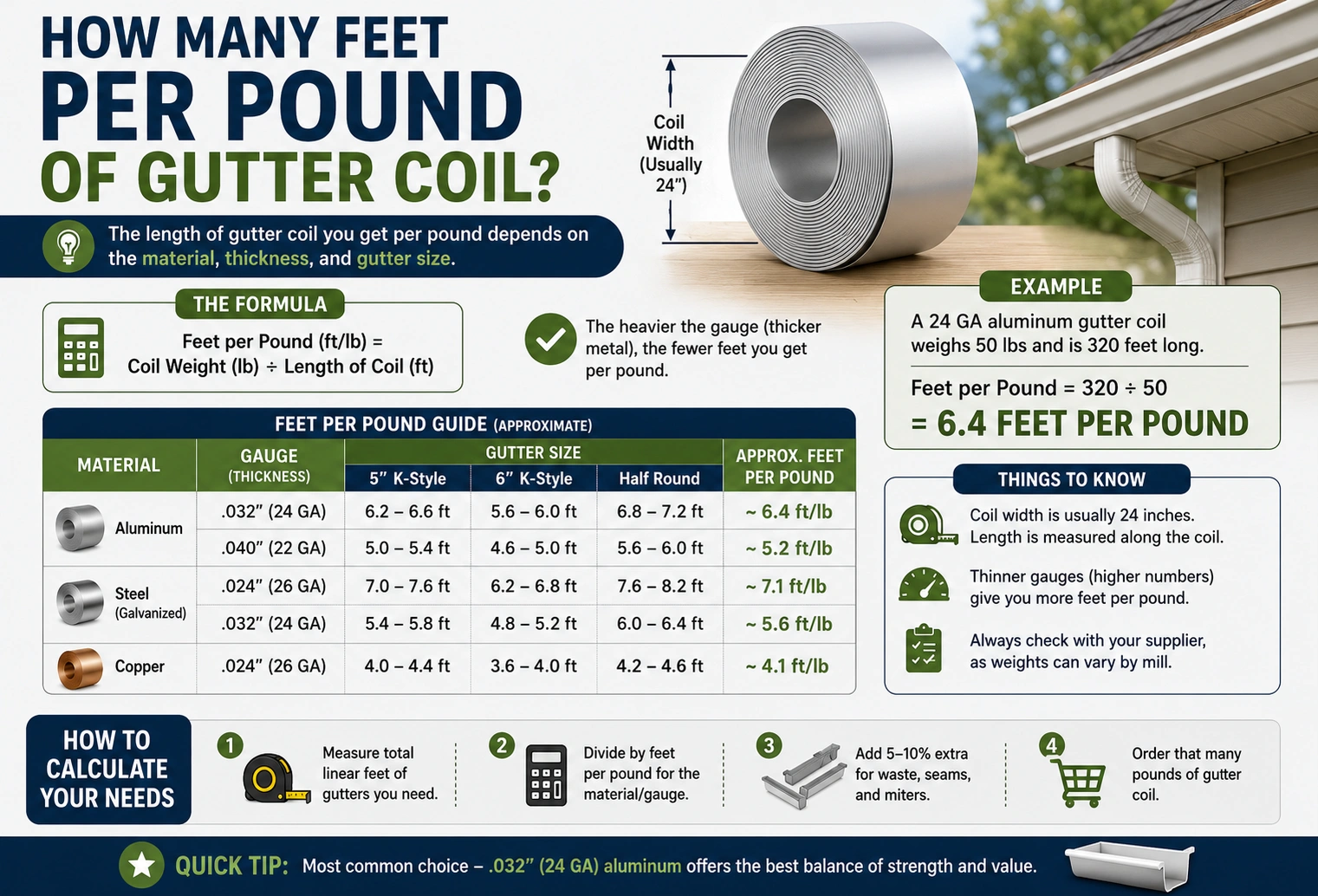
The amount of gutter coil you get per pound depends mainly on the metal type, coil thickness, and coil width.
For standard aluminum gutter coil, a useful estimate is often around 2–3 linear feet per pound, depending on the coil’s thickness and width.
For example, a common 11- to 12-inch-wide aluminum gutter coil can provide approximately:
2.3–3 feet per pound
when using typical gutter-coil thicknesses.
However, there is no single universal feet-per-pound number. A thicker or wider coil weighs more per linear foot, so it provides fewer feet per pound.
Quick Answer
For many standard aluminum gutter-coil products, you can use approximately 2–3 linear feet per pound as a rough estimating range.
| Gutter Coil Thickness | Approx. Feet per Pound* |
|---|---|
| 0.027 in | About 3 ft/lb |
| 0.032 in | About 2.5 ft/lb |
| 0.035 in | About 2.3 ft/lb |
| 0.040 in | About 2 ft/lb |
*Approximate values for common gutter-coil widths. Actual footage varies by material, width, thickness, alloy, and manufacturer.
Why Does Gutter Coil Have Different Feet per Pound?
The amount of linear footage in a pound changes because the weight per foot changes.
A thicker coil contains more metal in the same length and therefore weighs more.
For example, if one coil weighs 0.4 pounds per foot:
1 ÷ 0.4 = 2.5 feet per pound
If another coil weighs 0.33 pounds per foot:
1 ÷ 0.33 ≈ 3.03 feet per pound
The lighter material gives you more linear feet for every pound.
How Do You Calculate Feet per Pound of Gutter Coil?
If you know the weight per linear foot, the calculation is simple:
Feet per Pound = 1 ÷ Pounds per Foot
For example, if a gutter coil weighs 0.4 pounds per foot:
1 ÷ 0.4 = 2.5 feet per pound
So you get approximately 2.5 linear feet per pound.
If a coil weighs 0.5 pounds per foot:
1 ÷ 0.5 = 2 feet per pound
The heavier material provides fewer feet per pound.
How Does Gutter Coil Thickness Affect Feet per Pound?
Thickness has a major effect on the weight of aluminum gutter coil.
As thickness increases, the same length of coil contains more metal and becomes heavier.
For example, a 0.040-inch coil will generally weigh more per foot than a 0.027-inch coil of the same width.
That means:
Thicker coil = fewer feet per pound
while:
Thinner coil = more feet per pound
This is why you should always consider the coil’s thickness when estimating footage from its weight.
Gutter Coil Thickness and Estimated Feet per Pound
| Coil Thickness | Relative Weight | Approx. Feet per Pound |
| 0.027 in | Lighter | ~3 ft/lb |
| 0.030 in | Light-medium | ~2.7 ft/lb |
| 0.032 in | Medium | ~2.5 ft/lb |
| 0.035 in | Heavier | ~2.3 ft/lb |
| 0.040 in | Heavy | ~2 ft/lb |
These numbers are general estimates rather than specifications for a particular brand.
Does Gutter Coil Width Affect Feet per Pound?
Yes.
Width is another important factor.
A wider coil contains more material per linear foot than a narrower coil of the same thickness. Therefore, the wider coil weighs more per foot.
For example, if two coils have the same thickness but one is 12 inches wide and the other is 15 inches wide, the 15-inch coil will generally have fewer linear feet per pound.
The relationship is:
Wider coil = more weight per foot = fewer feet per pound
What Is a Common Gutter Coil Width?
Gutter coil is commonly supplied in widths appropriate for forming residential gutters and related components. Widths can vary depending on the gutter profile and manufacturer.
The width is important when calculating material weight because a wider strip contains more aluminum per foot.
When purchasing coil, check the product specification for:
- Width
- Thickness
- Alloy
- Weight
- Coil length
- Coil weight
These details provide a more accurate estimate than using a generic feet-per-pound figure.
How Many Feet Are in a 10-Pound Roll of Gutter Coil?
The answer depends on the coil’s feet-per-pound rating.
For example, if the coil provides 2.5 feet per pound:
10 × 2.5 = 25 feet
So a 10-pound coil would contain approximately 25 linear feet.
If the coil provides 3 feet per pound:
10 × 3 = 30 feet
Therefore, the same 10-pound weight could contain approximately 25–30 feet depending on the material specifications.
How Many Feet Are in a 20-Pound Roll of Gutter Coil?
Using a 2.5-foot-per-pound estimate:
20 × 2.5 = 50 feet
So a 20-pound roll would contain approximately 50 linear feet.
Using 3 feet per pound:
20 × 3 = 60 feet
This illustrates why the actual coil specification matters.
How Many Feet Are in a 50-Pound Roll of Gutter Coil?
At 2.5 feet per pound:
50 × 2.5 = 125 feet
At 3 feet per pound:
50 × 3 = 150 feet
Therefore, a 50-pound coil could contain approximately 125–150 linear feet under these example assumptions.
Gutter Coil Weight-to-Footage Examples
| Coil Weight | At 2 ft/lb | At 2.5 ft/lb | At 3 ft/lb |
| 10 lb | 20 ft | 25 ft | 30 ft |
| 20 lb | 40 ft | 50 ft | 60 ft |
| 30 lb | 60 ft | 75 ft | 90 ft |
| 40 lb | 80 ft | 100 ft | 120 ft |
| 50 lb | 100 ft | 125 ft | 150 ft |
| 60 lb | 120 ft | 150 ft | 180 ft |
| 100 lb | 200 ft | 250 ft | 300 ft |
These are mathematical examples showing how footage changes based on the feet-per-pound value.
How Do You Calculate the Weight of Gutter Coil?
If you know the footage and pounds per foot, use:
Weight = Linear Feet × Pounds per Foot
For example, if you have 100 feet of coil that weighs 0.4 pounds per foot:
100 × 0.4 = 40 pounds
So the material would weigh approximately 40 pounds.
You can also reverse the calculation:
Pounds per Foot = Total Weight ÷ Total Feet
If a coil weighs 40 pounds and contains 100 feet:
40 ÷ 100 = 0.4 pounds per foot
Then:
1 ÷ 0.4 = 2.5 feet per pound
Why Aluminum Gutter Coil Is Often Sold by Weight
Aluminum coil is commonly supplied in rolls and may be described by its total weight.
Weight provides a convenient way to identify the amount of metal in a coil, while the actual footage depends on the coil’s width and thickness.
Two coils that weigh the same can have different lengths if they have different thicknesses or widths.
For this reason, contractors should not assume that every pound of gutter coil equals the same number of linear feet.
How Much Gutter Coil Do You Need?
To estimate the amount of coil required for a gutter project, first determine the total linear footage of gutters needed.
Then compare that footage with the manufacturer’s stated coil length.
For example, suppose a project requires 200 linear feet of gutter and your coil provides 2.5 feet per pound.
The estimated weight is:
200 ÷ 2.5 = 80 pounds
You would need approximately 80 pounds of material, before accounting for cutting waste and other manufacturing considerations.
If the coil provides 3 feet per pound:
200 ÷ 3 ≈ 66.7 pounds
The difference can be significant, which is why accurate product specifications are important.
Does Waste Affect Gutter Coil Requirements?
Yes.
Gutter installation and forming can produce some material waste because of:
- Cuts
- Seams
- Corners
- End pieces
- Downspout openings
- Damaged sections
- Installation errors
- Custom lengths
The amount of waste depends on the project and how efficiently the installer can use the coil.
For a basic estimate, you may want to include a small additional allowance rather than purchasing exactly the calculated amount.
Frequently Asked Questions
How many feet of gutter coil are in one pound?
For many standard aluminum gutter coils, a rough estimate is about 2–3 linear feet per pound, depending on thickness and width.
How many feet per pound is 0.027 aluminum gutter coil?
A common 0.027-inch aluminum gutter coil may provide approximately 3 feet per pound, depending on its width and exact material specifications.
How many feet per pound is 0.032 aluminum gutter coil?
A 0.032-inch aluminum gutter coil may provide approximately 2.5 feet per pound, although the exact amount depends on width and manufacturer.
How many feet per pound is 0.040 aluminum gutter coil?
A 0.040-inch coil may provide approximately 2 feet per pound for common gutter-coil widths.
How many feet are in a 50-pound roll of gutter coil?
Depending on the product, a 50-pound roll could contain approximately 100–150 feet when using a 2–3 feet-per-pound range.
Does thicker gutter coil weigh more?
Yes. If width remains the same, thicker coil generally weighs more per linear foot and therefore provides fewer feet per pound.
Does wider gutter coil weigh more?
Yes. A wider strip contains more metal per linear foot, so it generally weighs more and provides fewer feet per pound.
How do I get the exact feet per pound?
Use the manufacturer’s stated coil weight and length. Calculate:
Feet per Pound = Total Feet ÷ Total Pounds
This gives a product-specific value.
Is 2.5 feet per pound a good estimate?
It can be a useful rough estimate for certain common aluminum gutter coils, but it should not replace the manufacturer’s specifications.
Conclusion
So, how many feet per pound of gutter coil are there? For many common aluminum gutter coils, a reasonable preliminary estimate is approximately 2–3 linear feet per pound.
The exact amount depends on the coil thickness, width, material, and manufacturer. Thicker and wider coil weighs more per linear foot, so it provides fewer feet per pound.
For accurate estimating, use the manufacturer’s listed weight and footage whenever available.
The basic formulas are:
Feet per Pound = Total Feet ÷ Total Pounds
and:
Total Feet = Pounds × Feet per Pound
For example, at 2.5 feet per pound, a 50-pound coil would provide approximately 125 linear feet of material.
Discover More Articles
How Many Square Feet per BTU for an Air Conditioner?