

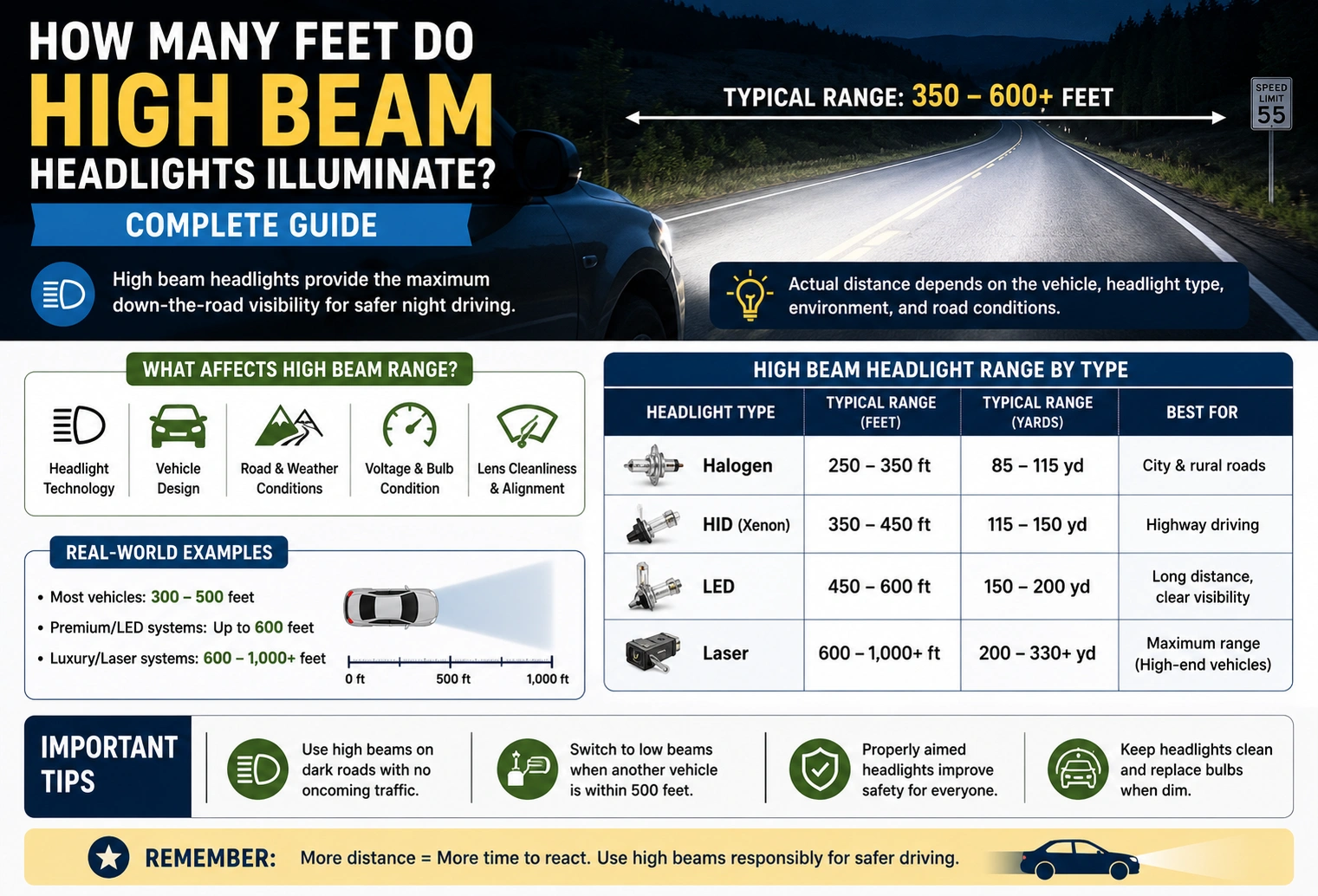
High beam headlights typically illuminate the road much farther ahead than low beams, often around 300–500 feet depending on the vehicle, headlight system, road conditions, and regulations.
A commonly used benchmark for conventional headlights is roughly 350–500 feet of forward visibility with high beams, while low beams generally provide a shorter range.
The exact distance is not the same for every vehicle.
| Headlight Setting | Typical Approximate Range |
|---|---|
| Low beams | About 100–200 ft |
| High beams | About 300–500 ft |
| Advanced lighting systems | Can vary significantly |
These are general ranges, not guaranteed distances. Weather, road shape, headlight design, vehicle height, and visibility conditions can all change how far you can actually see.
How Many Feet Do High Beam Headlights Illuminate?
If you’re asking how many feet do high beam headlights illuminate, a useful general estimate is about 300 to 500 feet ahead.
High beams are designed to project light farther down the road than normal low beams.
This extra illumination can help drivers identify:
- Road curves
- Pedestrians
- Animals
- Obstacles
- Road signs
- Other vehicles
- Changes in road conditions
However, illumination distance is not the same thing as guaranteed stopping distance. Seeing an object farther away does not automatically mean the vehicle can safely stop before reaching it.
How Far Do High Beam Headlights Illuminate?
The actual distance varies by vehicle.
Some headlights may provide useful illumination beyond 500 feet, while others may have a shorter effective range.
Factors include:
- Headlight technology
- Beam pattern
- Bulb condition
- Headlight alignment
- Vehicle design
- Road elevation
- Weather
- Road surface
- Ambient light
For this reason, 300–500 feet is best treated as a general reference range rather than a fixed specification.
High Beams vs. Low Beams
High beams and low beams are designed for different driving situations.
Low beams point more toward the road immediately ahead and reduce glare for other road users.
High beams project light farther down the road when there is no nearby traffic that could be dazzled.
| Feature | Low Beams | High Beams |
|---|---|---|
| Typical range | ~100–200 ft | ~300–500 ft |
| Main purpose | Normal nighttime driving | Dark roads with little traffic |
| Beam direction | Lower and closer | Higher and farther |
| Visibility | Shorter | Longer |
| Glare risk | Lower | Higher |
| Use around traffic | Generally appropriate | Often inappropriate |
The actual ranges depend on the vehicle and lighting system.
Why High Beams Illuminate Farther
High beams use a different beam pattern from low beams.
Instead of concentrating most of the light close to the vehicle, high beams project more light farther down the road.
This creates a longer illuminated area.
For example, imagine driving on a dark rural road.
With low beams, you may see the roadway primarily in the area immediately ahead.
With high beams, the beam can extend much farther forward, giving you more time to identify distant objects.
However, the additional range is only helpful when the road is clear of other vehicles.
How Much More Road Can You See?
Suppose a vehicle’s low beams provide useful illumination for approximately 150 feet and its high beams provide approximately 400 feet.
The difference is:
400 − 150 = 250 feet
So the high beams could provide roughly 250 additional feet of illuminated distance under those conditions.
| Example | Distance |
|---|---|
| Low-beam range | 150 ft |
| High-beam range | 400 ft |
| Additional distance | 250 ft |
This is an example, not a universal measurement.
Actual performance varies between vehicles.
High Beam Visibility at Different Speeds
Headlight range becomes particularly important as driving speed increases.
The faster you travel, the less time you have to react to an object at a given distance.
For example, suppose your headlights allow you to identify an obstacle 400 feet ahead.
At a higher speed, that 400-foot distance disappears more quickly than it would at a lower speed.
This is why nighttime driving requires a speed appropriate for:
- Visibility
- Road conditions
- Traffic
- Weather
- Your stopping ability
You should never assume that having high beams means you can safely drive at any speed.
High Beams and Stopping Distance
Headlight illumination and stopping distance are related but different concepts.
Illumination distance tells you how far ahead your headlights light up the road.
Stopping distance is how far your vehicle travels before coming to a complete stop after you recognize a hazard and react.
Stopping distance depends on:
- Vehicle speed
- Driver reaction time
- Road surface
- Tire condition
- Braking system
- Weather
- Vehicle load
For example, wet pavement can increase braking distance.
Therefore, even if your high beams illuminate an object hundreds of feet away, you still need enough distance to recognize the hazard and stop safely.
When Should You Use High Beams?
High beams are generally most useful on dark roads with little or no nearby traffic.
They can be particularly helpful on:
- Rural roads
- Unlit highways
- Open country roads
- Dark residential roads
- Roads with limited street lighting
They can help you identify hazards that are farther ahead than your low beams would clearly illuminate.
Always follow the laws applicable where you are driving.
When Should You Turn High Beams Off?
High beams can create dangerous glare for other drivers.
You should generally switch to low beams when:
- An approaching vehicle is close enough to be affected by glare.
- You are following another vehicle closely.
- Road conditions require lower lighting.
- Local law requires low beams.
The exact distance at which high beams must be dimmed varies by jurisdiction.
If another driver’s high beams are shining directly into your eyes, avoid staring at the headlights. Focus on the road ahead and reduce your speed if visibility is affected.
Why High-Beam Glare Is Dangerous
High beams are intentionally bright and aimed to illuminate farther away.
That same brightness can temporarily reduce another driver’s ability to see.
Glare can make it harder to identify:
- Lane markings
- Pedestrians
- Road edges
- Vehicles
- Obstacles
This is especially important on dark roads because the contrast between bright headlights and the surrounding darkness can be significant.
What Determines Headlight Illumination Distance?
1. Headlight Technology
Halogen, HID, LED, and newer adaptive lighting systems can have different beam patterns and performance.
2. Headlight Alignment
Incorrectly aimed headlights may illuminate too close, too far, or in the wrong direction.
3. Lens Condition
Cloudy, yellowed, scratched, or damaged headlight lenses can reduce useful light output.
4. Weather
Rain, fog, snow, and dust can scatter light and reduce visibility.
5. Road Design
A straight road makes it easier to use the full forward beam.
Curves, hills, and dips can greatly reduce the distance you can see.
6. Vehicle Height
The height of the headlights can affect the way the beam reaches the road.
7. Road Surface
Dark pavement, wet pavement, and reflective road markings can change how the illuminated area appears.
Headlight Range in Different Conditions
The same headlights can perform very differently depending on the environment.
| Driving Condition | Expected Visibility |
|---|---|
| Clear, dark rural road | Best |
| Clear road with streetlights | Moderate |
| Rain | Reduced |
| Fog | Significantly reduced |
| Heavy snow | Reduced |
| Sharp curves | Reduced |
| Hills and dips | Reduced |
| Dirty/cloudy lenses | Reduced |
This is why the number of feet a headlight “illuminates” should never be treated as an exact real-world visibility guarantee.
How to Improve Headlight Visibility
If your headlights do not seem to illuminate the road properly, check the following:
Clean the Headlight Lenses
Dirt and oxidation can reduce light output.
Check Headlight Alignment
Misaligned headlights can point too low or too high.
Replace Damaged Bulbs
A weak or failing bulb can reduce visibility.
Keep the Windshield Clean
A dirty windshield can increase glare and reduce nighttime visibility.
Reduce Speed When Visibility Is Poor
Good headlights cannot eliminate hazards caused by fog, heavy rain, or other conditions.
Common Headlight Mistakes
Mistake 1: Using High Beams Around Other Drivers
High beams can cause glare and reduce the other driver’s ability to see.
Mistake 2: Assuming High Beams Make You Invincible
High beams improve forward illumination but do not eliminate stopping-distance limitations.
Mistake 3: Driving Too Fast for Visibility
Your speed should match the road and visibility conditions.
Mistake 4: Ignoring Headlight Alignment
Misaligned headlights can significantly affect how the beam reaches the road.
Mistake 5: Using High Beams in Fog
Bright light can reflect off fog particles and make visibility worse.
High Beam Headlights: Quick Comparison
| Factor | Low Beam | High Beam |
|---|---|---|
| Approx. illumination | 100–200 ft | 300–500 ft |
| Best for | Normal traffic | Dark, open roads |
| Glare potential | Lower | Higher |
| Forward reach | Shorter | Longer |
| Use around approaching vehicles | Yes | Usually switch off |
| Best in dense fog | Usually preferred | Can create glare |
These ranges are general estimates and can vary substantially by vehicle and conditions.
FAQs
1. How many feet do high beam headlights illuminate?
High beams commonly provide useful illumination at roughly 300–500 feet ahead, although the actual distance varies by vehicle, headlight technology, alignment, weather, and road conditions.
2. How far do low beam headlights illuminate?
Low beams commonly provide useful illumination for approximately 100–200 feet, although actual performance varies.
3. Do high beams help you see farther at night?
Yes. High beams are designed to project light farther down a dark road than low beams, helping drivers identify distant hazards when conditions allow their safe use.
4. How far away should you turn off high beams?
The required distance varies by local traffic law. In general, switch to low beams early enough to avoid creating glare for approaching or nearby drivers.
5. Can high beams be used in fog?
High beams are generally not ideal in dense fog because bright light can reflect off water droplets and create additional glare. Low beams are typically more suitable.
Conclusion
So, how many feet do high beam headlights illuminate? A useful general estimate is approximately 300–500 feet ahead, although actual headlight range depends on the vehicle and driving conditions.
High beams provide a longer forward beam than low beams and can be valuable on dark, unlit roads. However, rain, fog, curves, hills, dirty lenses, and headlight alignment can reduce effective visibility.
Most importantly, high beams should be used responsibly. They can help you see farther, but they should be switched to low beams when they could create glare for other drivers. Your driving speed should also remain appropriate for the distance you can safely see and stop within.
Discover More Articles
How Many Square Feet per BTU for an Air Conditioner?