
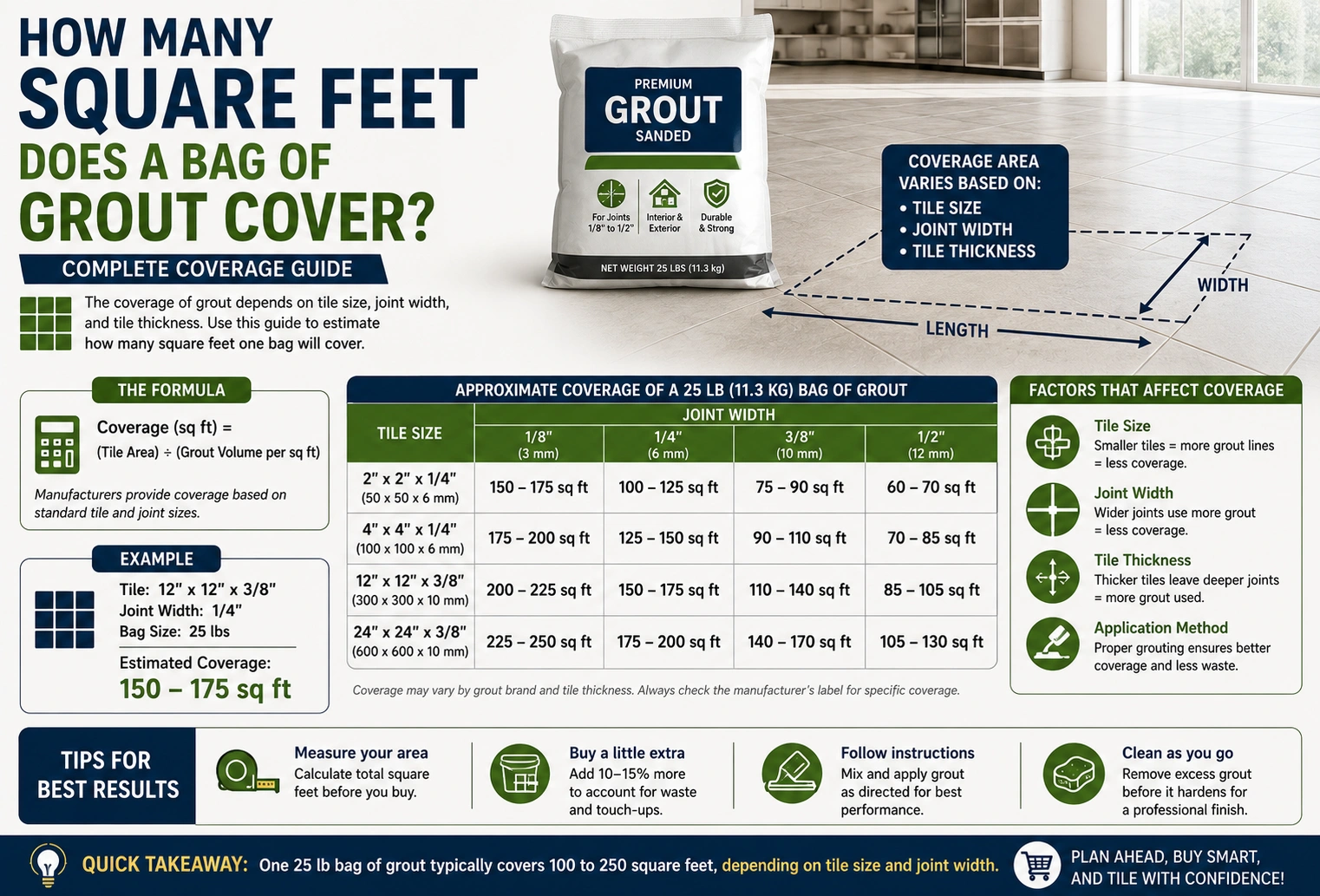
A bag of grout can cover anywhere from about 20 to more than 1,000 square feet, depending on the bag size, tile dimensions, grout-joint width, grout depth, and product type.
There is no single coverage rate for every bag of grout.
A larger tile with narrow grout joints requires much less grout than small tiles with wide joints because grout fills the spaces between the tiles.
For example, a 25-pound bag of grout may cover several hundred square feet with large-format tile and narrow joints, but significantly less with small tiles and wide joints.
Quick Answer
As a rough planning range, a typical 25-pound bag of grout may cover approximately 50–500+ square feet, depending heavily on tile and joint dimensions.
| Grout Bag Size | Rough Coverage Range* |
|---|---|
| 5 lb | 10–100+ sq ft |
| 10 lb | 20–200+ sq ft |
| 25 lb | 50–500+ sq ft |
| 50 lb | 100–1,000+ sq ft |
*These are broad estimates. Actual coverage can vary dramatically based on tile size, joint width, joint depth, grout density, and manufacturer specifications.
What Determines How Much Area a Bag of Grout Covers?
The most important factors are:
- Tile size
- Grout-joint width
- Grout-joint depth
- Bag size
- Grout density
- Tile layout
- Product type
- Installation technique
The amount of grout required is determined by the total volume of grout joints rather than the total tile area alone.
This means two projects with exactly 100 square feet of tile can require very different amounts of grout.
Does Tile Size Affect Grout Coverage?
Yes.
Large-format tiles usually have fewer linear feet of grout joints per square foot than small tiles.
For example, 24 × 24-inch tiles have much fewer joints than 2 × 2-inch mosaic tiles covering the same floor area.
That means large tiles generally require less grout when the joint width and depth are similar.
Tile Size and Grout Requirements
| Tile Size | Typical Effect on Grout Use |
| 2 × 2 in | Very high grout usage |
| 4 × 4 in | High grout usage |
| 6 × 6 in | Moderate-high |
| 12 × 12 in | Moderate |
| 12 × 24 in | Lower |
| 24 × 24 in | Low |
| Large-format tile | Generally lower |
These are relative comparisons. The actual grout requirement also depends on joint width and depth.
Does Grout Joint Width Affect Coverage?
Yes, and it can make a major difference.
A wider grout joint requires more material because the joint contains more grout.
For example, a 1/8-inch joint generally requires less grout than a 1/4-inch joint using the same tile size and depth.
The relationship is straightforward:
Wider joint = more grout required
Narrower joint = less grout required
This is one reason manufacturer coverage charts are useful when estimating material.
Does Grout Depth Affect Coverage?
Yes.
A deeper joint contains more grout.
If the grout joint is deeper, more material is required to fill it.
However, the actual installation depth depends on the tile thickness, substrate, joint configuration, and manufacturer’s instructions.
Grout should be installed according to the product instructions rather than simply filling every available space to an arbitrary depth.
How Many Square Feet Does a 25-Pound Bag of Grout Cover?
A 25-pound bag can cover a wide range of areas.
For large tiles with narrow joints, it may cover several hundred square feet.
For small tiles with wide joints, the same bag may cover substantially less.
For example, a product might cover around 200 square feet in one application but much more or less in another.
Therefore, the best answer is not simply “25 pounds equals a specific number of square feet.”
Instead, check the manufacturer’s coverage chart for your exact:
- Tile dimensions
- Joint width
- Joint depth
- Grout type
How Many Square Feet Does a 10-Pound Bag of Grout Cover?
A 10-pound bag generally covers less area than a 25-pound bag.
As a broad estimate, it might cover approximately 20–200+ square feet, depending on the tile installation.
For example, large tiles with very narrow joints can produce high coverage, while mosaics with wide joints can produce much lower coverage.
How Many Square Feet Does a 5-Pound Bag of Grout Cover?
A 5-pound bag may cover approximately 10–100+ square feet, depending on the installation.
Small tiles and wide joints can use grout quickly, while large tiles and narrow joints can dramatically increase coverage.
For small repair projects, a 5-pound package may be convenient because you may not need a full-size bag.
How Much Grout Do I Need for 100 Square Feet?
The amount required for 100 square feet depends on the tile dimensions and grout joints.
For example, 100 square feet of 12 × 24-inch tile with narrow joints can require much less grout than 100 square feet of small mosaic tile.
A useful way to estimate the quantity is to use the manufacturer’s coverage chart.
If a 25-pound bag is rated to cover 250 square feet for your particular tile and joint size:
100 ÷ 250 = 0.4 bag
Since grout is normally purchased in whole packages, you would need 1 bag.
If the same bag covers only 80 square feet:
100 ÷ 80 = 1.25 bags
You would need 2 bags.
Grout Coverage by Common Tile Sizes
The following table illustrates how tile size affects grout consumption. It is a general comparison rather than a manufacturer-specific coverage chart.
| Tile Size | Grout Usage at Similar Joint Conditions |
| 2 × 2 in | Very high |
| 4 × 4 in | High |
| 6 × 6 in | Moderate-high |
| 12 × 12 in | Moderate |
| 12 × 24 in | Low-moderate |
| 24 × 24 in | Low |
The smaller the tile, the more grout-joint length is typically present per square foot.
How Do You Calculate Grout Coverage?
A simplified grout-volume calculation can be based on the joint dimensions and total joint length.
For a basic estimate:
Grout Volume ≈ Total Joint Length × Joint Width × Joint Depth
However, determining total joint length depends on the tile dimensions and layout.
For professional estimates, manufacturer-provided coverage calculators and product-specific charts are generally easier and more reliable.
For example, if a product manufacturer provides coverage for a specific tile and joint combination, use that number rather than trying to estimate grout density manually.
How Many Bags of Grout Do I Need?
Once you know the manufacturer’s coverage per bag, use:
Number of Bags = Total Square Feet ÷ Coverage per Bag
Then round the result up.
For example, if your project is 300 square feet and one bag covers 150 square feet:
300 ÷ 150 = 2 bags
You would need 2 bags before accounting for additional material.
If the calculation is:
300 ÷ 140 = 2.14
you would need 3 bags.
Should You Buy Extra Grout?
It can be helpful to have some extra grout available.
Waste can result from:
- Mixing
- Spills
- Uneven joints
- Tile layout
- Absorbent tile
- Installation mistakes
- Future repairs
However, buying excessive quantities can be unnecessary, especially because grout color and product formulations can change.
For a straightforward installation, a modest extra allowance is often reasonable.
Does the Type of Grout Affect Coverage?
Yes.
Cement-based, sanded, unsanded, and epoxy grouts can have different densities and coverage rates.
The product’s formulation affects how much material is required for a given volume of joints.
For this reason, two 25-pound bags from different products should not automatically be assumed to cover the same number of square feet.
Always check the specific manufacturer’s coverage information.
Sanded vs. Unsanded Grout Coverage
Sanded and unsanded grout are used in different applications, and their coverage can vary based on the product.
Sanded grout is commonly used for wider joints, while unsanded grout is often selected for narrower joints and certain tile applications.
The appropriate grout depends on the tile, joint width, application, and manufacturer recommendations.
Coverage should be calculated using the specific product’s instructions.
Does Porcelain or Ceramic Tile Change Grout Coverage?
The tile material itself is not usually the primary factor determining grout quantity.
The main factors are the tile dimensions and grout-joint geometry.
However, tile installation details, joint spacing, and tile layout can influence the final amount required.
Frequently Asked Questions
How many square feet does a bag of grout cover?
There is no universal coverage rate. Depending on the bag size and installation, a bag may cover tens to hundreds of square feet or more.
How many square feet does a 25-pound bag of grout cover?
A 25-pound bag can cover approximately 50–500+ square feet in broad planning terms, but actual coverage depends heavily on tile size, joint width, joint depth, and product formulation.
How much grout do I need for 100 square feet?
It depends on your tile size and grout-joint dimensions. Use the manufacturer’s coverage chart for the specific grout and tile configuration.
Does larger tile require less grout?
Generally, yes. Larger tiles create fewer grout joints per square foot, so they typically require less grout than small tiles when joint width and depth are similar.
Does wider grout require more material?
Yes. Wider grout joints require more grout to fill the additional volume.
Does deeper grout require more grout?
Yes. A deeper joint contains more grout and therefore requires more material.
How many bags of grout do I need for 500 square feet?
The answer depends on the coverage per bag. If one bag covers 200 square feet, then:
500 ÷ 200 = 2.5
You would need 3 bags.
Can I use a grout calculator?
Yes. A grout calculator can provide a useful estimate when you enter the tile dimensions, joint width, joint depth, and project area. Manufacturer-specific calculators are generally preferable because they use the product’s actual characteristics.
Should I buy grout based only on square footage?
No. Square footage alone is not enough. Tile dimensions and grout-joint width and depth have a major effect on material consumption.
Can grout coverage vary between products?
Yes. Different grout formulations can have different coverage rates even when the bags have the same weight.
Conclusion
A bag of grout does not have one fixed square-foot coverage rate. Depending on the bag size, tile dimensions, grout-joint width, joint depth, and grout type, coverage can range from a few dozen square feet to several hundred square feet or more.
As a broad planning estimate, a 25-pound bag may cover roughly 50–500+ square feet, but this range is too broad to use for an exact purchase.
For an accurate estimate, first determine your total tile area, tile dimensions, and grout-joint size. Then check the manufacturer’s coverage chart and use:
Number of Bags = Total Square Feet ÷ Coverage per Bag
Round up to the next whole bag and consider a reasonable allowance for waste. For the most accurate result, always use the coverage information provided for the exact grout product you plan to install.
Discover More Articles
How Many Square Feet per BTU for an Air Conditioner?