
If you’ve ever looked at a skyscraper and wondered how many stories is 1000 feet, you’re not alone. Building height is often measured in feet, while people usually think about structures in terms of stories or floors.
The quick answer is:
- A 1,000-foot building is typically 75 to 100 stories tall
The exact number depends on the height of each floor.
Using a common office-building floor height:
1000÷13≈77 stories
So a 1,000-foot skyscraper is often around 75–80 stories.
Understanding Building Stories and Height
Before converting feet into stories, it’s important to understand how stories are measured.
What Is a Story?
A story (or floor) is one level of a building.
Examples include:
- Ground floor
- Second floor
- Office floors
- Residential apartment levels
Average Story Height
The height of a story varies depending on the building type.
Typical averages:
| Building Type | Average Height per Story |
|---|---|
| Residential | 10 feet |
| Apartment Building | 10–12 feet |
| Office Building | 12–14 feet |
| Skyscraper | 13–15 feet |
| Luxury High-Rise | 14–16 feet |
Why Heights Vary
Different buildings require different ceiling heights, structural systems, and mechanical equipment.
As a result, two buildings with the same height may have different numbers of stories.
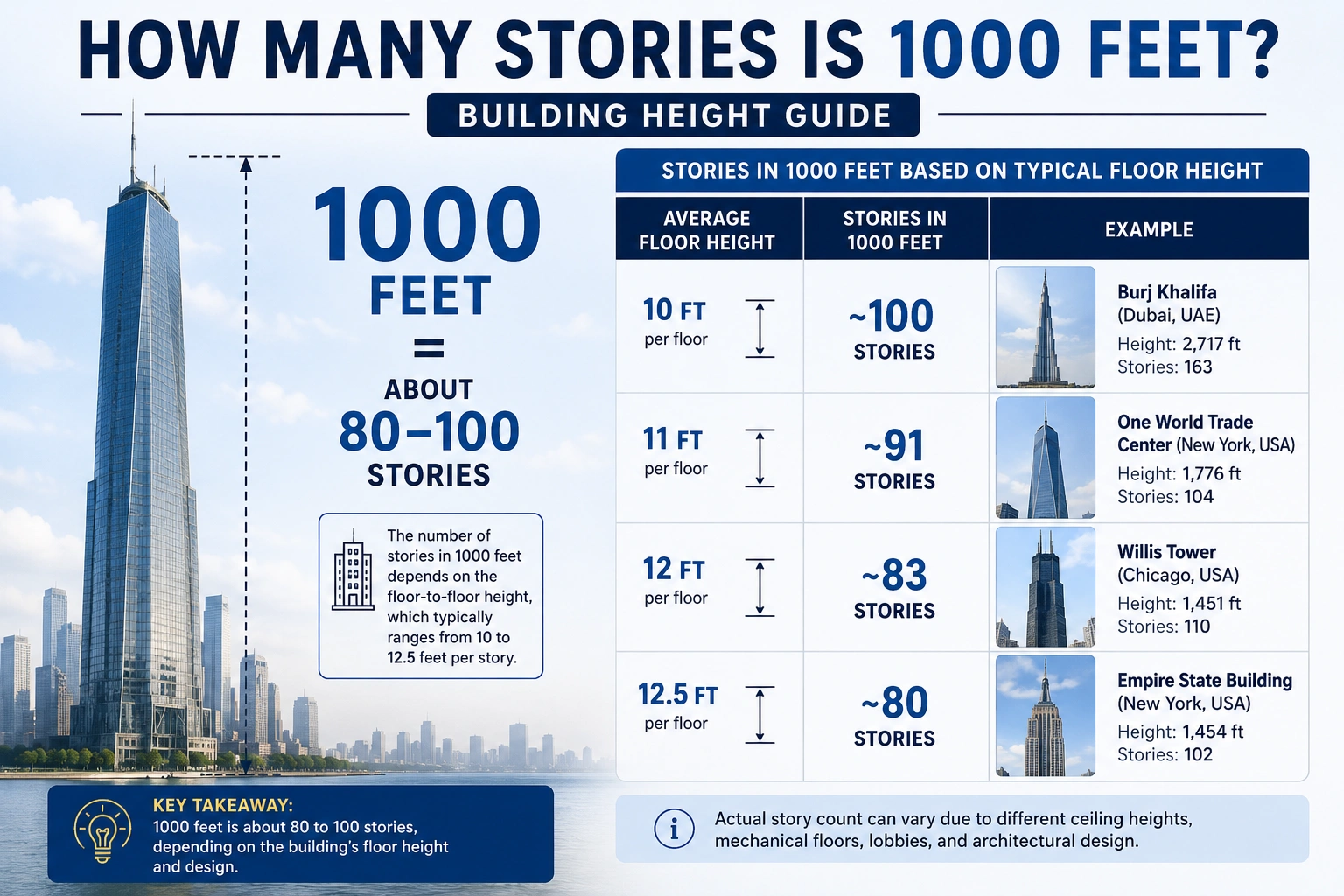
How Many Stories Is 1000 Feet?
The answer depends on the average floor height.
Residential Buildings
Using 10-foot floors:
1000÷10=100 stories
Result:
- Approximately 100 stories
Apartment Buildings
Using 11-foot floors:
1000÷11≈91 stories
Result:
- About 91 stories
Office Buildings
Using 13-foot floors:
1000÷13≈77 stories
Result:
- About 77 stories
Modern Skyscrapers
Using 14-foot floors:
1000÷14≈71 stories
Result:
- Around 71 stories
Feet to Stories Formula
Converting building height into stories is straightforward.
Standard Formula
Use:
Stories=Average Floor HeightBuilding Height
Example Calculation
For a 1,000-foot office tower:
1000÷13≈77
Result:
- Approximately 77 stories
Story Height Comparison Chart
Here’s a quick reference chart.
| Average Story Height | Stories in 1,000 Feet |
|---|---|
| 10 ft | 100 |
| 11 ft | 91 |
| 12 ft | 83 |
| 13 ft | 77 |
| 14 ft | 71 |
| 15 ft | 67 |
This chart shows why story counts vary from one building to another.
Real-World Examples of 1000-Foot Buildings
A 1,000-foot building is considered a major skyscraper.
Skyline Landmark
Most cities have only a few buildings reaching or exceeding 1,000 feet.
Observation Towers
Many observation towers exceed the 1,000-foot mark and dominate city skylines.
Modern High-Rises
Large office towers and mixed-use skyscrapers commonly range between 70 and 90 stories at this height.
Urban Comparison
A 1,000-foot building is often taller than:
- 90% of nearby buildings
- Most residential towers
- Many regional landmarks
Factors That Affect Story Count
Several design choices influence the number of floors.
Ceiling Heights
Luxury buildings often feature taller ceilings.
Mechanical Floors
Elevator equipment and building systems may occupy entire levels.
Building Type
Office buildings usually have taller floors than residential towers.
Architectural Design
Observation decks, crowns, and spires add height without adding stories.
Common Conversion Mistakes
Avoid these frequent errors.
Assuming Every Story Is 10 Feet
Commercial buildings often exceed 10 feet per floor.
Ignoring Mechanical Levels
Mechanical floors reduce the number of occupiable stories.
Forgetting Roof Structures
Architectural features can increase height without increasing floor count.
Expert Tips for Estimating Stories
Professionals often use simple averages.
Use 10 Feet for Residential Buildings
This provides a quick estimate.
Use 13–14 Feet for Office Towers
Most modern skyscrapers fall within this range.
Check Building Specifications
Actual story counts vary significantly among buildings.
Real-World Example
Suppose a skyscraper measures:
1000 feet
And each floor averages:
13 feet
Calculation:
1000÷13≈77 stories
Result:
- Approximately 77 stories
FAQs
1. How many stories is 1000 feet tall?
Most 1,000-foot buildings are between 70 and 100 stories, depending on floor height.
2. How many stories is 1000 feet using 10-foot floors?
About 100 stories.
3. How many stories is a 1000-foot skyscraper?
Most skyscrapers of this height contain roughly 70–80 stories.
4. Why do story counts vary?
Different building types use different floor-to-floor heights.
5. Is a 1000-foot building considered a skyscraper?
Yes. A 1,000-foot structure is considered a major skyscraper.
Conclusion
Understanding how many stories is 1000 feet requires knowing the average height of each floor. While the exact number varies, most buildings of this height contain:
- Around 70–80 stories for office towers
- Around 90–100 stories for residential buildings
Using a common commercial floor height:
1000÷13≈77 stories
A 1,000-foot building is typically about 77 stories tall, making it one of the tallest structures in most city skylines.
Discover More Articles
How Many Square Feet Is 10 Acres? Exact Land Size Conversion Guide
How Many Square Feet Are in a Mile? Complete Guide
How Many Cubic Feet Is a Standard Refrigerator? Complete Size Guide