
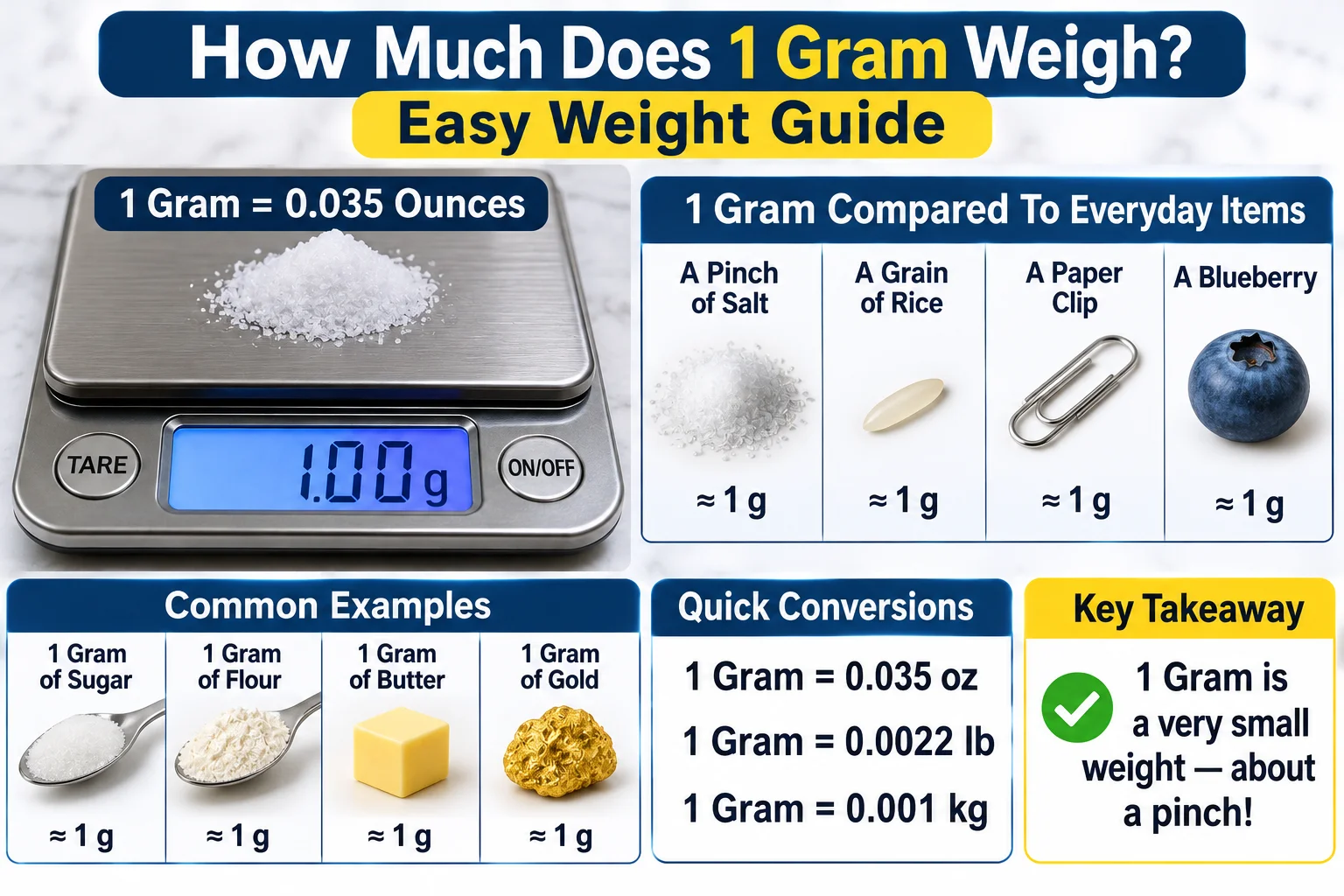
One gram is a very small unit of weight, equal to 0.001 kilograms or approximately 0.035 ounces. It is light enough that you may barely notice it when holding a tiny object, but it is useful for measuring food, jewelry, medicine, and other lightweight items.
Understanding what 1 gram weighs can be difficult because most everyday objects are heavier than this amount. However, simple comparisons and conversions can help you picture this tiny measurement.
What Does 1 Gram Weigh?
One gram weighs exactly one-thousandth of a kilogram. It is part of the metric system and is commonly used to measure small quantities.
For a practical comparison, a small paper clip may weigh around 1 gram, depending on its size and material. This gives you an easy way to imagine how light one gram really is.
Here are the basic facts:
- 1 gram equals 1,000 milligrams.
- 1 gram equals 0.001 kilograms.
- 1 gram equals approximately 0.0353 ounces.
- 1 gram equals approximately 0.0022 pounds.
A gram measures mass. In everyday situations, people often use the word weight when discussing grams.
1 Gram Weight Conversions
One gram can be converted into several other measurement units. These conversions are helpful when following recipes, measuring ingredients, weighing small packages, or comparing products.
| Measurement Unit | Equivalent to 1 Gram |
|---|---|
| Milligrams (mg) | 1,000 mg |
| Kilograms (kg) | 0.001 kg |
| Ounces (oz) | 0.03527 oz |
| Pounds (lb) | 0.002205 lb |
| Micrograms (mcg) | 1,000,000 mcg |
| Metric tonnes | 0.000001 tonnes |
The most useful conversion to remember is that 1 gram equals 1,000 milligrams.
How Many Ounces Does 1 Gram Weigh?
One gram is approximately 0.03527 ounces.
This means you need about 28.35 grams to make one ounce.
| Grams | Ounces |
|---|---|
| 1 g | 0.0353 oz |
| 5 g | 0.1764 oz |
| 10 g | 0.3527 oz |
| 20 g | 0.7055 oz |
| 28.35 g | 1 oz |
| 50 g | 1.7637 oz |
| 100 g | 3.5274 oz |
How Many Pounds Does 1 Gram Weigh?
One gram is approximately 0.002205 pounds.
Since a pound contains about 453.592 grams, a single gram represents only a tiny fraction of a pound.
| Grams | Pounds |
|---|---|
| 1 g | 0.002205 lb |
| 10 g | 0.02205 lb |
| 50 g | 0.11023 lb |
| 100 g | 0.22046 lb |
| 250 g | 0.55116 lb |
| 453.59 g | 1 lb |
Everyday Objects That Weigh About 1 Gram
It is easier to understand one gram when you compare it with familiar objects. Several small household items have weights close to this amount, although their actual weights vary by brand, size, and material.
Here are some examples:
1. A Small Paper Clip
A small standard paper clip can weigh approximately 1 gram. Larger or thicker paper clips may weigh more.
This is one of the easiest objects to use when imagining a one-gram measurement.
2. A Small Pin
Some small metal pins weigh close to 1 gram. However, larger pins and safety pins can be noticeably heavier.
3. A Small Piece of Paper
A tiny piece of ordinary paper may weigh around 1 gram, depending on its dimensions and thickness.
A full sheet of standard printer paper usually weighs several grams, so only a portion of the sheet would be close to 1 gram.
4. A Small Amount of Sugar
One gram of granulated sugar is a very small quantity. It is roughly one-quarter teaspoon, although the exact volume depends on the sugar’s texture and how tightly it is packed.
This comparison is useful when following recipes that require small ingredient measurements.
5. A Small Bead
Some lightweight plastic or decorative beads may weigh close to 1 gram. Glass and metal beads can weigh more, depending on their size and density.
Comparison Table of Objects Around 1 Gram
| Everyday Object | Approximate Weight |
|---|---|
| Small paper clip | Around 1 g |
| Small metal pin | Around 1 g |
| Small plastic bead | Around 1 g |
| Small piece of paper | Around 1 g |
| Granulated sugar | 1 g by measurement |
These are approximate comparisons, not guaranteed weights. If you need exactly 1 gram, use a digital scale.
How Small Is 1 Gram?
One gram is extremely light compared with common household items.
For example, a standard 500 ml bottle of water contains approximately 500 grams of water, excluding the bottle. That means 500 grams is equal to 500 individual one-gram amounts.
Here are a few comparisons to help you understand the difference:
| Item or Quantity | Approximate Weight |
|---|---|
| 1 gram of water | 1 g |
| 10 grams of sugar | 10 g |
| Small chocolate piece | Varies |
| 100 ml of water | 100 g |
| 500 ml of water | 500 g |
| 1 liter of water | 1,000 g (1 kg) |
Water provides a particularly useful comparison because 1 milliliter of pure water has a mass of approximately 1 gram under ordinary reference conditions.
This means:
- 1 ml of water weighs approximately 1 gram.
- 10 ml of water weighs approximately 10 grams.
- 100 ml of water weighs approximately 100 grams.
- 1,000 ml of water weighs approximately 1,000 grams.
How to Measure 1 Gram Without a Scale
Measuring exactly 1 gram without a scale can be difficult. However, you can estimate small quantities using familiar measurements.
Use a Measuring Spoon
For ingredients such as sugar or salt, a measuring spoon can help you estimate small amounts. However, teaspoons measure volume, not weight.
One gram of granulated sugar is roughly one-quarter teaspoon, but this is only an estimate.
Use Water as a Reference
Water provides a simple way to understand gram measurements.
Since 1 ml of pure water has a mass of approximately 1 gram, you can use a graduated measuring tool to estimate the amount.
For example, 5 ml of water has a mass of approximately 5 grams.
Use a Digital Kitchen Scale
A digital kitchen scale is the most reliable option for measuring 1 gram.
Choose a scale that displays measurements in grams and has a suitable precision. Place a small container on the scale, use the tare function to reset it to zero, and add your material until the display reaches 1 gram.
Important: Do not rely on household comparisons when measuring medication, chemicals, jewelry, or other materials that require accurate measurements. Use an appropriate calibrated scale.
Difference Between Grams and Other Weight Units
Grams are part of the metric system, but other measurement systems use units such as ounces and pounds.
Understanding their differences helps when comparing product labels, recipes, and package weights.
| Unit | Equivalent in Grams |
|---|---|
| 1 milligram | 0.001 g |
| 1 gram | 1 g |
| 1 kilogram | 1,000 g |
| 1 ounce | 28.35 g |
| 1 pound | 453.59 g |
| 1 metric tonne | 1,000,000 g |
A milligram is smaller than a gram, while a kilogram is much larger.
For example, a small amount of medicine may be measured in milligrams, a food ingredient in grams, and a person’s body weight in kilograms.
Why Is Understanding 1 Gram Useful?
Knowing what 1 gram weighs can help in many everyday situations.
Cooking and Baking
Recipes sometimes require small quantities of ingredients. Measuring one gram of yeast, salt, spices, or other ingredients can make a difference in certain recipes.
A kitchen scale provides better accuracy than estimating with a spoon.
Jewelry and Precious Metals
Gold, silver, and other precious metals are often sold and measured in grams. Understanding this unit helps buyers compare the weights of jewelry and small metal items.
Science and Education
Students use grams when learning about mass, measurement, and the metric system.
One gram is also a useful starting point for understanding larger units such as kilograms.
Shopping and Packaging
Small food packages, craft supplies, and lightweight products may display their net weight in grams.
Understanding the unit makes it easier to compare quantities and product sizes.
Common Mistakes When Measuring 1 Gram
Even though a gram is a simple unit, a few common mistakes can cause inaccurate measurements.
- Confusing grams with milligrams: One gram equals 1,000 milligrams. These units are not interchangeable.
- Assuming every paper clip weighs 1 gram: Paper clips come in different sizes and materials, so their weights vary.
- Using teaspoons as exact weight measurements: A teaspoon measures volume, and different ingredients have different densities.
- Confusing mass and weight: Grams measure mass. Weight is technically the force caused by gravity, although everyday product labels commonly use weight terminology.
- Ignoring scale precision: A scale that only displays whole grams may not be suitable when you need to measure smaller fractions of a gram.
Frequently Asked Questions
1. How much does 1 gram weigh?
One gram weighs 0.001 kilograms, approximately 0.03527 ounces, or 0.002205 pounds. It is a very small amount of mass.
2. What common object weighs about 1 gram?
A small paper clip is a useful example of an object that may weigh around 1 gram. Small pins and lightweight beads can also have similar weights.
3. Is 1 gram heavier than 1 milligram?
Yes. One gram is equal to 1,000 milligrams, making it 1,000 times heavier than one milligram.
4. How many grams are in one ounce?
One standard avoirdupois ounce equals approximately 28.35 grams. Therefore, you need about 28.35 one-gram portions to make one ounce.
5. How many grams are in a kilogram?
There are exactly 1,000 grams in one kilogram. For example, a 2 kg package contains 2,000 grams.
6. Can I measure 1 gram without a digital scale?
You can estimate 1 gram using familiar objects or small volume measurements, but these methods are not exact. A digital scale is the best option when accuracy matters.
7. Does 1 ml always weigh 1 gram?
No. One milliliter is a unit of volume, while one gram is a unit of mass. One milliliter of pure water has a mass of approximately 1 gram, but other liquids and materials can weigh more or less.
Conclusion
One gram is a very small amount of mass, equal to 1,000 milligrams, 0.001 kilograms, and approximately 0.03527 ounces. A small paper clip is a useful everyday comparison, although its actual weight can vary.
Understanding this measurement makes it easier to compare small objects, follow recipes, read product labels, and work with metric conversions. For an exact measurement, a digital scale is the most reliable choice.
Discover More Articles
Measuring 3 Inches: Exact Size, Conversions, and Everyday Examples