

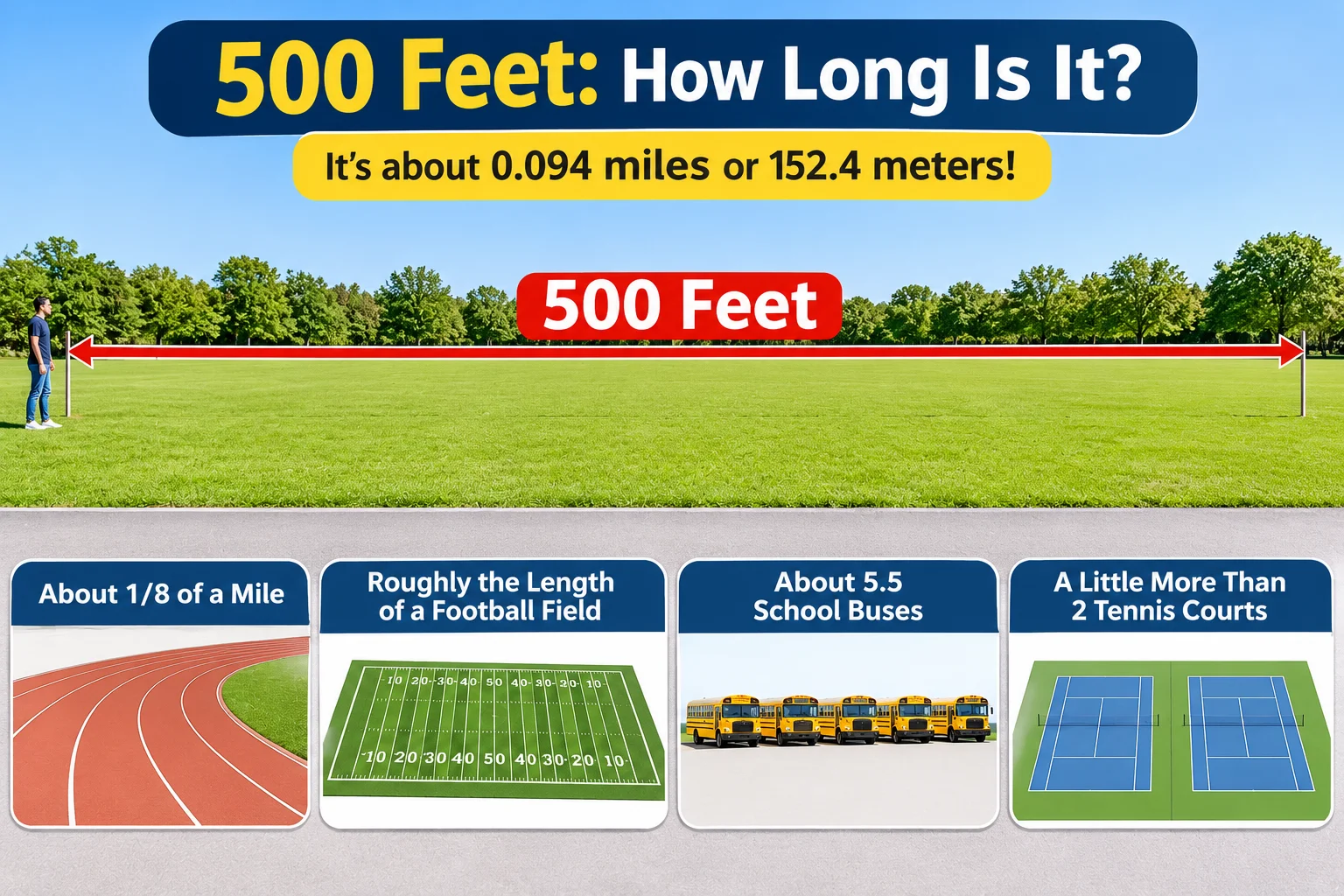
If you need to measure 500 feet, you are working with a fairly long distance. Five hundred feet is not difficult to measure, but it is too far for most ordinary rulers or short measuring tapes to handle in one pass.
500 feet equals 166.67 yards, 152.4 meters, or about 0.0947 miles. In simple terms, it is just under one-tenth of a mile.
To picture the distance, 500 feet is about 1.67 times the length of a 100-yard football field, excluding the end zones. It is also a distance that many people can walk in roughly one to two minutes, depending on walking speed.
This guide explains how long 500 feet is, how to measure it accurately, and how to compare the distance with familiar places and objects.
How Long Is 500 Feet?
A foot is a standard unit of length used primarily in the United States and a few other countries.
When you have 500 feet, you can write the measurement as:
500 ft
It is equal to:
500 feet = 166.67 yards
and:
500 feet = 152.4 meters
This makes 500 feet a useful distance for property layouts, construction, sports areas, outdoor projects, and other applications where a longer measurement is needed.
Understanding 500 Feet
Five hundred feet is much longer than an average residential room or backyard.
It is also considerably shorter than a mile.
A simple way to remember it is:
500 feet = almost 1/10 of a mile
More precisely, 500 feet is approximately 0.0947 miles.
So if you imagine walking one mile, 500 feet is about the first tenth of that journey.
500 Feet in Other Units
Converting 500 feet into several units helps when working with maps, plans, property measurements, or international specifications.
| Unit | 500 Feet Equals |
|---|---|
| Feet | 500 ft |
| Yards | 166.67 yd |
| Meters | 152.4 m |
| Miles | 0.0947 mi |
| Inches | 6,000 in |
| Centimeters | 15,240 cm |
| Kilometers | 0.1524 km |
For everyday use, the most useful conversions are:
500 feet = 166.67 yards = 152.4 meters
500 Feet in Meters, Yards, and Miles
500 Feet to Meters
One foot equals exactly 0.3048 meters.
To convert 500 feet:
500 × 0.3048 = 152.4 meters
Therefore:
500 feet = 152.4 meters
This is useful when working with metric measurements.
If someone tells you that two locations are 152.4 meters apart, that is exactly the same distance as 500 feet.
500 Feet to Yards
One yard contains 3 feet.
To convert 500 feet into yards:
500 ÷ 3 = 166.67 yards
Therefore:
500 feet = 166.67 yards
It is not exactly 167 yards, although 167 yards can be used as a rough estimate.
500 Feet to Miles
There are 5,280 feet in one mile.
Therefore:
500 ÷ 5,280 = 0.0947 miles
So:
500 feet ≈ 0.095 miles
This is slightly less than one-tenth of a mile.
What Does 500 Feet Look Like?
Knowing the mathematical conversion is useful, but distance is often easier to understand through familiar comparisons.
500 Feet Compared With a Football Field
A standard American football field is 100 yards long between the goal lines, which equals 300 feet.
The two end zones add another 20 yards, or 60 feet, making the full playing field 360 feet from end line to end line.
Compared with the 100-yard playing area:
500 feet ÷ 300 feet = 1.67
So 500 feet is about 1.67 times the length of the 100-yard field between the goal lines.
Compared with the full 360-foot field including end zones, 500 feet is about 1.39 full field lengths.
| Comparison | Approximate Length |
|---|---|
| 100-yard football field | 300 ft |
| Full football field including end zones | 360 ft |
| 500-foot distance | 500 ft |
| 500 ft vs. 100-yard field | 1.67 times |
| 500 ft vs. full field | 1.39 times |
This makes a football field a useful visual reference.
500 Feet Compared With a City Block
A city block does not have one standard size. Block lengths vary greatly between cities and neighborhoods.
However, if a particular block is around 500 feet long, the distance would be roughly one full block.
Because city blocks vary, you should not assume every block equals 500 feet.
For an exact distance, use a map scale, measuring tool, or physical measuring equipment.
500 Feet as a Walking Distance
Walking speed varies from person to person.
At a moderate walking pace of around 3 miles per hour, 500 feet takes roughly 1.9 minutes to walk.
At a faster pace, it may take less time.
This makes 500 feet a relatively short walking distance even though it is a substantial measurement when viewed on a property or construction site.
How to Measure 500 Feet Accurately
The best method depends on how precise the measurement needs to be and where you are measuring.
Using a Measuring Tape
A standard measuring tape is useful for short distances, but measuring the entire 500 feet with a typical 12- or 25-foot tape would require many repeated measurements.
For example, a 25-foot tape would require:
500 ÷ 25 = 20 sections
That means you would need to mark each section carefully and maintain a straight line.
This method can work, but it is time-consuming and creates more opportunities for small errors.
Using a Measuring Wheel
A measuring wheel is usually much easier for measuring 500 feet.
A measuring wheel has a wheel that rolls across the ground while a counter records the distance.
To use one:
- Set the counter to zero.
- Place the wheel at the starting point.
- Keep the wheel moving in a straight line.
- Walk toward the endpoint.
- Stop when the counter reaches 500 feet.
- Mark the endpoint.
For property layouts, landscaping, sports areas, and outdoor projects, this is often much more convenient than repeatedly using a short tape.
Using a GPS or Mapping Tool
For large outdoor distances, a GPS device or digital mapping tool can provide a quick estimate.
You can mark the starting location and endpoint and check the calculated distance.
However, digital measurements can vary depending on the mapping system, GPS accuracy, terrain, and the exact points selected.
For legal property boundaries, construction work, or surveying, use the appropriate professional measurement method rather than relying only on a consumer map.
Step-by-Step: Measuring 500 Feet
If you need to physically mark a 500-foot distance, follow this process.
Step 1: Identify the Starting Point
Choose the exact point where the measurement begins.
Mark it clearly so you do not accidentally start from a different location.
Step 2: Choose Your Measuring Tool
For a long outdoor distance, a measuring wheel is generally more practical than a short tape.
For a highly precise measurement, specialized surveying equipment may be appropriate.
Step 3: Establish a Straight Line
Try to keep the measurement path straight.
If the goal is to measure direct distance between two points, walking around obstacles will produce a longer path.
Step 4: Measure to 500 Feet
Move along the planned path until your device reaches:
500 feet
Mark the endpoint.
Step 5: Verify the Measurement
If accuracy matters, measure the distance again.
A second measurement can help identify mistakes caused by starting position, uneven movement, or an inaccurate tool.
500-Foot Distance Comparison Chart
The following chart gives several ways to visualize the distance:
| Measurement | Equivalent to 500 Feet |
|---|---|
| Feet | 500 ft |
| Yards | 166.67 yd |
| Meters | 152.4 m |
| Miles | 0.0947 mi |
| Kilometers | 0.1524 km |
| Inches | 6,000 in |
| Football field, goal line to goal line | About 1.67 lengths |
| Full football field with end zones | About 1.39 lengths |
The easiest number to remember is:
500 feet ≈ 152 meters
For a quick mental estimate, you can also think of it as about one-tenth of a mile.
Where Is a 500-Foot Measurement Useful?
A distance of 500 feet can be useful in many practical situations.
Property and Construction
Property owners and contractors may need to understand distances between buildings, roads, fences, utility points, or other features.
For example, a 500-foot distance may be relevant when planning:
- Long fences
- Driveways
- Utility runs
- Drainage layouts
- Landscaping
- Large outdoor spaces
- Construction site layouts
Exact requirements depend on local rules and project specifications.
Sports and Recreation
Sports facilities can involve long distances for training, course layouts, or equipment placement.
A coach might mark a 500-foot running or conditioning distance, for example.
Outdoor Planning
Five hundred feet is also useful when estimating distances across parks, fields, gardens, farms, and large properties.
Instead of trying to visualize 500 feet directly, converting it to approximately 152.4 meters can make the distance easier to plan.
Common Mistakes When Measuring 500 Feet
Long-distance measurements can become inaccurate if small errors are repeated.
Using the Wrong Unit
Always confirm whether your measuring tool is displaying feet, yards, meters, or another unit.
A reading of 500 meters is much longer than 500 feet.
Measuring a Curved Path
If you need a straight-line distance, do not follow a curved route around obstacles.
The path you walk and the direct distance between two points are not always the same.
Forgetting to Reset the Measuring Wheel
Before starting, make sure the measuring wheel is set to zero.
An incorrect starting reading can affect the entire measurement.
Relying on an Estimate for Exact Work
Saying that 500 feet is “about a football field and a half” is useful for visualization, but it is not a substitute for precise measurement.
For construction, surveying, legal boundaries, or safety-related work, use an appropriate measurement tool.
Expert Tips for Measuring 500 Feet
Tip 1: Use a measuring wheel for speed.
It is much easier than repeatedly moving a short measuring tape.
Tip 2: Mark the start and endpoint clearly.
This prevents confusion when checking the measurement.
Tip 3: Keep your path straight.
A winding path can make the measured distance longer than the direct distance.
Tip 4: Double-check important measurements.
If a project depends on the exact distance, take a second measurement.
Tip 5: Remember 500 feet is 152.4 meters.
This is the easiest metric conversion to remember.
Tip 6: Think of 500 feet as about one-tenth of a mile.
This gives you a quick mental picture when estimating distances.
9. FAQs
1. How long is 500 feet?
500 feet is 166.67 yards, 152.4 meters, or about 0.0947 miles. It is just under one-tenth of a mile.
2. How many meters are in 500 feet?
500 feet equals exactly 152.4 meters. The conversion uses the exact relationship of 0.3048 meters per foot.
3. How many yards is 500 feet?
There are 3 feet in a yard, so 500 feet equals 166.67 yards.
4. How can I measure 500 feet?
A measuring wheel is one of the easiest tools for measuring 500 feet outdoors. You can also use a long measuring tape, GPS equipment, or a mapping tool depending on the required accuracy.
5. Is 500 feet a long distance?
It is a substantial distance but not a very long walking distance. Five hundred feet is about 152 meters and can typically be walked in roughly two minutes at a moderate pace.
Conclusion
To measure 500 feet accurately, a measuring wheel is usually one of the simplest options for an outdoor distance. For more precise work, specialized surveying equipment may be better.
The key conversions are straightforward: 500 feet equals 166.67 yards, 152.4 meters, 6,000 inches, and about 0.0947 miles.
For visualization, 500 feet is about 1.67 times the 100-yard distance between the goal lines on an American football field, or roughly 1.39 full football fields when the end zones are included.
The easiest shortcut to remember is 500 feet ≈ 152 meters ≈ 0.095 miles. Once you know these comparisons, it becomes much easier to estimate and measure this distance in real-world situations.
Discover More Articles
How Much Does 40 Kilograms Weigh? Everyday Comparisons


