

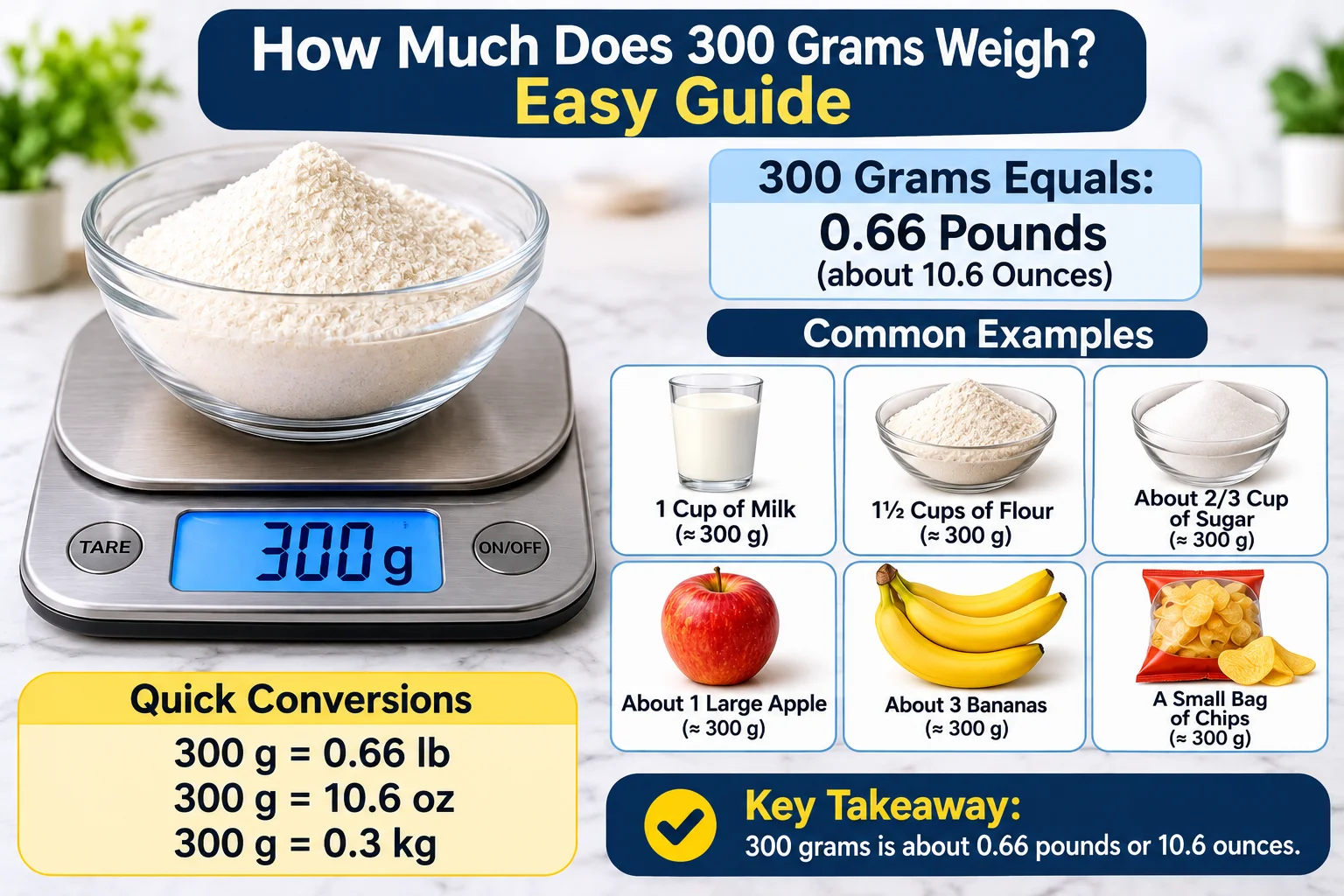
If you are trying to understand how much 300 grams weighs, the easiest way to picture it is to convert the measurement into ounces, pounds, and kilograms. Three hundred grams is a relatively light weight, but it is heavy enough to represent many common food items, household objects, and small packages.
Quick Answer: How Much Does 300 Grams Weigh?
300 grams weighs approximately 10.58 ounces or 0.66 pounds.
It is also equal to 0.3 kilograms.
Here is the basic conversion:
| Unit | 300 Grams Equals |
|---|---|
| Grams | 300 g |
| Kilograms | 0.3 kg |
| Ounces | 10.58 oz |
| Pounds | 0.66 lb |
| Milligrams | 300,000 mg |
| Metric tons | 0.0003 tons |
So, if you see a package labeled 300 grams, you can think of it as roughly 10.6 ounces or about two-thirds of a pound.
300 Grams in Ounces
To convert grams to ounces, use the conversion:
1 gram = 0.035274 ounces
Therefore:
300 × 0.035274 = 10.5822 ounces
So:
300 grams = approximately 10.58 ounces
For everyday use, you can round this to 10.6 ounces.
This conversion is particularly useful when a recipe, product, or package uses grams while you are more familiar with ounces.
| Grams | Ounces |
|---|---|
| 100 g | 3.53 oz |
| 150 g | 5.29 oz |
| 200 g | 7.05 oz |
| 250 g | 8.82 oz |
| 300 g | 10.58 oz |
| 350 g | 12.35 oz |
| 400 g | 14.11 oz |
| 500 g | 17.64 oz |
300 Grams in Pounds
There are approximately 453.592 grams in one pound.
To convert 300 grams to pounds:
300 ÷ 453.592 = 0.6614 pounds
Therefore:
300 grams = approximately 0.66 pounds
You can think of 300 grams as a little less than three-quarters of a pound.
| Weight | Pounds |
|---|---|
| 100 g | 0.22 lb |
| 200 g | 0.44 lb |
| 300 g | 0.66 lb |
| 400 g | 0.88 lb |
| 500 g | 1.10 lb |
| 1,000 g | 2.20 lb |
This makes it easy to see that 300 grams is substantially lighter than one pound.
300 Grams in Kilograms
One kilogram contains 1,000 grams.
To convert:
300 ÷ 1,000 = 0.3 kilograms
Therefore:
300 grams = 0.3 kilograms
This is also equal to 300,000 milligrams.
| Unit | Equivalent |
|---|---|
| Grams | 300 g |
| Kilograms | 0.3 kg |
| Milligrams | 300,000 mg |
| Ounces | 10.58 oz |
| Pounds | 0.66 lb |
What Does 300 Grams Look Like?
Weight is difficult to visualize because grams are not a unit most people physically sense. A useful way to understand 300 grams is to compare it with familiar objects.
Three hundred grams is:
- Heavier than many small electronic accessories.
- Lighter than a typical 1-pound package.
- About two-thirds of a pound.
- Equal to 0.3 kilograms.
- Similar in weight to some medium-sized food portions.
The exact weight of an everyday object varies, so these comparisons should be treated as visual estimates rather than exact measurements.
Everyday Objects That Can Be Around 300 Grams
Several common items can weigh close to 300 grams, although their actual weight depends on size and construction.
A Small Food Package
Many packaged foods are sold in sizes around 250–300 grams. A 300-gram package can therefore be a useful reference when visualizing this weight.
Three 100-Gram Portions
An easy way to understand 300 grams is to divide it into three equal parts:
100 g + 100 g + 100 g = 300 g
If you are familiar with what 100 grams feels like, imagine three identical 100-gram portions together.
A Portion of Food
Some servings of meat, vegetables, fruit, flour, or other foods can approach 300 grams. However, volume varies depending on the food because different materials have different densities.
For example, 300 grams of flour will occupy a different amount of space than 300 grams of water.
Three 100-Gram Weights
If you have three objects or weights that are each exactly 100 grams, placing them together gives you an exact 300 grams.
This is a better reference than guessing based on appearance because the total mass is known.
300 Grams vs. Other Common Weights
Comparing 300 grams with nearby weights can make it easier to understand.
| Weight | Difference From 300 g | Relative Size |
|---|---|---|
| 100 g | 200 g lighter | One-third of 300 g |
| 150 g | 150 g lighter | Half of 300 g |
| 200 g | 100 g lighter | Two-thirds of 300 g |
| 250 g | 50 g lighter | Slightly less |
| 300 g | — | Reference |
| 350 g | 50 g heavier | Slightly more |
| 400 g | 100 g heavier | One-third more |
| 500 g | 200 g heavier | About 1.67× 300 g |
| 1 kg | 700 g heavier | More than 3× 300 g |
This comparison shows that 300 grams falls between a quarter kilogram and half a kilogram, and it is much closer to 250 grams than to 500 grams.
How to Measure 300 Grams Accurately
The most reliable way to measure 300 grams is with a digital kitchen scale, food scale, postal scale, or another scale designed for small weights.
Step 1: Place the Scale on a Stable Surface
Put the scale on a flat, stable surface. Avoid using it on an uneven or soft surface because this can interfere with the reading.
Step 2: Turn the Scale On
Switch on the scale and wait for the display to reach zero.
Step 3: Select Grams
If your scale allows multiple units, select grams (g).
This prevents confusion between grams, ounces, pounds, or other measurement units.
Step 4: Use the Tare Function
If you are placing food or another item inside a container, put the empty container on the scale and press Tare or Zero.
The scale should then return to zero while the container remains on it.
Step 5: Add the Material
Slowly add the item until the display reaches:
300 g
If you go over, remove a small amount until the reading returns to 300 grams.
How to Measure 300 Grams Without a Scale
You can estimate 300 grams without a scale, but you cannot reliably determine an exact 300-gram weight simply by looking at an object.
The best alternative is to use a known weight.
For example, if you have three objects that are each exactly 100 grams:
100 + 100 + 100 = 300 grams
You can also use a package with a clearly stated net weight as a reference.
For cooking and baking, however, estimating by cups, spoons, or handfuls is less accurate because different ingredients have different densities.
Why Volume Does Not Equal Weight
A common mistake is assuming that 300 grams always occupies the same amount of space.
It does not.
For example, 300 grams of water and 300 grams of flour have the same mass, but they do not necessarily occupy the same volume.
That is because weight and volume measure different properties.
Grams measure mass, while cups, milliliters, and tablespoons measure volume.
300 Grams in Cooking
Three hundred grams is a useful measurement in cooking and baking.
Recipes may specify ingredients in grams because weight-based measurements are generally more consistent than volume-based measurements.
For example, a recipe might call for:
- 300 grams of flour
- 300 grams of meat
- 300 grams of vegetables
- 300 grams of fruit
- 300 grams of sugar
- 300 grams of another ingredient
The exact volume of each ingredient will differ.
For baking especially, using a kitchen scale is often preferable to estimating 300 grams with cups because ingredients can be packed or loosely filled.
300 Grams for Shipping and Packages
A 300-gram weight can also matter when packaging products for shipping.
Remember that:
300 grams = 0.3 kilograms
and:
300 grams ≈ 10.58 ounces
If a shipping service uses kilograms, 300 grams should be entered as 0.3 kg.
If the service uses pounds, it is approximately 0.66 lb.
When calculating shipping costs, remember that the package weight may include the product, box, wrapping, labels, and other packing materials.
Common Mistakes When Measuring 300 Grams
Mistake 1: Confusing Grams With Ounces
A gram and an ounce are not the same unit.
300 grams ≈ 10.58 ounces, not 300 ounces.
Mistake 2: Assuming 300 Grams Equals 1 Pound
One pound is approximately 453.6 grams.
Therefore, 300 grams is only about 0.66 pounds.
Mistake 3: Confusing 300 Grams With 300 Milligrams
One gram contains 1,000 milligrams.
Therefore:
300 grams = 300,000 milligrams
Three hundred milligrams is dramatically lighter than 300 grams.
Mistake 4: Measuring by Volume Without Checking the Ingredient
A cup of one ingredient can weigh very differently from a cup of another ingredient.
If a recipe specifically calls for 300 grams, use a scale when accuracy matters.
Mistake 5: Forgetting the Container Weight
If you weigh an item inside a bowl or container without using the tare function, the container’s weight will be included in the reading.
Always zero the scale with the empty container when appropriate.
Tips for Measuring 300 Grams Correctly
For the most accurate results, keep a few simple habits in mind.
Use grams mode. Make sure the scale is displaying grams before you begin.
Tare the container. Zero the scale after placing your bowl or package on it.
Add material slowly. This makes it easier to stop at exactly 300 grams.
Keep the scale level. A stable surface helps produce consistent readings.
Check the scale’s capacity. Use a scale appropriate for the item you are weighing.
Avoid relying on visual estimates. An object can look small or large without accurately indicating its mass.
Record the exact measurement. If precision matters, write down 300 g rather than rounding it unnecessarily.
300 Grams: Quick Conversion Chart
| Conversion | Result |
|---|---|
| 300 grams to kilograms | 0.3 kg |
| 300 grams to ounces | 10.58 oz |
| 300 grams to pounds | 0.66 lb |
| 300 grams to milligrams | 300,000 mg |
| 300 grams to metric tons | 0.0003 tons |
| 300 grams to pounds and ounces | About 10 oz 9.6 g |
| 300 grams as a fraction of 1 kg | 30% |
The most useful everyday conversions are 300 grams = 10.58 ounces = 0.66 pounds = 0.3 kilograms.
FAQs About Weighing 300 Grams
How much does 300 grams weigh in pounds?
300 grams weighs approximately 0.66 pounds.
How many ounces are in 300 grams?
There are approximately 10.58 ounces in 300 grams.
Is 300 grams the same as 0.3 kilograms?
Yes. Since 1 kilogram equals 1,000 grams, 300 grams equals 0.3 kilograms.
Is 300 grams close to one pound?
It is somewhat lighter than one pound. One pound is approximately 453.6 grams, while 300 grams is about 66% of a pound.
Can I measure 300 grams without a scale?
You can estimate it using objects or packages with known weights, but a scale is the best option when an accurate 300-gram measurement is required.
Conclusion
300 grams is a relatively light weight equal to 0.3 kilograms, approximately 10.58 ounces, or about 0.66 pounds. It is useful to think of it as roughly two-thirds of a pound or three 100-gram portions.
For accurate cooking, shipping, crafting, or other measurements, a digital scale is the most reliable method. If you do not have a scale, known-weight objects can provide a rough reference, but visual comparisons should not be treated as exact.
Discover More Articles
How Much Does 20 Grams Weigh? Easy Guide
Measuring 1,375 Inches: Exact Length and Everyday Comparisons


