

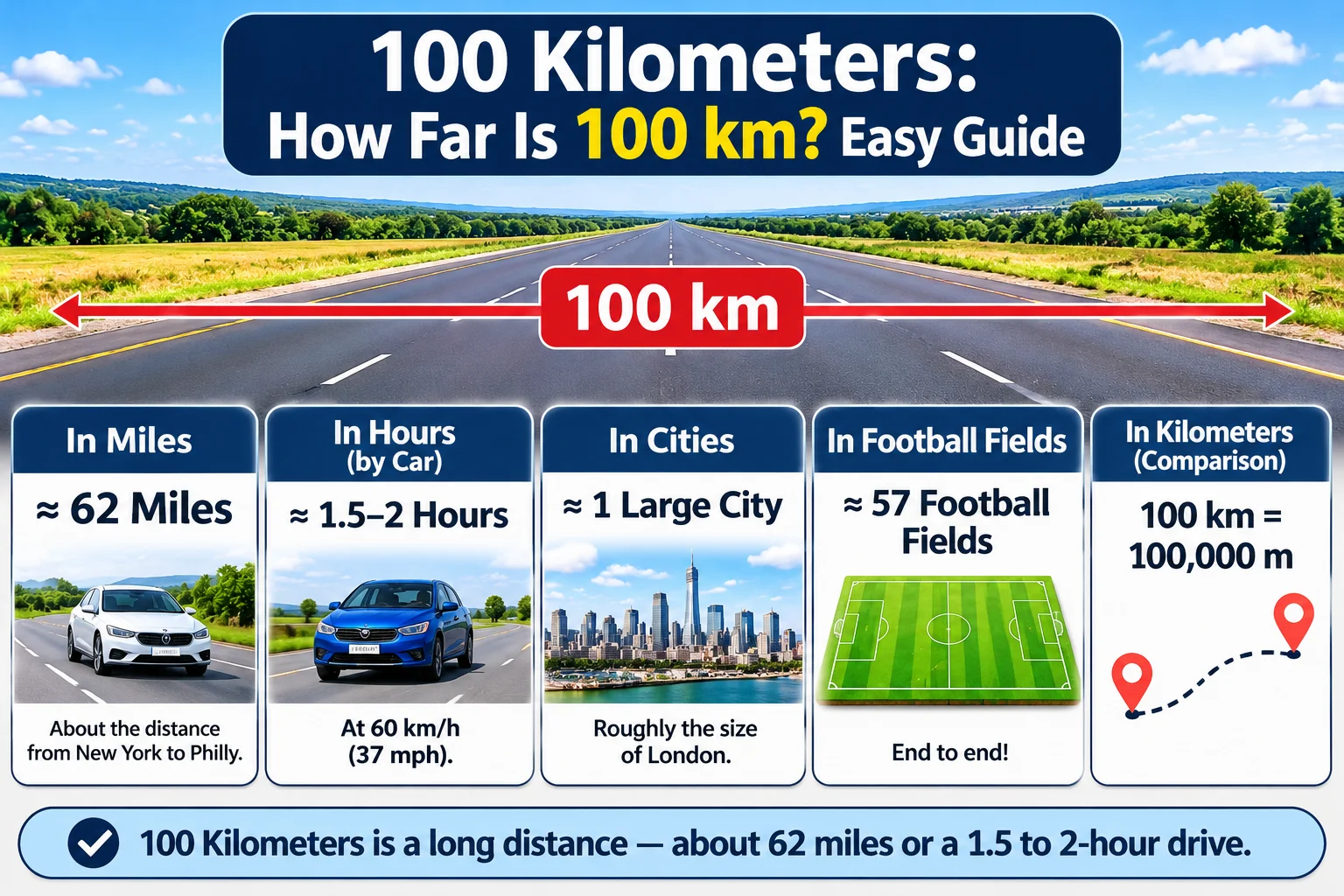
100 kilometers is a significant distance equal to about 62.14 miles. It is also exactly 100,000 meters, 328,084 feet, or about 109,361 yards. If you are trying to picture the distance, think of 100 km as a long road trip rather than a short drive across town.
How long it takes to travel 100 kilometers depends on your speed and the type of journey. At 100 km/h, for example, it takes about 1 hour. At 50 km/h, it takes about 2 hours.
This guide explains exactly how far 100 kilometers is, converts it into common units, and gives practical examples that make the distance easier to understand.
How Far Is 100 Kilometers?
100 kilometers = 62.14 miles.
A kilometer is a metric unit used to measure distance. One kilometer contains 1,000 meters.
So:
100 km × 1,000 = 100,000 meters
That means traveling 100 kilometers means covering 100,000 meters of distance.
For people who normally use miles, the easiest conversion to remember is:
100 kilometers ≈ 62 miles.
This makes 100 km a little more than 60 miles.
100 Kilometers in Different Units
The same distance can be expressed in several measurement systems.
| Unit | Equivalent to 100 kilometers |
|---|---|
| Kilometers | 100 km |
| Miles | 62.14 mi |
| Meters | 100,000 m |
| Centimeters | 10,000,000 cm |
| Millimeters | 100,000,000 mm |
| Yards | 109,361 yd |
| Feet | 328,084 ft |
| Inches | 3,937,008 in |
For everyday travel, kilometers and miles are the most useful comparison.
For scientific, engineering, or metric measurements, meters are often more practical.
How to Convert 100 Kilometers to Miles
The standard conversion is:
1 kilometer ≈ 0.621371 miles
To convert 100 kilometers:
100 × 0.621371 = 62.1371 miles
Therefore:
100 kilometers ≈ 62.14 miles
For quick estimates, you can simply remember that 100 km is about 62 miles.
This is useful when reading a road sign, planning a trip, or comparing distances between places that use different measurement systems.
How to Convert 100 Kilometers to Meters
One kilometer equals 1,000 meters.
Therefore:
100 × 1,000 = 100,000 meters
So:
100 kilometers = 100,000 meters
This is an exact conversion, unlike the kilometer-to-mile conversion, which uses a decimal relationship.
Quick conversion
- 1 km = 1,000 m
- 10 km = 10,000 m
- 50 km = 50,000 m
- 100 km = 100,000 m
How to Convert 100 Kilometers to Feet
One kilometer is approximately 3,280.84 feet.
Therefore:
100 km ≈ 328,084 feet
So 100 kilometers is roughly 328 thousand feet.
Although feet are not usually used for long road distances, this conversion can help when comparing metric and imperial measurements.
How Long Does It Take to Travel 100 Kilometers?
Travel time depends mainly on your average speed.
The basic formula is:
Time = Distance ÷ Speed
For a distance of 100 kilometers:
| Average Speed | Approximate Travel Time |
|---|---|
| 20 km/h | 5 hours |
| 30 km/h | 3 hours 20 minutes |
| 40 km/h | 2 hours 30 minutes |
| 50 km/h | 2 hours |
| 60 km/h | 1 hour 40 minutes |
| 80 km/h | 1 hour 15 minutes |
| 100 km/h | 1 hour |
| 120 km/h | 50 minutes |
These are theoretical travel times. Real journeys can take longer because of traffic, intersections, road conditions, stops, speed limits, and other delays.
How Far Is 100 Kilometers by Car?
For a car, 100 kilometers is usually a moderate-to-long journey.
If a vehicle maintains an average speed of 100 km/h, the mathematical travel time is exactly 1 hour.
However, most real-world drives involve changing speeds.
For example, a trip of 100 km might include:
- Slow traffic near a city
- Faster highway driving
- Traffic lights
- Rest stops
- Construction zones
- Lower speed limits
- Curved or mountainous roads
Because of these factors, a 100-km road trip might take considerably longer than one hour.
The distance stays the same, but the actual travel time changes with the route.
What Does 100 Kilometers Look Like?
Distance is difficult to visualize when you only see a number.
One way to picture 100 km is to break it into smaller sections:
100 km = 10 × 10 km
It is also:
100 km = 4 × 25 km
Or:
100 km = 2 × 50 km
Thinking about the distance this way makes it easier to understand.
A 10-km journey might feel relatively short. Repeating that distance ten times gives you 100 km.
100 Kilometers Compared With Other Distances
Comparing 100 km with familiar distances can make its scale clearer.
| Distance | In Miles | Compared With 100 km |
|---|---|---|
| 1 km | 0.62 mi | Much shorter |
| 5 km | 3.11 mi | 20 times shorter |
| 10 km | 6.21 mi | 10 times shorter |
| 25 km | 15.53 mi | One-quarter as far |
| 50 km | 31.07 mi | Half as far |
| 100 km | 62.14 mi | Reference distance |
| 150 km | 93.21 mi | 50 km farther |
| 200 km | 124.27 mi | Twice as far |
| 500 km | 310.69 mi | Five times farther |
| 1,000 km | 621.37 mi | Ten times farther |
This comparison shows why 100 km is a useful benchmark. It is long enough to represent a substantial journey but still much shorter than a cross-country trip in many countries.
100 Kilometers vs. 100 Miles
These two distances are easy to confuse, but they are not equal.
100 kilometers ≈ 62.14 miles.
100 miles ≈ 160.93 kilometers.
That means 100 miles is significantly farther than 100 kilometers.
| Distance | Kilometers | Miles |
|---|---|---|
| 100 km | 100 km | 62.14 mi |
| 100 miles | 160.93 km | 100 mi |
| Difference | 60.93 km | 37.86 mi |
So if a route is described as 100 km, it is not a 100-mile journey. The difference is nearly 61 kilometers.
How Far Is 100 Kilometers on a Map?
On a map, the visual size of 100 km depends on the map’s scale.
A road map showing a small local area may make 100 km appear very large. A map showing an entire country may make the same distance look relatively small.
This is why measuring distance directly from a map without checking its scale can be misleading.
Road distance can also differ from straight-line distance.
For example, two locations may be 100 km apart by road but less than 100 km apart in a straight line because roads follow curves, hills, rivers, and existing infrastructure.
100 Kilometers in Everyday Travel
A 100-km distance can occur in many common situations.
Road trips
A 100-km drive can take you from one city or town to another, depending on where you live.
Cycling
For experienced cyclists, 100 km can represent a substantial long-distance ride. A recreational cyclist may take several hours to complete it, depending on terrain, speed, and rest breaks.
Running
A 100-km run is an ultra-distance event. It is far beyond the standard marathon distance of 42.195 km.
In fact, 100 km is more than twice the distance of a marathon.
Walking
Walking 100 km would be a major endurance challenge for most people. Even at a steady walking pace, it would take many hours and would generally require rest periods.
How Many Steps Are in 100 Kilometers?
There is no single exact number because step length varies from person to person.
For a rough estimate, suppose someone takes about 1,300 steps per kilometer.
Then:
100 × 1,300 = about 130,000 steps
So 100 kilometers could represent roughly 130,000 steps for someone with that average step rate.
A taller person with a longer stride may take fewer steps, while a person with a shorter stride may take more.
This is an estimate rather than a fixed conversion.
How Long Would It Take to Walk 100 Kilometers?
A typical walking speed might be around 4–5 km/h, although actual speed varies considerably.
At 5 km/h:
100 ÷ 5 = 20 hours
At 4 km/h:
100 ÷ 4 = 25 hours
So walking 100 km could require roughly 20–25 hours of walking time, before accounting for sleep, meals, rest breaks, terrain, weather, and other interruptions.
That is why a 100-km walking journey is a serious endurance effort.
How Long Would It Take to Cycle 100 Kilometers?
Cycling speed varies widely.
For illustration:
| Cycling Speed | Time for 100 km |
|---|---|
| 15 km/h | 6 hours 40 minutes |
| 20 km/h | 5 hours |
| 25 km/h | 4 hours |
| 30 km/h | 3 hours 20 minutes |
| 35 km/h | About 2 hours 51 minutes |
| 40 km/h | 2 hours 30 minutes |
These figures exclude breaks and assume the rider maintains the listed average speed.
Terrain makes a major difference. A flat route can be much faster than a mountainous route even when both are exactly 100 km long.
100 Kilometers in Sports
A distance of 100 km appears in several endurance activities.
The best-known example is the 100-kilometer ultramarathon.
For comparison:
- 5K = 5 km
- 10K = 10 km
- Half marathon = 21.0975 km
- Marathon = 42.195 km
- 100K = 100 km
A 100-km race is therefore more than twice the distance of a standard marathon.
For runners, completing 100 km requires significant endurance, pacing, nutrition planning, and preparation.
Common Mistakes With 100 Kilometers
Mistake 1: Confusing kilometers with miles
Remember:
100 km ≈ 62.14 miles
It is not 100 miles.
Mistake 2: Assuming travel time from distance alone
Knowing that a journey is 100 km does not tell you exactly how long it will take.
Speed, traffic, road quality, stops, and terrain all matter.
Mistake 3: Confusing road distance with straight-line distance
A route can cover more distance because roads do not always follow a direct path.
Mistake 4: Treating 100 km as a fixed walking time
Different people walk at different speeds. A 100-km walk can take very different amounts of time depending on fitness and terrain.
Tips for Understanding 100 Kilometers Quickly
If you need to remember the distance, keep these key conversions in mind:
- 100 km = 100,000 meters
- 100 km ≈ 62.14 miles
- 100 km ≈ 328,084 feet
- 100 km ≈ 109,361 yards
- 100 km = 10 × 10 km
- 100 km = 2 × 50 km
- 100 km = 4 × 25 km
For most everyday situations, remembering 100 km ≈ 62 miles is enough.
Frequently Asked Questions
1. How many miles are in 100 kilometers?
There are approximately 62.14 miles in 100 kilometers. For a quick estimate, you can round this to 62 miles.
2. How many meters are in 100 kilometers?
There are exactly 100,000 meters in 100 kilometers because one kilometer equals 1,000 meters.
3. How long does it take to drive 100 kilometers?
At an average speed of 100 km/h, it takes about 1 hour. At 50 km/h, it takes about 2 hours. Actual driving time depends on traffic, road conditions, speed limits, and stops.
4. Is 100 kilometers a long distance?
Yes, 100 kilometers is a substantial distance for most everyday activities. It is about 62 miles and can represent a significant road trip, cycling distance, or endurance challenge.
5. How far is 100 kilometers compared with a marathon?
A marathon is 42.195 km, while 100 km is more than twice that distance. Specifically, 100 km is about 2.37 marathon distances.
Conclusion
100 kilometers is equal to about 62.14 miles, 100,000 meters, 328,084 feet, and 109,361 yards. It is a substantial distance that can represent a road trip, long cycling route, or major endurance challenge.
The easiest comparison to remember is that 100 km is roughly 62 miles. Travel time depends on your speed: at 100 km/h, the distance takes about one hour, while at 50 km/h, it takes about two hours.
Whether you are converting a measurement, planning a trip, or simply trying to understand how far 100 kilometers is, breaking the distance into smaller sections and comparing it with familiar travel distances makes the measurement much easier to visualize.
Discover More Articles
How Long Is 40 Centimeters? Size, Conversions and Everyday Comparisons
How Big Is 2 Centimeters? Size, Conversions and Everyday Comparisons


