

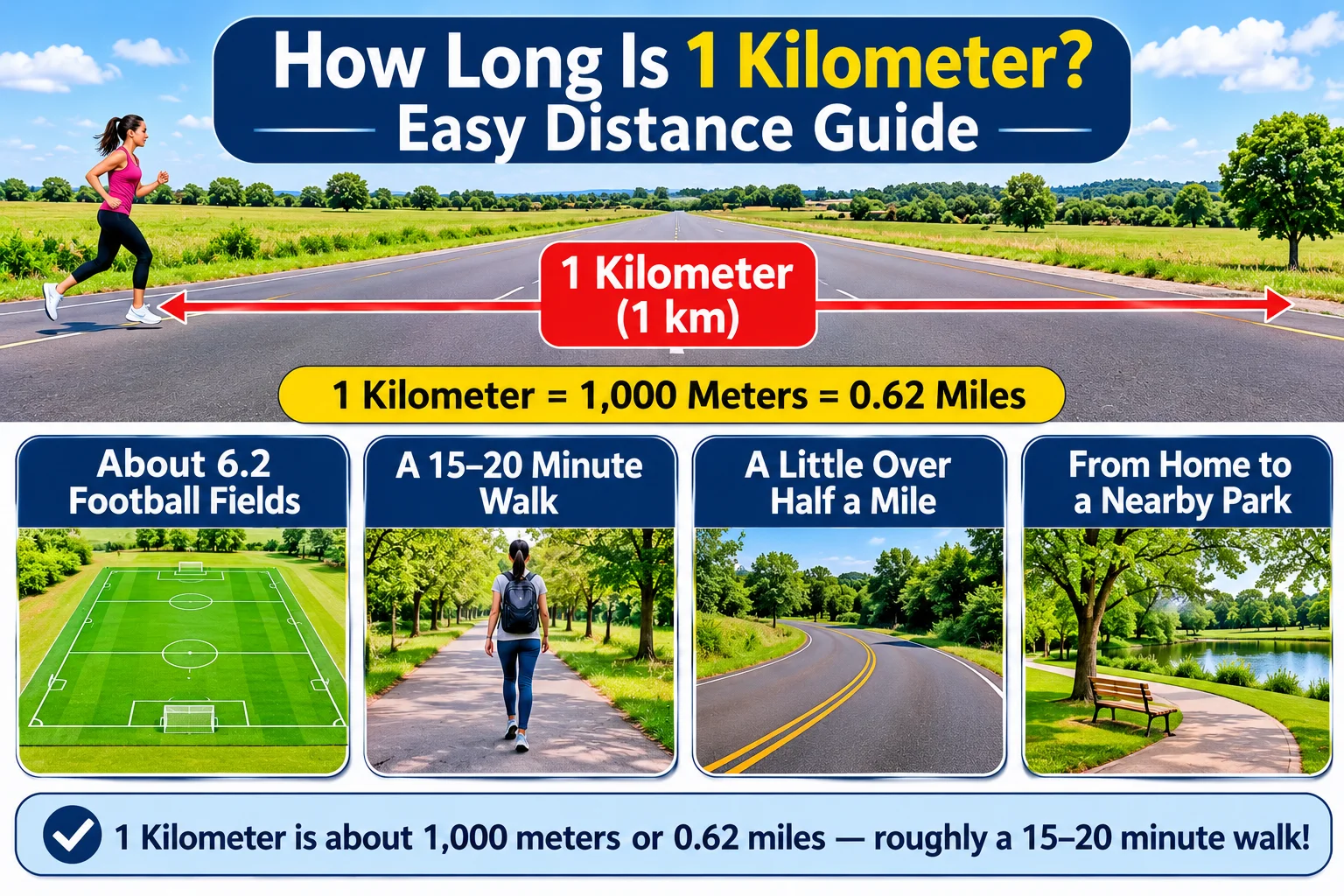
One kilometer is a common metric unit used to measure distance. It is often used for road distances, walking routes, running events, and travel between places.
If you are more familiar with miles, feet, or yards, converting a kilometer into these units can make the distance easier to understand.
Quick Answer: How Long Is 1 Kilometer?
1 kilometer equals 1,000 meters, 0.621 miles, 3,280.84 feet, or 1,093.61 yards.
It is slightly longer than half a mile and takes an average person around 10–15 minutes to walk at a comfortable pace.
| Measurement | Equivalent to 1 kilometer |
|---|---|
| Meters | 1,000 m |
| Miles | 0.621 mi |
| Feet | 3,280.84 ft |
| Yards | 1,093.61 yd |
| Inches | 39,370.08 in |
| Centimeters | 100,000 cm |
| Millimeters | 1,000,000 mm |
A kilometer is a unit of length, not area. It measures how far something is from one point to another.
What Is a Kilometer?
A kilometer, abbreviated as km, is a metric unit of length. The word comes from the metric system, where the prefix “kilo” means one thousand.
Therefore:
- 1 kilometer = 1,000 meters
- 1 kilometer = 100,000 centimeters
- 1 kilometer = 1,000,000 millimeters
Kilometers are commonly used to measure longer distances than meters. For example, a short street may be measured in meters, while the distance between towns is usually measured in kilometers.
Countries that use the metric system commonly display road distances and speed limits in kilometers and kilometers per hour.
How Many Miles Is 1 Kilometer?
One kilometer is approximately 0.621 miles.
The exact conversion is:
1 kilometer = 0.621371 miles
This means 1 kilometer is a little more than three-fifths of a mile. It is not quite two-thirds of a mile.
| Kilometers | Miles |
|---|---|
| 1 km | 0.621 mi |
| 2 km | 1.243 mi |
| 3 km | 1.864 mi |
| 5 km | 3.107 mi |
| 10 km | 6.214 mi |
To convert kilometers into miles, multiply the kilometer value by 0.621371.
Formula:
Miles = Kilometers × 0.621371
For example:
1 × 0.621371 = 0.621371 miles
A 5-kilometer route is approximately 3.1 miles, which is why a 5K running event is often described as a little over three miles.
How Many Feet Are in 1 Kilometer?
There are approximately 3,280.84 feet in 1 kilometer.
Since 1 meter equals about 3.28084 feet, multiplying 1,000 meters by that conversion gives the total number of feet in a kilometer.
| Distance | Feet |
|---|---|
| 100 meters | 328.08 ft |
| 250 meters | 820.21 ft |
| 500 meters | 1,640.42 ft |
| 1 kilometer | 3,280.84 ft |
| 2 kilometers | 6,561.68 ft |
A kilometer is therefore a little longer than 3,280 feet.
To convert kilometers to feet:
Feet = Kilometers × 3,280.84
For everyday estimates, you can round 1 kilometer to about 3,281 feet.
How Many Yards Are in 1 Kilometer?
One kilometer equals approximately 1,093.61 yards.
A yard is shorter than a meter. Since 1 meter is about 1.094 yards, 1,000 meters make roughly 1,094 yards.
| Distance | Yards |
|---|---|
| 100 meters | 109.36 yd |
| 250 meters | 273.40 yd |
| 500 meters | 546.81 yd |
| 1 kilometer | 1,093.61 yd |
| 2 kilometers | 2,187.23 yd |
A kilometer is longer than 1,000 yards by about 93.6 yards.
What Does 1 Kilometer Look Like?
A kilometer can be difficult to picture if you are used to measuring distance in feet or miles. Comparing it with familiar places and activities makes it easier to visualize.
A kilometer is slightly longer than half a mile
Half a mile equals 804.67 meters.
A kilometer is 1,000 meters, so it is approximately 195 meters longer than half a mile.
This is a useful comparison when estimating road or walking distances in a country that uses miles.
A kilometer is 10 football fields long
A standard American football field is 100 yards between the goal lines. That playing distance is 91.44 meters.
Ten playing-field lengths equal 914.4 meters, which is slightly less than 1 kilometer.
If the end zones are included, a full American football field is 120 yards, or 109.728 meters. In that case, 1 kilometer is about 9.1 full field lengths.
A kilometer is 2.5 laps around a 400-meter track
A standard outdoor running track has a 400-meter lap in lane one.
To cover 1 kilometer:
400 meters × 2.5 = 1,000 meters
That means running two and a half laps around a standard 400-meter track is exactly 1 kilometer.
A kilometer can be a short neighborhood walk
In many neighborhoods, walking from one street corner to another or around a few blocks may cover approximately 1 kilometer.
However, block lengths vary considerably. A kilometer may include only a few long blocks or several short ones.
How Long Does It Take to Walk 1 Kilometer?
Walking time depends on your pace, fitness, terrain, and whether you stop along the way.
For many adults, walking 1 kilometer takes around 10–15 minutes at a comfortable pace.
| Walking speed | Time for 1 km |
|---|---|
| 3 km/h | 20 minutes |
| 4 km/h | 15 minutes |
| 5 km/h | 12 minutes |
| 6 km/h | 10 minutes |
| 7 km/h | 8 minutes 34 seconds |
A slower walk may take longer than 20 minutes, while a brisk walk can cover the distance in about 10 minutes.
The table assumes a steady walking speed without breaks.
How Long Does It Take to Run 1 Kilometer?
Running 1 kilometer usually takes less time than walking it. Your pace determines how quickly you complete the distance.
| Running pace | Time for 1 km |
|---|---|
| 4 min/km | 4 minutes |
| 5 min/km | 5 minutes |
| 6 min/km | 6 minutes |
| 7 min/km | 7 minutes |
| 8 min/km | 8 minutes |
| 10 min/km | 10 minutes |
A runner who completes a 5-kilometer race in 30 minutes has an average pace of 6 minutes per kilometer.
A beginner may take 8–10 minutes or longer to run 1 kilometer, while experienced runners can complete it much faster.
How Far Is 1 Kilometer by Car?
A kilometer is a short driving distance, but the time required depends on traffic, road conditions, and speed limits.
| Driving speed | Time to travel 1 km |
|---|---|
| 20 km/h | 3 minutes |
| 30 km/h | 2 minutes |
| 40 km/h | 1 minute 30 seconds |
| 50 km/h | 1 minute 12 seconds |
| 60 km/h | 1 minute |
| 80 km/h | 45 seconds |
| 100 km/h | 36 seconds |
At 60 km/h, a vehicle travels 1 kilometer in one minute.
These are mathematical estimates based on maintaining a constant speed. Actual driving time may be longer because of traffic lights, turns, congestion, or stopping.
How to Measure 1 Kilometer
There are several simple ways to measure a kilometer without specialized equipment.
1. Use a measuring or survey tool
A measuring wheel can measure distance along a flat surface. For longer distances, survey equipment or a GPS measuring device can provide more accurate results.
2. Use a GPS or mapping app
A phone’s GPS or a map app can estimate a walking, running, or driving route of 1 kilometer.
Remember that the distance shown may follow roads or paths rather than a straight line.
3. Use a running track
If you have access to a standard 400-meter track, run or walk two and a half laps in lane one to cover 1 kilometer.
4. Estimate using walking time
At a walking speed of 5 km/h, you cover approximately 1 kilometer in 12 minutes.
This is useful for a rough estimate, but walking pace varies from person to person.
Kilometer vs. Mile: What Is the Difference?
Kilometers and miles both measure distance, but they belong to different measurement systems.
A kilometer is part of the metric system, while a mile is commonly used in the US customary and imperial systems.
| Feature | Kilometer | Mile |
|---|---|---|
| Meters | 1,000 | 1,609.344 |
| Feet | 3,280.84 | 5,280 |
| Yards | 1,093.61 | 1,760 |
| Equivalent in other unit | 0.621 mi | 1.609 km |
A mile is longer than a kilometer. It takes approximately 1.609 kilometers to equal one mile.
For a quick mental conversion:
- 1 km is a little over half a mile.
- 5 km is about 3.1 miles.
- 10 km is about 6.2 miles.
- 1 mile is about 1.6 km.
Common Distances Measured in Kilometers
Kilometers are useful for measuring many everyday distances.
| Example | Approximate distance |
|---|---|
| Short neighborhood walk | 1 km |
| Two-kilometer walk | 2 km |
| Common 5K running event | 5 km |
| Common 10K running event | 10 km |
| Short drive between nearby places | 1–5 km |
| Distance between nearby towns | Several kilometers or more |
These examples are general. Actual distances depend on the location and route.
Frequently Asked Questions
Is 1 kilometer longer than half a mile?
Yes. Half a mile is approximately 804.67 meters, while 1 kilometer is 1,000 meters. A kilometer is about 195 meters longer.
Is 1 kilometer exactly 1,000 meters?
Yes. One kilometer is exactly 1,000 meters.
Is 1 kilometer the same as 1 mile?
No. One mile is approximately 1.609 kilometers. One kilometer is approximately 0.621 miles.
How many steps are in 1 kilometer?
Many adults take approximately 1,250–1,500 steps to walk 1 kilometer. The actual number depends on stride length, height, walking speed, and terrain.
How many minutes is 1 kilometer?
Walking 1 kilometer usually takes about 10–15 minutes at a comfortable pace. Running time varies by fitness and pace, often ranging from around 4 to 10 minutes for many recreational runners.
Is 1 kilometer a long distance to walk?
For many people, 1 kilometer is a short to moderate walk. It may take around 10–15 minutes, although hills, weather, mobility, and walking speed can change the experience.
How do you convert kilometers to meters?
Multiply the number of kilometers by 1,000.
For example:
2 km × 1,000 = 2,000 meters
How do you convert kilometers to miles?
Multiply the kilometer value by 0.621371.
For example:
3 km × 0.621371 ≈ 1.864 miles
Conclusion
One kilometer equals 1,000 meters, approximately 0.621 miles, 3,280.84 feet, and 1,093.61 yards. It is slightly longer than half a mile and takes most people around 10–15 minutes to walk at a comfortable pace.
Remembering that a kilometer is 1,000 meters makes metric distance conversions simple. For route planning, use a map or distance calculator to check the actual route rather than relying only on a visual estimate.
Discover More Articles
How Long Is 40 Centimeters? Size, Conversions and Everyday Comparisons
How Big Is 2 Centimeters? Size, Conversions and Everyday Comparisons