
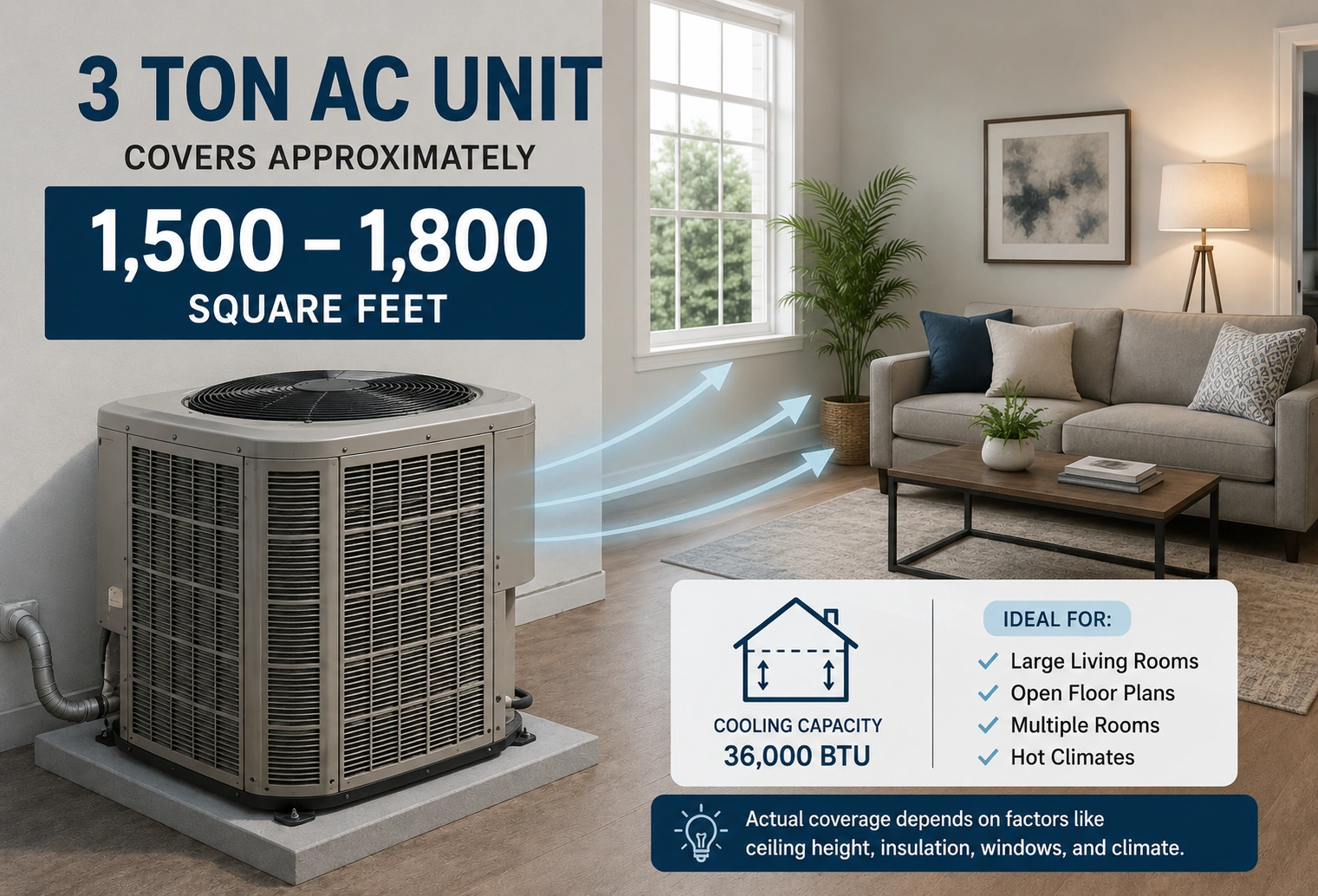
A 3-ton air conditioner has a cooling capacity of 36,000 BTU per hour and can typically cool approximately 1,500–2,100 square feet in a residential application.
A commonly used preliminary estimate is around 20 BTUs per square foot, which gives:
36,000 ÷ 20 = 1,800 square feet
So, about 1,800 square feet is a useful starting estimate for a 3-ton AC unit.
However, the actual area a 3-ton system can cool depends on climate, insulation, windows, ceiling height, home layout, sun exposure, and other heat-gain factors.
Quick Answer
A 3-ton AC unit = 36,000 BTU/hour.
As a rough residential estimate, it may cover approximately 1,500–2,100 square feet, with around 1,800 square feet being a useful midpoint.
| AC Size | BTU/Hour | Approx. Square-Foot Coverage* |
|---|---|---|
| 1.5 ton | 18,000 BTU | 750–1,050 sq ft |
| 2 ton | 24,000 BTU | 1,000–1,400 sq ft |
| 2.5 ton | 30,000 BTU | 1,250–1,750 sq ft |
| 3 ton | 36,000 BTU | 1,500–2,100 sq ft |
| 3.5 ton | 42,000 BTU | 1,750–2,450 sq ft |
| 4 ton | 48,000 BTU | 2,000–2,800 sq ft |
| 5 ton | 60,000 BTU | 2,500–3,500 sq ft |
*These are rough planning estimates, not a substitute for a professional cooling-load calculation.
How Many BTUs Is a 3 Ton AC?
One ton of air-conditioning capacity equals 12,000 BTU/hour.
Therefore:
3 × 12,000 = 36,000 BTU/hour
A 3-ton AC is therefore rated at 36,000 BTU/hour.
This does not mean the unit will use 36,000 BTUs of electricity. BTU/hour describes its cooling capacity, or the amount of heat it can remove under rated conditions.
How Do You Calculate 3 Ton AC Coverage?
A simple preliminary calculation is:
Square Feet = AC BTUs ÷ BTUs per Square Foot
For a 3-ton unit:
36,000 ÷ 20 = 1,800 square feet
If you use 24 BTUs per square foot:
36,000 ÷ 24 = 1,500 square feet
If you use approximately 17 BTUs per square foot:
36,000 ÷ 17 ≈ 2,118 square feet
This demonstrates why different homes can require different AC sizes even when their floor areas are similar.
Is a 3 Ton AC Enough for 1,500 Square Feet?
A 3-ton AC may be sufficient for a 1,500-square-foot home, but the answer depends on the home’s cooling load.
At 1,500 square feet:
36,000 ÷ 1,500 = 24 BTUs per square foot
That can be a reasonable capacity in some warmer or less efficient buildings.
However, if the home is highly insulated and located in a mild climate, a 3-ton system could potentially be larger than necessary.
Is a 3 Ton AC Enough for 1,800 Square Feet?
For many homes, 1,800 square feet is a reasonable target for a 3-ton AC.
The calculation is:
36,000 ÷ 1,800 = 20 BTUs per square foot
That makes 1,800 square feet a useful general estimate.
Still, proper sizing should consider the home’s actual cooling load rather than square footage alone.
Is a 3 Ton AC Enough for 2,000 Square Feet?
A 3-ton AC can cool a 2,000-square-foot home in some circumstances.
The required capacity would be:
36,000 ÷ 2,000 = 18 BTUs per square foot
If the home has good insulation, efficient windows, appropriate shading, and moderate cooling demand, this may be reasonable.
In a very hot climate or a poorly insulated home, however, the required capacity could be higher.
Can a 3 Ton AC Cool 2,500 Square Feet?
A 3-ton system may struggle to cool 2,500 square feet if the building has a high cooling load.
At 2,500 square feet:
36,000 ÷ 2,500 = 14.4 BTUs per square foot
That is considerably lower than many basic residential estimating assumptions.
A 3-ton unit could potentially work in an exceptionally efficient building under favorable conditions, but it should not automatically be selected for a 2,500-square-foot home.
What Factors Affect 3 Ton AC Coverage?
The number of square feet a 3-ton system can comfortably cool depends on more than floor area.
Climate
Homes in hotter climates generally experience greater cooling loads.
A 1,800-square-foot house in a very hot region may require more cooling capacity than a similarly sized house in a mild climate.
Insulation
Good insulation slows heat transfer through walls, ceilings, and roofs.
Poor insulation can increase the amount of heat entering the building.
Windows
Large windows, older single-pane windows, and windows exposed to direct sunlight can increase cooling demand.
Ceiling Height
A home with 8-foot ceilings has less conditioned volume than one with 12-foot ceilings.
Higher ceilings can therefore affect the required cooling capacity.
Sun Exposure
Rooms and homes exposed to strong direct sunlight can gain more heat during the day.
Shading, trees, roof design, and window orientation can all influence cooling demand.
Number of Occupants
People generate heat. A home with many occupants can require more cooling than a similarly sized home with fewer occupants.
Appliances and Lighting
Ovens, refrigerators, computers, televisions, lighting, and other equipment can add heat to the indoor environment.
3 Ton AC Coverage by Home Size
| Home Size | 3 Ton AC Capacity per Sq Ft | General Assessment |
| 1,200 sq ft | 30 BTU/sq ft | May be more capacity than needed |
| 1,500 sq ft | 24 BTU/sq ft | Often reasonable in higher-load conditions |
| 1,800 sq ft | 20 BTU/sq ft | Common planning estimate |
| 2,000 sq ft | 18 BTU/sq ft | May work in efficient homes |
| 2,200 sq ft | 16.4 BTU/sq ft | Depends heavily on conditions |
| 2,500 sq ft | 14.4 BTU/sq ft | May be undersized in many homes |
This table is intended to show how the same 36,000 BTU capacity translates into different BTU-per-square-foot ratios.
What Happens If a 3 Ton AC Is Too Small?
If a 3-ton system does not have enough capacity for the home’s cooling load, it may run for long periods while struggling to reach the thermostat setting.
Possible signs include:
- Long or nearly continuous operation
- Difficulty cooling rooms
- Higher indoor temperatures
- Poor comfort during peak heat
- Uneven temperatures
- Increased energy use
An undersized system may not remove heat quickly enough during the hottest parts of the day.
What Happens If a 3 Ton AC Is Too Large?
Oversizing can also create problems.
A system that is substantially larger than necessary may cool the indoor air quickly and shut off before completing a sufficiently long cycle.
Potential issues include:
- Short cycling
- Uneven temperatures
- Reduced humidity removal
- Increased mechanical wear
- Less comfortable indoor conditions
The goal is not to choose the largest AC possible. The goal is to choose the capacity that matches the actual cooling load.
How Does a 3 Ton AC Compare With Other Sizes?
A 3-ton unit sits in the middle of many residential AC sizing options.
| AC Size | Cooling Capacity | Typical Preliminary Coverage |
| 2 ton | 24,000 BTU | 1,000–1,400 sq ft |
| 2.5 ton | 30,000 BTU | 1,250–1,750 sq ft |
| 3 ton | 36,000 BTU | 1,500–2,100 sq ft |
| 3.5 ton | 42,000 BTU | 1,750–2,450 sq ft |
| 4 ton | 48,000 BTU | 2,000–2,800 sq ft |
| 5 ton | 60,000 BTU | 2,500–3,500 sq ft |
Actual coverage varies with building conditions.
Does a 3 Ton Mini-Split Cover the Same Area?
Not necessarily.
A mini-split and a central AC system with the same nominal BTU capacity can have different installation configurations and performance characteristics.
A 36,000 BTU mini-split may be used to condition multiple zones, while a central system distributes conditioned air through ductwork.
The building’s layout and the number of indoor units are important when determining whether a particular mini-split configuration is appropriate.
How Many Tons of AC Do I Need for 1,800 Square Feet?
A 3-ton system is often a reasonable starting point for an 1,800-square-foot home because:
1,800 × 20 = 36,000 BTU
and:
36,000 BTU ÷ 12,000 = 3 tons
But this is only a rough sizing method.
An HVAC professional can perform a cooling-load calculation using factors such as local climate, insulation, windows, orientation, occupancy, and building construction.
Frequently Asked Questions
How many square feet does a 3 ton AC unit cool?
A 3-ton AC has 36,000 BTU/hour of cooling capacity and may roughly cool 1,500–2,100 square feet in residential applications. Around 1,800 square feet is a common preliminary estimate.
How many BTUs is a 3 ton AC?
A 3-ton AC provides 36,000 BTU/hour of nominal cooling capacity.
Is a 3 ton AC enough for 1,500 square feet?
It can be, particularly in a home with a relatively high cooling load. In a highly efficient home, however, 3 tons could potentially be more capacity than necessary.
Is a 3 ton AC enough for 1,800 square feet?
Yes, 1,800 square feet is a common rough target for a 3-ton AC using a 20-BTU-per-square-foot estimate.
Is a 3 ton AC enough for 2,000 square feet?
It can be, especially in an efficient home with moderate cooling requirements. Proper sizing should be based on a cooling-load calculation.
Is a 3 ton AC enough for 2,500 square feet?
It may be undersized for many homes, particularly in hot climates or buildings with poor insulation.
How many tons of AC do I need for 2,000 square feet?
A rough estimate might place a 2,000-square-foot home around 3–3.5 tons, but the actual requirement depends on the building’s cooling load.
Does climate affect 3 ton AC coverage?
Yes. A 3-ton system may cover fewer square feet in a very hot climate than in a mild climate.
Does insulation affect AC sizing?
Yes. Better insulation generally reduces heat gain and can reduce the cooling capacity needed.
Should I choose an AC based only on square footage?
No. Square footage is useful for an initial estimate, but a proper cooling-load calculation is more accurate and can help prevent both undersizing and oversizing.
Conclusion
A 3-ton AC unit has a nominal cooling capacity of 36,000 BTU/hour. As a rough residential estimate, it can cover approximately 1,500–2,100 square feet, with around 1,800 square feet being a useful midpoint.
The actual coverage depends on climate, insulation, windows, ceiling height, sunlight, occupancy, appliances, and other heat-gain factors.
For example, a 1,800-square-foot home requires:
1,800 × 20 = 36,000 BTU
which equals:
36,000 ÷ 12,000 = 3 tons
This makes a 3-ton system a reasonable preliminary estimate for an 1,800-square-foot home, but it should not be considered an exact sizing rule. For a new installation or replacement, a proper HVAC cooling-load calculation is the best way to determine the appropriate AC capacity.
Discover More Articles
How Many Square Feet Does a Bag of Grout Cover?