

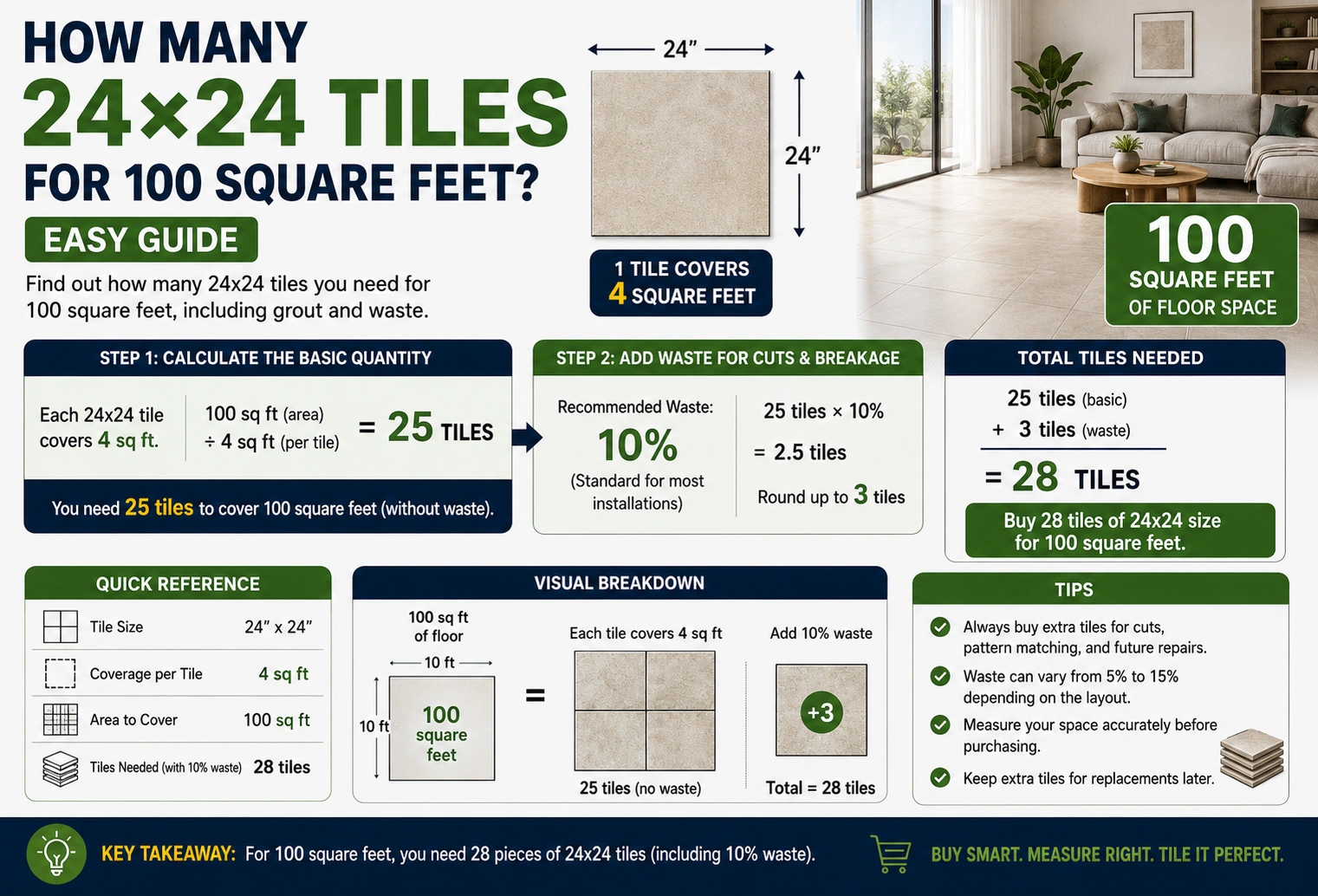
If you’re planning a flooring project, you may be wondering how many 24×24 tiles are needed for 100 square feet.
A 24×24-inch tile measures 2 feet by 2 feet. Its area is therefore:
2 × 2 = 4 square feet
To cover 100 square feet:
100 ÷ 4 = 25 tiles
Quick Answer
✅ You need exactly 25 24×24-inch tiles to cover 100 square feet, before accounting for cuts, breakage, or waste.
For a real installation, it’s generally wise to purchase additional tiles.
Quick Calculation
| Measurement | Result |
|---|---|
| Tile size | 24 × 24 inches |
| Tile size in feet | 2 × 2 feet |
| Area per tile | 4 sq ft |
| Area to cover | 100 sq ft |
| Tiles needed | 25 tiles |
So, 25 tiles cover exactly 100 square feet when there are no cuts or installation losses.
How Much Area Does One 24×24 Tile Cover?
A 24×24-inch tile is equivalent to a 2×2-foot tile.
To calculate its area:
2 ft × 2 ft = 4 square feet
Therefore:
One 24×24 tile covers 4 square feet.
This makes larger-format tiles relatively efficient for covering large, open floor areas.
How to Calculate the Number of Tiles
Use this simple formula:
Number of Tiles = Total Area ÷ Area per Tile
For a 100-square-foot floor:
100 ÷ 4 = 25 tiles
Therefore, the mathematical minimum is 25 tiles.
However, this assumes that every tile can be installed without cutting and that none are damaged.
Real rooms usually require some cutting around:
- Walls
- Doorways
- Cabinets
- Corners
- Closets
- Irregular areas
How Many Tiles Should You Actually Buy?
For most tile installations, you should plan for extra material.
A common allowance is approximately 10% extra.
For 100 square feet:
100 × 1.10 = 110 square feet
Then:
110 ÷ 4 = 27.5 tiles
Since you can’t purchase half a tile, round up.
Recommended purchase: about 28 tiles.
For simple, open layouts, 10% extra may be sufficient. More complicated layouts or diagonal installations may require additional material.
Tile Coverage and Waste Chart
| Coverage Area | Exact Tiles | With 10% Extra |
| 50 sq ft | 13 | 14 |
| 100 sq ft | 25 | 28 |
| 150 sq ft | 38 | 42 |
| 200 sq ft | 50 | 55 |
| 250 sq ft | 63 | 69 |
| 500 sq ft | 125 | 138 |
The numbers are rounded up to the nearest whole tile.
Why Should You Buy Extra Tiles?
Buying exactly 25 tiles for a 100-square-foot floor may not be enough.
Extra tiles help account for:
Cutting Waste
Tiles frequently need to be cut around walls, corners, door frames, and fixtures.
Breakage
Large tiles can break during transportation or installation.
Pattern Matching
Certain tile patterns require additional cuts to maintain alignment.
Future Repairs
Keeping a few spare tiles can be valuable if a tile becomes cracked or damaged later.
How Many Boxes of Tile Do You Need?
Tiles are commonly sold by the box, rather than individually.
The number of boxes depends on the manufacturer’s packaging.
For example, if one box contains 4 tiles:
4 × 4 = 16 square feet per box
To cover 100 square feet:
100 ÷ 16 = 6.25 boxes
You would need to buy 7 boxes before considering additional waste.
Always check the box label for the exact square-foot coverage rather than assuming every box contains the same number of tiles.
Example: Tiling a 10×10 Room
A 10×10 room has:
10 × 10 = 100 square feet
Because each 24×24 tile covers 4 square feet:
100 ÷ 4 = 25 tiles
With approximately 10% extra:
25 × 1.10 = 27.5
Round up:
28 tiles
So a 10×10 room measuring exactly 100 square feet would require 25 tiles mathematically, or roughly 28 tiles with a 10% allowance.
Tips for Planning a 24×24 Tile Project
Measure the Room Carefully
Measure the length and width and multiply them to determine the floor area.
Account for Irregular Areas
Break complicated rooms into smaller rectangles and calculate each section separately.
Check the Tile Packaging
Look at the box for the manufacturer’s stated coverage.
Consider the Installation Pattern
Straight layouts generally create less waste than diagonal or more complicated patterns.
Keep Spare Tiles
Save several unused tiles after installation for potential future repairs.
Common Mistakes
Forgetting to Convert Inches to Feet
A 24-inch tile is 2 feet, not 24 feet.
Buying Exactly 25 Tiles
Twenty-five tiles cover 100 square feet mathematically, but installation usually creates waste.
Ignoring Tile Thickness
Thickness doesn’t change the floor area covered by a tile, but it matters when planning transitions between different flooring materials.
Forgetting Grout Joints
Grout lines slightly change the exact layout, although the overall material estimate should still include an appropriate waste allowance.
9. FAQs
1. How many 24×24 tiles do I need for 100 square feet?
You need 25 tiles to mathematically cover 100 square feet.
2. How many square feet does a 24×24 tile cover?
A 24×24-inch tile is 2×2 feet and covers 4 square feet.
3. Should I buy extra 24×24 tiles?
Yes. Buying approximately 10% extra is a common starting point for accounting for cuts, breakage, and waste. Complex layouts may require more.
4. How many 24×24 tiles do I need for a 10×10 room?
A 10×10 room is 100 square feet, so you need 25 tiles exactly, or approximately 28 tiles with a 10% extra allowance.
5. How many 24×24 tiles are in a box?
The number varies by manufacturer and product. Check the packaging for the number of pieces and total square-foot coverage per box.
6. Can 24×24 tiles be used on floors?
Yes, 24×24 tiles are commonly used for flooring when the selected tile is rated for floor use and the subfloor is properly prepared.
10. Conclusion
If you’re asking how many 24×24 tiles are needed for 100 square feet, the exact answer is 25 tiles. Each 24×24-inch tile measures 2×2 feet and covers 4 square feet.
For an actual flooring installation, buying about 28 tiles provides a 10% allowance for cuts, breakage, and waste. Always check the manufacturer’s box coverage and consider the room’s layout before making your final purchase.
Discover More Articles
How Many Feet Is 36 Inches? Exact Conversion Guide