

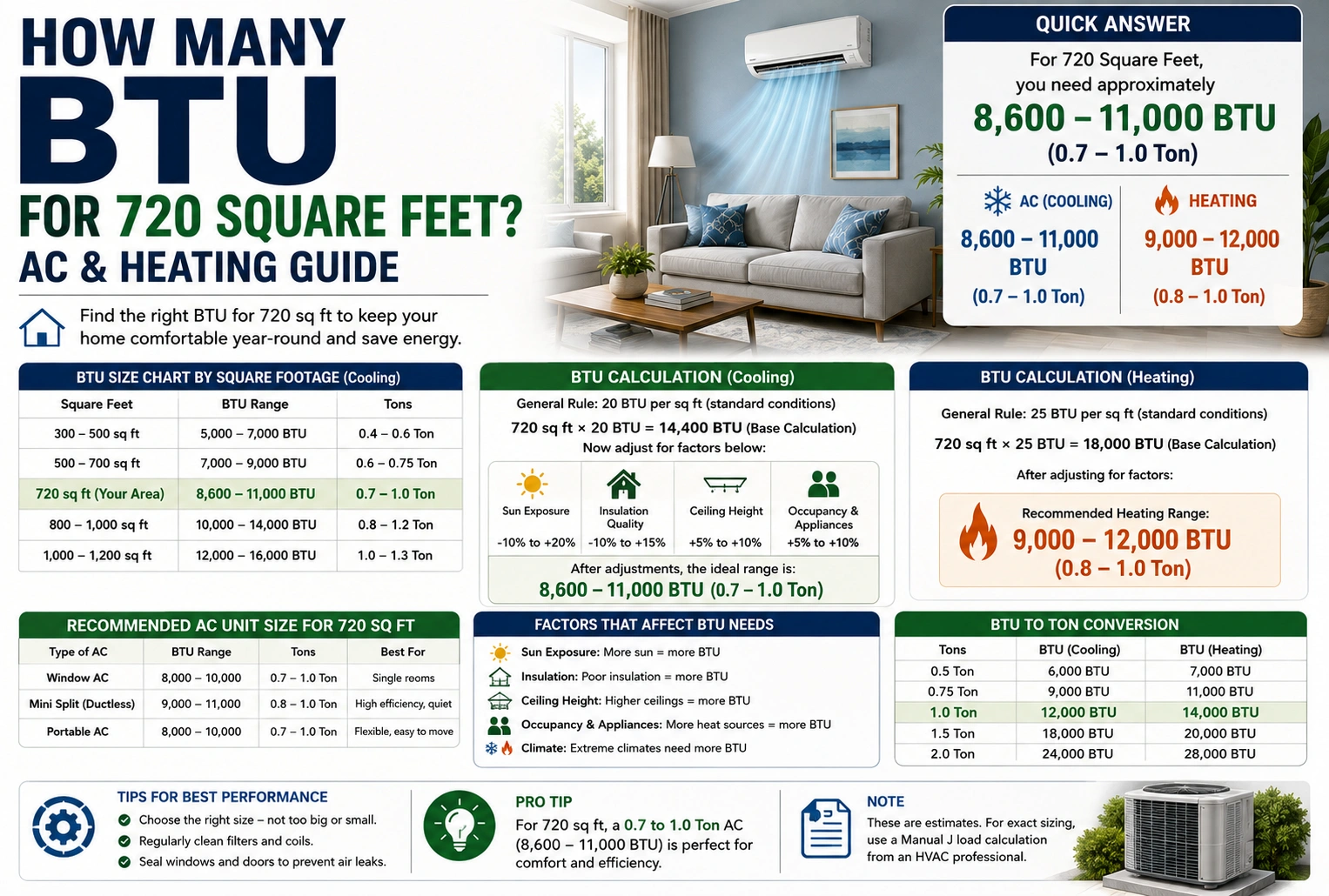
For a 720-square-foot space, the amount of BTU capacity you need depends on whether you are cooling or heating and on factors such as climate, insulation, ceiling height, windows, sunlight, and air leakage.
For cooling, a rough preliminary estimate is approximately 14,000–22,000 BTU per hour, depending on the building and climate.
For heating, the requirement can vary much more widely, with a rough range of approximately 14,000–43,000 BTU per hour depending on climate and insulation.
For many average 720-square-foot spaces, an air conditioner around 18,000 BTU may be considered as a starting point, but the correct capacity should be determined from the actual cooling load.
Quick Answer
| Application | Approximate BTU Range for 720 Sq Ft |
|---|---|
| Mild cooling conditions | 14,000–16,000 BTU/hr |
| Moderate cooling conditions | 16,000–18,000 BTU/hr |
| Hot cooling conditions | 18,000–22,000 BTU/hr |
| Mild heating conditions | 14,000–22,000 BTU/hr |
| Moderate heating conditions | 22,000–29,000 BTU/hr |
| Cold heating conditions | 29,000–43,000 BTU/hr |
These are rough estimates for planning purposes and should not replace a professional HVAC load calculation.
How Many BTUs Do I Need to Cool 720 Square Feet?
A simple preliminary cooling estimate often uses approximately 20–30 BTUs per square foot, although actual HVAC sizing should consider the building’s cooling load.
For 720 square feet:
720 × 20 = 14,400 BTU
At 25 BTUs per square foot:
720 × 25 = 18,000 BTU
At 30 BTUs per square foot:
720 × 30 = 21,600 BTU
This gives a broad estimate of approximately 14,400–21,600 BTU/hr.
For a typical space with average conditions, 18,000 BTU is a useful mathematical midpoint:
720 × 25 = 18,000 BTU
However, that does not mean every 720-square-foot space requires an 18,000-BTU air conditioner.
Is 12,000 BTU Enough for 720 Square Feet?
A 12,000-BTU air conditioner provides:
12,000 ÷ 720 ≈ 16.7 BTU per square foot
Whether that is enough depends on the building.
A highly efficient, well-shaded space in a mild climate could potentially require less cooling than a poorly insulated space in a hot climate.
For many 720-square-foot spaces, however, 12,000 BTU may be on the lower side if the cooling load is closer to 18,000 BTU.
Is 15,000 BTU Enough for 720 Square Feet?
A 15,000-BTU system provides:
15,000 ÷ 720 ≈ 20.8 BTU per square foot
This can be appropriate under some moderate conditions, but actual requirements depend on climate, insulation, windows, ceiling height, and heat gain.
Is 18,000 BTU Enough for 720 Square Feet?
An 18,000-BTU air conditioner provides:
18,000 ÷ 720 = 25 BTU per square foot
This matches a common preliminary estimate of 25 BTUs per square foot.
Therefore, 18,000 BTU may be a reasonable starting point for some 720-square-foot spaces, especially when conditions are moderate.
But a load calculation should be used before making a final equipment choice.
Is 24,000 BTU Too Much for 720 Square Feet?
A 24,000-BTU air conditioner provides:
24,000 ÷ 720 ≈ 33.3 BTU per square foot
That may be more capacity than necessary for many 720-square-foot spaces.
An oversized air conditioner can cool the room quickly but may not run long enough to remove humidity effectively.
It can also result in frequent cycling and uneven comfort.
However, whether 24,000 BTU is oversized depends on the actual cooling load and climate.
How Many Tons Is 18,000 BTU?
In air conditioning:
1 ton = 12,000 BTU/hr
Therefore:
18,000 ÷ 12,000 = 1.5 tons
So an 18,000-BTU air conditioner is a 1.5-ton system.
For a 720-square-foot space, a 1.5-ton unit may be considered during preliminary sizing, depending on the building’s actual cooling requirements.
AC Size for 720 Square Feet
| AC Capacity | BTU/hr | BTU per Sq Ft |
| 1 ton | 12,000 | 16.7 |
| 1.25 tons | 15,000 | 20.8 |
| 1.5 tons | 18,000 | 25.0 |
| 1.75 tons | 21,000 | 29.2 |
| 2 tons | 24,000 | 33.3 |
This table shows the mathematical relationship between AC capacity and 720 square feet. The correct equipment size still depends on the actual cooling load.
How Many BTUs Do I Need to Heat 720 Square Feet?
Heating requirements can vary considerably based on climate and building efficiency.
A rough preliminary estimate might use approximately 20–60 BTUs per square foot.
For 720 square feet:
720 × 20 = 14,400 BTU
720 × 40 = 28,800 BTU
720 × 60 = 43,200 BTU
That produces a broad estimate of approximately 14,400–43,200 BTU/hr.
A mild-climate, well-insulated space may require much less heating capacity than a poorly insulated space in a cold climate.
Heating BTU Estimates for 720 Square Feet
| Heating Requirement | BTU per Sq Ft | BTUs for 720 Sq Ft |
| Mild | 20 | 14,400 BTU |
| Moderate | 30 | 21,600 BTU |
| Moderate-cold | 40 | 28,800 BTU |
| Cold | 50 | 36,000 BTU |
| Very cold | 60 | 43,200 BTU |
These numbers are preliminary estimates rather than final furnace-sizing recommendations.
What Size Furnace for 720 Square Feet?
A 720-square-foot space may require a relatively small heating system, but the appropriate furnace size depends on the calculated heat loss.
For example, if the estimated heat requirement is 25,000 BTU/hr, a furnace capable of delivering approximately that amount of output may be appropriate.
Furnace ratings can be confusing because manufacturers commonly list input BTUs, while the actual heat delivered to the home depends on efficiency.
For example, an 80,000-BTU furnace operating at 80% efficiency has a nominal output of approximately:
80,000 × 0.80 = 64,000 BTU
That would likely be considerably more capacity than a typical 720-square-foot space needs, depending on climate.
What Factors Affect BTU Requirements for 720 Square Feet?
Square footage is only one part of HVAC sizing.
Climate
Outdoor temperatures strongly affect both heating and cooling requirements.
A 720-square-foot home in a hot climate can need substantially more cooling than one in a mild climate.
Similarly, a cold winter climate can increase heating requirements.
Insulation
Good insulation helps prevent unwanted heat transfer.
A well-insulated space generally needs less heating and cooling capacity than a poorly insulated one.
Windows
Large windows can increase cooling loads through solar heat gain.
Older or inefficient windows can also increase heating requirements during cold weather.
Ceiling Height
A 720-square-foot room with 8-foot ceilings contains:
720 × 8 = 5,760 cubic feet
With 10-foot ceilings:
720 × 10 = 7,200 cubic feet
The second space has more conditioned air volume, which can affect HVAC requirements.
Sun Exposure
A room with large west-facing windows can become considerably hotter in the afternoon than a shaded space.
This can increase the cooling load.
Air Leakage
Gaps around doors, windows, ducts, and other openings allow conditioned air to escape and outdoor air to enter.
Better air sealing can reduce heating and cooling demand.
Why You Should Not Choose an AC Based Only on 720 Square Feet
Two 720-square-foot homes can require different AC capacities.
For example, one might be:
- Well insulated
- Shaded
- Energy efficient
- Located in a mild climate
Another might be:
- Poorly insulated
- Exposed to direct sunlight
- Have older windows
- Located in a hot climate
The second home could require substantially more cooling.
A professional cooling-load calculation accounts for these differences.
Can an AC Be Too Large for 720 Square Feet?
Yes.
Oversizing an AC is not necessarily better.
A unit that is too large can cool the space very quickly and shut off before sufficiently removing humidity.
This can cause:
- Short cycling
- Higher indoor humidity
- Uneven temperatures
- Reduced comfort
- More frequent system starts
The goal is to match the cooling capacity to the actual load.
Can an AC Be Too Small for 720 Square Feet?
Yes.
An undersized system may struggle to maintain the desired temperature during the hottest days.
It may run continuously without adequately cooling the space.
Potential results include:
- Poor comfort
- Long operating cycles
- Increased wear
- Higher energy use
- Difficulty reaching the thermostat setting
Proper sizing helps avoid both problems.
Frequently Asked Questions
How many BTUs do I need for 720 square feet?
For cooling, a rough preliminary estimate is approximately 14,400–21,600 BTU/hr, while a common midpoint calculation is 18,000 BTU. Actual requirements vary by climate and building conditions.
Is 12,000 BTU enough for 720 square feet?
It may be enough in some highly efficient or mild-climate spaces, but 12,000 BTU can be on the low side for a typical 720-square-foot space with a higher cooling load.
Is 18,000 BTU enough for 720 square feet?
It can be. An 18,000-BTU unit provides 25 BTUs per square foot, which is a reasonable preliminary estimate for some average conditions.
How many tons is 18,000 BTU?
18,000 BTU equals 1.5 tons of cooling capacity.
Is a 2-ton AC too big for 720 square feet?
It could be. A 2-ton unit provides 24,000 BTU/hr, or about 33.3 BTUs per square foot. Whether that is oversized depends on the home’s actual cooling load.
How many BTUs do I need to heat 720 square feet?
A rough heating estimate can range from approximately 14,400–43,200 BTU/hr, depending heavily on climate, insulation, windows, and air leakage.
Does insulation affect how many BTUs I need?
Yes. Better insulation generally lowers the amount of heating and cooling capacity required.
Does climate affect BTU requirements?
Yes. Climate is one of the most important factors in HVAC sizing. Hot climates generally increase cooling requirements, while cold climates increase heating requirements.
Conclusion
So, how many BTU for 720 square feet?
For cooling, a rough preliminary estimate is approximately 14,400–21,600 BTU/hr, with 18,000 BTU representing a useful midpoint calculation for average conditions.
The calculation is:
720 × 25 = 18,000 BTU
An 18,000-BTU air conditioner is equal to:
18,000 ÷ 12,000 = 1.5 tons
For heating, the requirement can vary much more widely, with a rough estimate of approximately 14,400–43,200 BTU/hr depending on climate and building efficiency.
The actual HVAC size should be based on a professional heating or cooling load calculation, not square footage alone. Insulation, windows, ceiling height, sun exposure, air leakage, climate, and occupancy can all change the amount of BTU capacity your 720-square-foot space needs.
Discover More Articles
How Many Cubic Feet Are in a 53 Foot Trailer?