

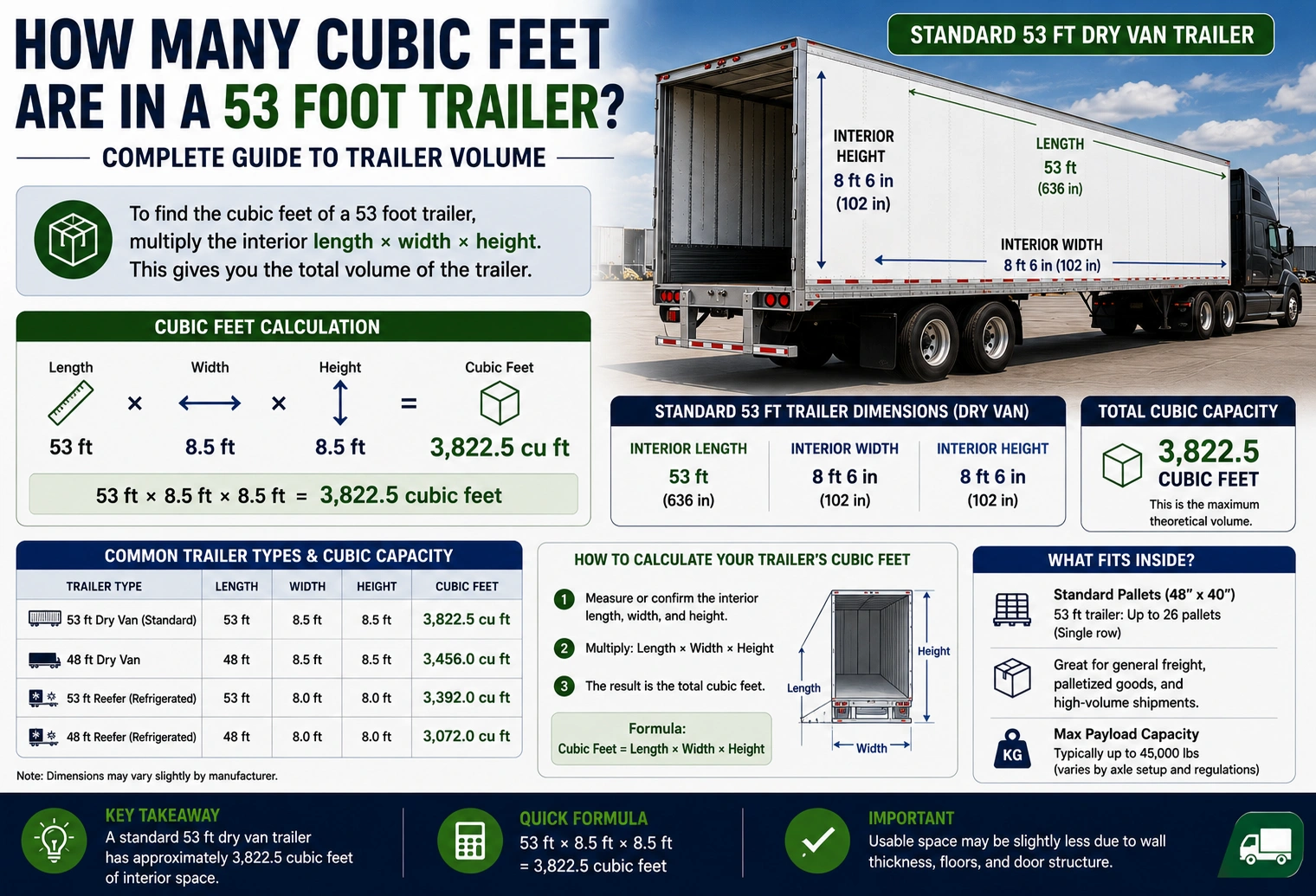
A typical 53-foot dry van trailer contains approximately 3,500–3,800 cubic feet of interior cargo volume, depending on its actual interior dimensions.
A common example uses approximately:
- 52.5 feet of interior length
- 8.25 feet of interior width
- 8.5 feet of interior height
The volume calculation is:
52.5 × 8.25 × 8.5 = 3,681 cubic feet
So, a typical 53-foot trailer can provide around 3,600–3,800 cubic feet of interior space.
The exact volume varies by trailer manufacturer, wall thickness, interior height, flooring, doors, and whether the trailer is a dry van or refrigerated trailer.
Quick Answer
A standard 53-foot dry van trailer generally has about 3,500–3,800 cubic feet of interior volume.
| Interior Dimension | Example Measurement |
|---|---|
| Length | 52.5 ft |
| Width | 8.25 ft |
| Height | 8.5 ft |
| Approx. Volume | 3,681 cu ft |
The actual interior dimensions should be checked for the specific trailer when planning freight.
How Do You Calculate Cubic Feet in a 53 Foot Trailer?
The basic formula for calculating trailer volume is:
Cubic Feet = Length × Width × Height
For example, using 52.5 feet long, 8.25 feet wide, and 8.5 feet high:
52.5 × 8.25 × 8.5 = 3,681.6 cubic feet
Rounded to the nearest whole number, that is approximately 3,682 cubic feet.
This calculation measures the theoretical interior volume. The amount of cargo you can actually load may be lower because of pallets, packaging, load restrictions, trailer structure, and available door space.
What Are the Interior Dimensions of a 53 Foot Trailer?
Although dimensions vary, a typical 53-foot dry van may have interior measurements close to the following:
| Dimension | Typical Approximate Measurement |
| Interior length | 52–53 ft |
| Interior width | 8–8.5 ft |
| Interior height | 8.5–9 ft |
| Floor area | About 416–450 sq ft |
| Interior volume | About 3,500–3,800 cu ft |
These measurements are approximate rather than universal specifications.
A particular trailer may have different dimensions, so manufacturers’ specifications are the best source for exact cargo-volume calculations.
How Many Cubic Feet Does a 53 Foot Dry Van Hold?
A typical 53-foot dry van holds approximately 3,500–3,800 cubic feet.
For example, using dimensions of 52.5 × 8.25 × 8.5 feet:
52.5 × 8.25 × 8.5 ≈ 3,682 cubic feet
This makes approximately 3,682 cubic feet a useful example when estimating the interior capacity of a standard 53-foot dry van.
Can a 53 Foot Trailer Hold 4,000 Cubic Feet?
Most standard 53-foot dry vans do not provide a full 4,000 cubic feet of interior volume.
To reach 4,000 cubic feet, the trailer would need a combination of greater interior length, width, or height than many standard 53-foot trailers provide.
For example, if a trailer is 52.5 feet long and 8.5 feet wide, it would need an interior height of:
4,000 ÷ (52.5 × 8.5) ≈ 8.96 feet
Some trailer configurations may approach this volume, but you should use the actual manufacturer’s interior dimensions rather than assuming every 53-foot trailer has 4,000 cubic feet.
53 Foot Trailer Volume at Different Interior Heights
Height has a major effect on cubic-foot capacity.
Using 52.5 feet of interior length and 8.25 feet of width:
| Interior Height | Approx. Cubic Feet |
| 8 ft | 3,465 cu ft |
| 8.5 ft | 3,682 cu ft |
| 9 ft | 3,898 cu ft |
| 9.5 ft | 4,114 cu ft |
| 10 ft | 4,331 cu ft |
This demonstrates why trailer height is important when calculating total cargo volume.
53 Foot Trailer Cubic Feet vs. Other Trailer Sizes
Trailer length has a significant effect on interior volume.
Assuming approximately 8.25 feet of interior width and 8.5 feet of interior height:
| Trailer Length | Approx. Cubic Feet |
| 28 ft | 1,964 cu ft |
| 40 ft | 2,805 cu ft |
| 45 ft | 3,155 cu ft |
| 48 ft | 3,365 cu ft |
| 53 ft | 3,682 cu ft |
These figures are estimates using the same width and height for comparison. Actual trailer dimensions vary.
How Much Floor Space Does a 53 Foot Trailer Have?
Cubic feet measures total volume, while square feet measures floor area.
For example:
52.5 × 8.25 = 433.1 square feet
So a trailer with those interior dimensions has approximately 433 square feet of floor space.
Adding an interior height of 8.5 feet gives:
433.1 × 8.5 ≈ 3,682 cubic feet
This is why both floor area and interior height are needed to calculate cubic capacity.
How Many Pallets Fit in a 53 Foot Trailer?
A standard 53-foot dry van can commonly accommodate around 26 standard 48-by-40-inch pallets, depending on the loading arrangement.
However, pallet count is not the same as cubic-foot capacity.
A shipment can use only part of the trailer’s floor area while still reaching its maximum height. Conversely, bulky freight may fill much of the trailer’s volume without reaching the maximum weight limit.
Pallet dimensions, loading orientation, freight height, weight, and packaging all affect the actual number of pallets that can be transported.
How Many Cubic Feet Does a Pallet Take?
A standard 48-by-40-inch pallet has a floor footprint of approximately:
4 × 3.333 = 13.33 square feet
If the loaded pallet is 4 feet high:
13.33 × 4 ≈ 53.3 cubic feet
If the loaded pallet is 6 feet high:
13.33 × 6 ≈ 80 cubic feet
Therefore, pallet volume depends heavily on the height of the loaded freight.
| Pallet Height | Approx. Volume for 48 × 40 in. Pallet |
| 3 ft | 40 cu ft |
| 4 ft | 53 cu ft |
| 5 ft | 67 cu ft |
| 6 ft | 80 cu ft |
| 7 ft | 93 cu ft |
These are approximate geometric volumes and do not account for irregular shapes or packaging gaps.
Does a Reefer Have the Same Cubic Feet as a Dry Van?
Not necessarily.
A refrigerated trailer, or reefer, requires insulated walls and refrigeration equipment.
The insulation can reduce the interior width compared with some dry van designs. Refrigeration equipment can also affect usable space.
As a result, a 53-foot reefer may have a somewhat different internal volume than a 53-foot dry van, even though both have the same nominal length.
Always check the specific trailer’s interior dimensions.
Does Trailer Weight Limit Matter?
Yes.
Cubic capacity does not tell you how much freight can legally be transported.
A trailer may have enough volume to hold a shipment but reach its legal weight limit before the trailer is physically full.
This is particularly important for dense cargo such as:
- Machinery
- Metal products
- Building materials
- Paper
- Heavy equipment
- Bulk packaged goods
For lightweight but bulky freight, volume may be the limiting factor instead.
Cubic Feet vs. Weight Capacity
These two measurements describe different limitations.
| Factor | What It Measures |
| Cubic feet | Available interior volume |
| Square feet | Available floor area |
| Payload weight | How much cargo weight can be carried |
| Pallet count | Number of pallets that can physically fit |
| Trailer height | Vertical loading space |
A shipment must satisfy all relevant physical and legal restrictions.
What Reduces Usable Trailer Volume?
The theoretical volume calculated from length × width × height may be greater than the practical cargo space.
Usable space can be affected by:
- Interior walls
- Trailer doors
- Wheel areas on certain trailer designs
- Refrigeration equipment
- Uneven cargo
- Pallet spacing
- Packaging
- Load-securing equipment
- Required clearance
- Freight shape
For this reason, the calculated cubic footage should be treated as an estimate of interior volume rather than guaranteed usable cargo volume.
How Many Cubic Feet Is a 53 Foot Trailer With 9-Foot Height?
Using 52.5 feet of length, 8.25 feet of width, and 9 feet of height:
52.5 × 8.25 × 9 = 3,898.1 cubic feet
So the approximate volume would be 3,898 cubic feet.
A trailer with greater interior height can therefore hold considerably more volume than one with an 8-foot interior height.
How Many Cubic Feet Is a 53 Foot Trailer With 8.5-Foot Height?
Using 52.5 feet of interior length and 8.25 feet of interior width:
52.5 × 8.25 × 8.5 = 3,681.6 cubic feet
That gives approximately 3,682 cubic feet.
This is a useful reference calculation for a typical 53-foot dry van configuration.
Frequently Asked Questions
How many cubic feet are in a 53-foot trailer?
A typical 53-foot dry van contains approximately 3,500–3,800 cubic feet of interior volume, depending on its exact dimensions.
How many cubic feet does a 53-foot dry van hold?
A common estimate is around 3,600–3,800 cubic feet. For example, 52.5 × 8.25 × 8.5 feet gives approximately 3,682 cubic feet.
How do you calculate the cubic feet of a trailer?
Multiply the interior length by the interior width and interior height:
Length × Width × Height = Cubic Feet
How much cargo can a 53-foot trailer hold?
A 53-foot trailer’s cargo capacity depends on both volume and weight. A typical dry van may provide around 3,500–3,800 cubic feet and can commonly accommodate about 26 standard pallets, depending on the freight and loading configuration.
Does a 53-foot trailer have 4,000 cubic feet?
Most standard 53-foot dry vans are below 4,000 cubic feet, although some taller configurations can approach or exceed that amount.
How many cubic feet is a 53-foot trailer at 8.5 feet tall?
Using 52.5 feet of interior length and 8.25 feet of interior width, an 8.5-foot interior height gives approximately 3,682 cubic feet.
How many cubic feet is a 53-foot trailer at 9 feet tall?
Using the same 52.5 × 8.25-foot floor dimensions, a 9-foot interior height gives approximately 3,898 cubic feet.
Is cubic footage the same as trailer capacity?
No. Cubic footage measures physical interior volume. Actual cargo capacity is also limited by weight, loading configuration, trailer specifications, and legal restrictions.
Conclusion
So, how many cubic feet are in a 53-foot trailer? A typical 53-foot dry van has approximately 3,500–3,800 cubic feet of interior volume.
A representative calculation is:
52.5 × 8.25 × 8.5 = 3,681.6 cubic feet
So you can use about 3,682 cubic feet as a practical example for a 53-foot trailer with those interior dimensions.
The exact cubic footage depends on the trailer’s actual interior length, width, and height. Dry vans, reefers, and other trailer types can have different usable dimensions. For freight planning, always check the manufacturer’s interior specifications and consider both volume and weight capacity before determining how much cargo a trailer can carry.
Discover More Articles
3 Ton AC Unit Covers How Many Square Feet? Guide