

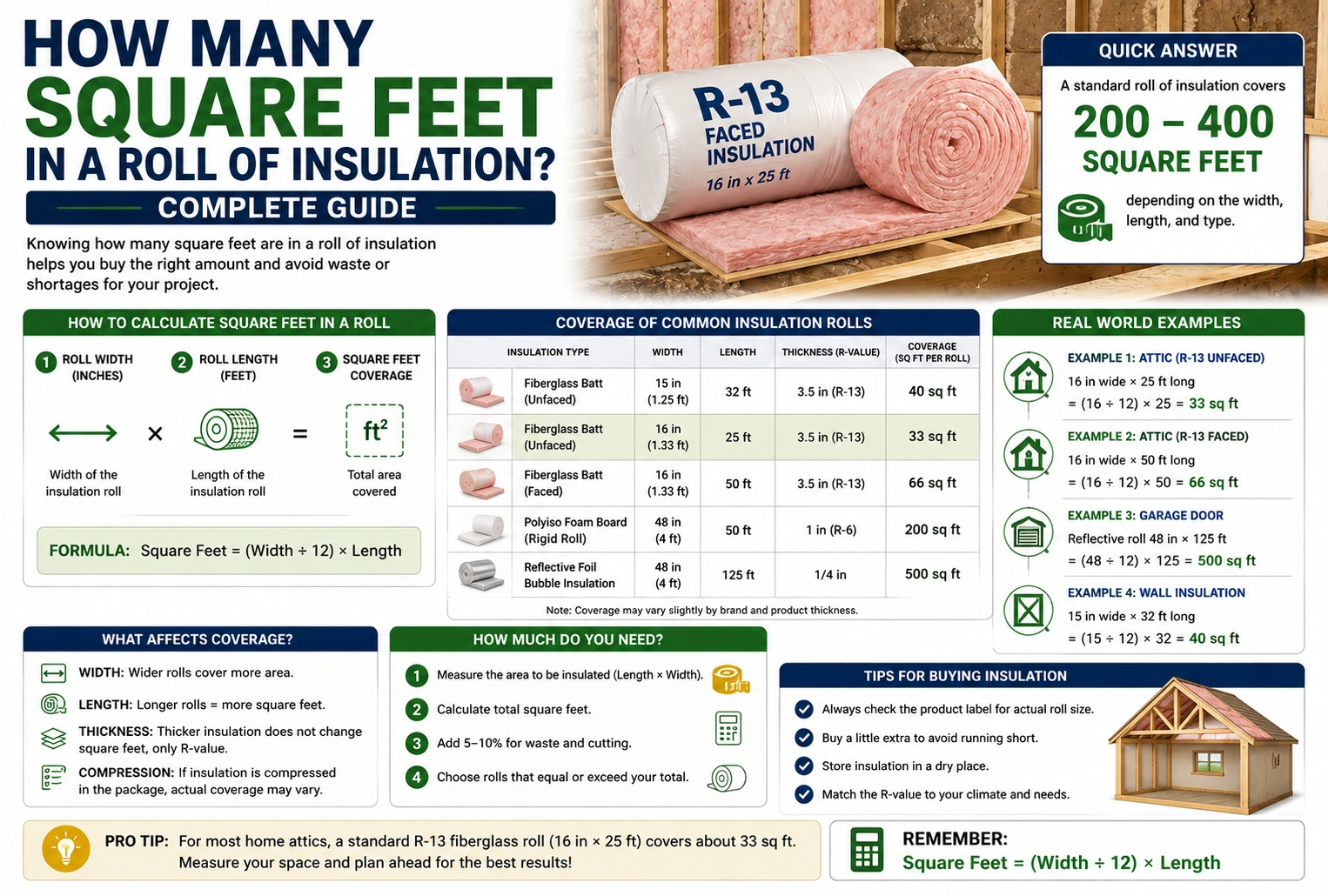
If you’re wondering how many square feet are in a roll of insulation, the answer depends on the insulation product, width, thickness, and roll length.
A typical fiberglass insulation roll may cover approximately 40 to 100+ square feet, while some large rolls can cover considerably more.
Always check the package because manufacturers sell insulation rolls in many different dimensions and R-values.
| Roll Type | Approximate Coverage |
|---|---|
| Small roll | 25–50 sq ft |
| Medium roll | 40–80 sq ft |
| Large roll | 80–100+ sq ft |
| High-coverage rolls | 100–200+ sq ft |
The package’s listed square-foot coverage is the most accurate number to use for your project.
How Many Square Feet Does a Roll of Insulation Cover?
There is no universal size for a roll of insulation.
The total coverage depends on:
- Roll width
- Roll length
- Insulation thickness
- R-value
- Manufacturer
- Product type
- Intended application
For example, if a roll is 3 feet wide and 20 feet long:
3 × 20 = 60 square feet
That roll would cover 60 square feet before accounting for cutting waste.
If another roll is 4 feet wide and 25 feet long:
4 × 25 = 100 square feet
That roll covers 100 square feet.
This is why simply asking how many square feet are in “a roll” does not produce one exact number.
Common Insulation Roll Sizes
Fiberglass and mineral wool insulation are commonly sold in different widths and lengths.
Common widths can include approximately:
- 15 inches
- 16 inches
- 23 inches
- 24 inches
- 3 feet
- 4 feet
Roll lengths can vary widely.
Some rolls are designed to fit standard wall cavities, while others are made for attics, floors, ceilings, or other applications.
| Example Width | Example Length | Coverage |
|---|---|---|
| 2 ft | 20 ft | 40 sq ft |
| 3 ft | 20 ft | 60 sq ft |
| 3 ft | 25 ft | 75 sq ft |
| 4 ft | 20 ft | 80 sq ft |
| 4 ft | 25 ft | 100 sq ft |
| 4 ft | 30 ft | 120 sq ft |
These are example dimensions to show how coverage is calculated. Actual commercial insulation products may use different dimensions.
How to Calculate Square Feet in a Roll
If the insulation roll dimensions are given, calculating coverage is simple.
Use:
Square Feet = Width × Length
Make sure both measurements use the same unit.
Example
Suppose a roll is:
- 4 feet wide
- 25 feet long
Calculate:
4 × 25 = 100 square feet
Therefore, the roll provides approximately 100 square feet of coverage.
What If the Width Is in Inches?
Suppose a roll is 24 inches wide and 25 feet long.
First convert 24 inches to feet:
24 ÷ 12 = 2 feet
Then:
2 × 25 = 50 square feet
So the roll covers 50 square feet.
How Many Rolls Do You Need?
Once you know the area you need to insulate and the coverage per roll, you can calculate the number of rolls.
Use:
Number of Rolls = Total Area ÷ Coverage per Roll
For example, suppose your project requires 800 square feet and each roll covers 80 square feet.
800 ÷ 80 = 10 rolls
You would need 10 rolls before accounting for waste.
It is usually wise to purchase a little extra because insulation often needs to be cut around:
- Windows
- Doors
- Electrical boxes
- Pipes
- Ductwork
- Corners
- Structural framing
How Many Rolls for 500 Square Feet?
The answer depends on the coverage of each roll.
| Coverage per Roll | Rolls for 500 sq ft |
|---|---|
| 40 sq ft | 12.5 → 13 rolls |
| 50 sq ft | 10 rolls |
| 60 sq ft | 8.33 → 9 rolls |
| 80 sq ft | 6.25 → 7 rolls |
| 100 sq ft | 5 rolls |
| 120 sq ft | 4.17 → 5 rolls |
You must round up, because you cannot purchase a fraction of a roll.
How Many Rolls for 1,000 Square Feet?
For a 1,000-square-foot project:
| Coverage per Roll | Rolls Needed |
|---|---|
| 40 sq ft | 25 rolls |
| 50 sq ft | 20 rolls |
| 60 sq ft | 17 rolls |
| 80 sq ft | 13 rolls |
| 100 sq ft | 10 rolls |
| 120 sq ft | 9 rolls |
| 150 sq ft | 7 rolls |
These figures are calculated by dividing 1,000 square feet by the coverage of one roll and rounding up.
How Many Rolls for 2,000 Square Feet?
For a 2,000-square-foot insulation project:
| Coverage per Roll | Rolls Needed |
|---|---|
| 40 sq ft | 50 rolls |
| 50 sq ft | 40 rolls |
| 60 sq ft | 34 rolls |
| 80 sq ft | 25 rolls |
| 100 sq ft | 20 rolls |
| 120 sq ft | 17 rolls |
| 150 sq ft | 14 rolls |
| 200 sq ft | 10 rolls |
Again, these numbers represent the theoretical quantity before allowing for cutting and waste.
Add Extra for Waste
Insulation rarely fits every space perfectly.
You may have to cut around framing, openings, utilities, and irregular areas.
For a straightforward project, adding around 5–10% to your calculated quantity can provide a useful allowance.
For example, if you calculate that you need 1,000 square feet:
1,000 × 1.10 = 1,100 square feet
You could plan for approximately 1,100 square feet of material.
The amount of extra material needed depends on the complexity of the installation.
Does R-Value Affect Coverage?
Yes, the insulation’s R-value is important when choosing a product, but R-value does not directly tell you how many square feet a roll covers.
R-value describes the insulation’s resistance to heat flow.
Two rolls can have similar coverage but different R-values.
For example, you might find products designed to provide:
- R-13
- R-15
- R-19
- R-21
- R-30
The appropriate R-value depends on the location of the insulation and the building requirements.
Always choose insulation based on the required performance, not just the number of square feet per roll.
Roll Insulation vs. Batt Insulation
Rolls and batts are both common forms of insulation.
Roll Insulation
Rolls are continuous lengths of insulation.
They can be useful when covering long, uninterrupted spaces.
Advantages may include:
- Continuous coverage
- Fewer seams in some applications
- Convenient for long runs
- Flexible installation
Batt Insulation
Batts are pre-cut pieces.
They are often designed to fit standard spaces between framing members.
Advantages may include:
- Easier handling
- Standardized dimensions
- Convenient for individual wall cavities
- Less measuring in repetitive spaces
The best option depends on the application and the dimensions of the area being insulated.
Price Comparison: Insulation by Square Foot
When comparing insulation products, don’t look only at the price of one roll.
Compare the cost per square foot.
The formula is:
Cost per Square Foot = Roll Price ÷ Square Feet per Roll
For example, suppose:
- Roll A costs $40
- Roll A covers 80 square feet
Then:
$40 ÷ 80 = $0.50 per square foot
Now suppose:
- Roll B costs $55
- Roll B covers 100 square feet
Then:
$55 ÷ 100 = $0.55 per square foot
Roll A would have the lower cost per square foot in this example.
| Product Example | Price | Coverage | Cost per Sq Ft |
|---|---|---|---|
| Roll A | $40 | 80 sq ft | $0.50 |
| Roll B | $55 | 100 sq ft | $0.55 |
| Roll C | $70 | 140 sq ft | $0.50 |
These are example prices for demonstrating the calculation, not current retail prices.
Also compare R-value and product suitability. The cheapest cost per square foot is not necessarily the best choice if it doesn’t meet your insulation requirements.
How to Measure an Area for Insulation
Walls
Measure the wall’s width and height.
Then:
Width × Height = Wall Area
Subtract large openings such as doors and windows when appropriate.
Attic
For a simple rectangular attic:
Length × Width = Area
For irregular spaces, divide the area into smaller rectangles and add them together.
Floor
Measure the length and width of the floor area:
Length × Width = Square Feet
Once you know the square footage, divide it by the product’s listed coverage per roll.
Common Insulation Calculation Mistakes
Mistake 1: Assuming Every Roll Has the Same Coverage
Roll dimensions vary widely.
Always check the package.
Mistake 2: Ignoring R-Value
Coverage is only one part of choosing insulation.
The product must also provide the appropriate thermal performance.
Mistake 3: Forgetting Waste
Cutting around obstacles can increase the amount of material required.
Mistake 4: Confusing Roll Dimensions With Coverage
A roll’s length alone doesn’t tell you its square footage.
You need:
Width × Length
Mistake 5: Rounding Down
If you need 10.2 rolls, you need 11 rolls, not 10.
FAQs
1. How many square feet are in a roll of insulation?
There is no standard amount. Many insulation rolls cover approximately 40–100+ square feet, while some larger products cover considerably more. Check the product label for exact coverage.
2. How do I calculate insulation roll coverage?
Multiply the roll’s width by its length after converting both measurements into feet.
Width × Length = Square Feet
3. How many rolls of insulation do I need for 1,000 square feet?
It depends on the coverage per roll. For example, if each roll covers 100 square feet, you need 10 rolls before accounting for waste.
4. Should I buy extra insulation?
Usually, some extra material is useful because insulation may need to be cut around windows, doors, framing, pipes, and other obstacles. A 5–10% allowance can be a reasonable starting point.
5. Does a higher R-value mean a roll covers more square feet?
No. R-value measures resistance to heat flow, while square-foot coverage measures the physical area covered by the roll. A higher R-value does not automatically mean greater coverage.
Conclusion
So, how many square feet are in a roll of insulation? There is no single standard answer. A typical roll may cover around 40 to 100+ square feet, while larger products can cover considerably more.
The exact coverage depends on the roll’s dimensions.
Use this simple formula:
Square Feet = Width × Length
Then calculate how many rolls you need:
Total Rolls = Project Area ÷ Coverage per Roll
For example, if your project is 1,000 square feet and each roll covers 100 square feet, you need 10 rolls, plus some extra material for cutting and waste.
Most importantly, check the square-foot coverage and R-value printed on the specific insulation package before purchasing.
Discover More Articles
How Many Cubic Feet Are in a 53 Foot Trailer?