
If you’ve ever wondered how many car lengths is 100 feet, you’re not alone. This question often comes up when learning about safe following distances, estimating parking space, measuring property, or simply trying to visualize a distance.
Because vehicles come in different sizes, there isn’t one exact answer. However, the average passenger car is about 15 feet long, making it easy to estimate.
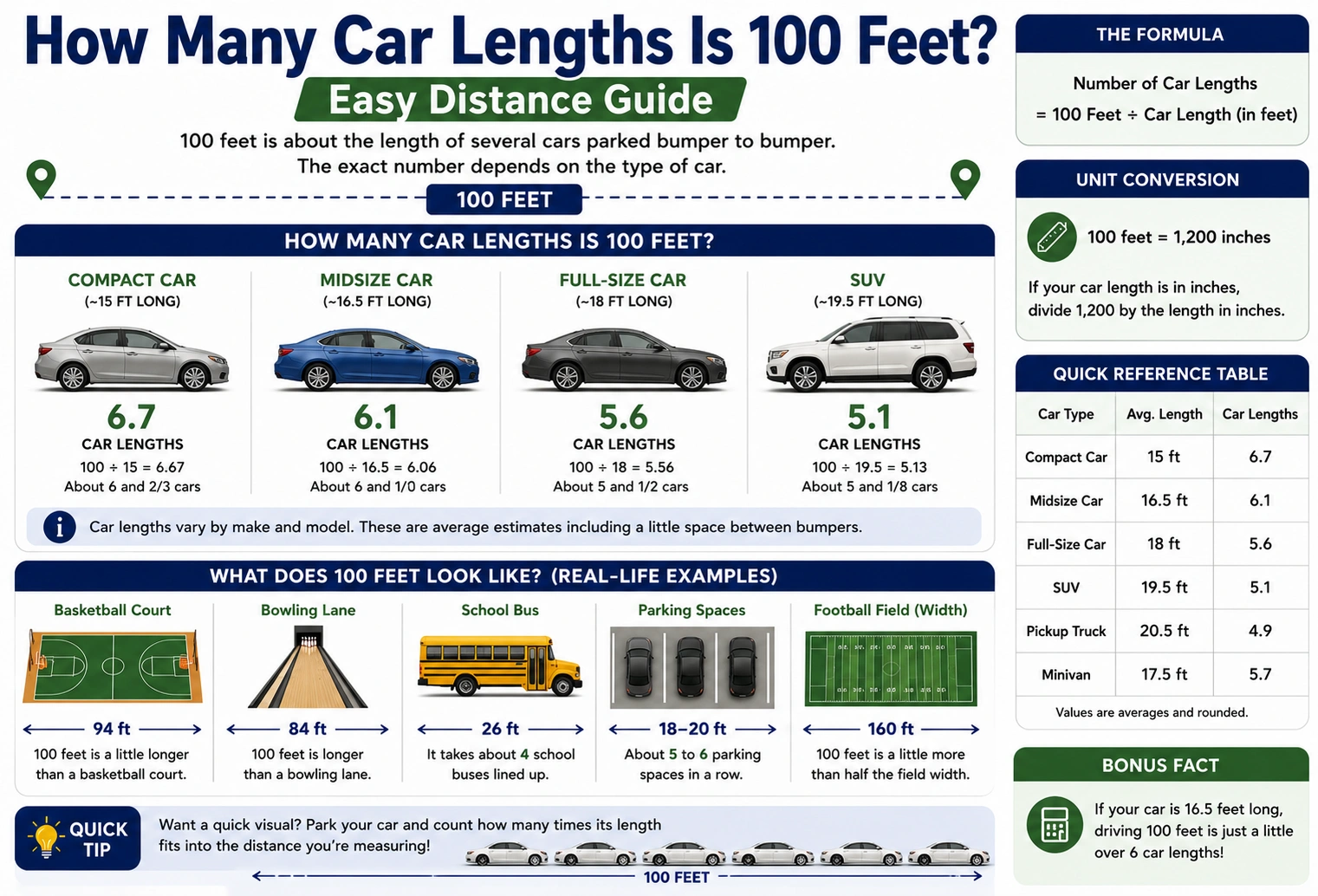
Using that average, 100 feet is approximately 6.7 average car lengths.
In this guide, you’ll learn how the calculation works, how different vehicle sizes affect the answer, and where this measurement is commonly used.
Quick Answer
The average passenger car is approximately 15 feet long.
Calculation:
100 ÷ 15 = 6.67
Answer:
100 feet is approximately 6.7 average car lengths.
Depending on vehicle type, the number ranges from about 5 to 8 car lengths.
What Is the Average Car Length?
Vehicle lengths vary depending on the model.
Typical averages include:
| Vehicle Type | Average Length |
|---|---|
| Compact Car | 13–14 feet |
| Sedan | 14–16 feet |
| Small SUV | 15–16 feet |
| Midsize SUV | 16–17 feet |
| Pickup Truck | 18–20 feet |
| Full-Size SUV | 17–19 feet |
For general calculations, 15 feet per car is a commonly used estimate.
How to Calculate Car Lengths from Feet
The calculation is simple.
Formula
Car Lengths = Distance (Feet) ÷ Average Vehicle Length
Example
Distance:
100 feet
Average car:
15 feet
Calculation:
100 ÷ 15 = 6.67
Rounded:
About 7 average car lengths
100 Feet Compared to Different Vehicle Types
Since not all vehicles are the same size, the number of car lengths changes.
| Vehicle Type | Average Length | Number in 100 Feet |
| Compact Car | 13 ft | 7.7 |
| Sedan | 15 ft | 6.7 |
| Small SUV | 16 ft | 6.3 |
| Full-Size SUV | 18 ft | 5.6 |
| Pickup Truck | 20 ft | 5 |
This shows why the exact answer depends on the type of vehicle you’re comparing.
Car Length Comparison Chart
| Distance | Approximate Car Lengths (15-ft Car) |
| 30 feet | 2 |
| 45 feet | 3 |
| 60 feet | 4 |
| 75 feet | 5 |
| 100 feet | 6.7 |
| 150 feet | 10 |
| 300 feet | 20 |
This chart provides quick estimates for common distances.
Why This Measurement Matters
Knowing how many car lengths equal 100 feet is useful in several situations.
Driving Safety
Driver education often uses car lengths to explain safe following distances.
Parking
Estimating space for multiple vehicles becomes easier.
Construction
Builders and surveyors frequently visualize distances using familiar objects like cars.
Real Estate
Property dimensions are often easier to imagine using vehicle comparisons.
Real-World Examples
Highway Driving
Imagine six or seven average sedans parked bumper to bumper.
That lineup is approximately 100 feet long.
Parking Lot
A row of about seven standard parking spaces occupied by average cars is close to 100 feet, depending on the parking layout and spacing.
Residential Street
The distance from one driveway to another on many residential streets can be around 100 feet.
Emergency Stopping
At higher speeds, a vehicle’s stopping distance can exceed 100 feet, making this measurement important for safe driving.
Why Average Car Length Matters
Using an average vehicle length provides a practical estimate.
However, compact cars occupy less space than pickup trucks.
For example:
- Seven compact cars may fit into 100 feet.
- Only five large pickup trucks may fit into the same distance.
This is why “average car length” is commonly used for estimation.
Common Mistakes
Assuming Every Car Is the Same Length
Vehicle sizes vary significantly.
Forgetting About Gaps
If cars are parked with spaces between them, fewer vehicles fit into 100 feet.
Confusing Parking Space Length with Vehicle Length
Parking spaces are typically longer than the vehicles themselves to allow room for maneuvering.
Estimating Without a Reference
Using a known average, such as 15 feet per car, provides more accurate results.
Practical Example
Suppose you’re instructed to leave approximately 100 feet of distance behind another vehicle.
Using the average sedan length:
100 ÷ 15 = 6.7
You should imagine maintaining a gap of roughly six to seven average car lengths.
Keep in mind that safe following distances also depend on your speed, weather, visibility, and road conditions.
Expert Tips
Use 15 Feet as a General Estimate
This works well for most passenger cars.
Adjust for Larger Vehicles
Pickup trucks and large SUVs require fewer vehicle lengths to cover 100 feet.
Don’t Rely Solely on Car Lengths for Safe Driving
Follow recommended time-based following distances (such as the three-second rule) rather than estimating only by vehicle lengths.
Consider Vehicle Spacing
If cars aren’t bumper to bumper, the total distance increases.
9. FAQs
How many car lengths is 100 feet?
Using an average car length of 15 feet, 100 feet equals approximately 6.7 car lengths.
What is the average length of a car?
Most passenger cars are approximately 15 feet long, although compact cars are shorter and trucks are longer.
How many pickup trucks fit into 100 feet?
If a pickup truck averages 20 feet long, about 5 pickup trucks fit into 100 feet.
Why do driving instructors use car lengths?
Car lengths help drivers estimate safe distances when exact measurements aren’t practical.
Is 100 feet a safe following distance?
It depends on your speed. At higher speeds, 100 feet may not provide enough stopping distance. Following a time-based rule, such as maintaining at least a three-second gap under normal conditions, is generally a more reliable approach.
10. Conclusion
If you’re wondering how many car lengths is 100 feet, the answer depends on the size of the vehicle. Using the average passenger car length of 15 feet, 100 feet equals approximately 6.7 car lengths, or about seven average cars lined up bumper to bumper. Larger vehicles such as pickup trucks reduce the number to around five, while compact cars increase it to nearly eight. Understanding this comparison is useful for visualizing distances, estimating parking space, and improving your awareness of road safety and following distances.
Discover More Articles
How Many Feet Are in 9 Yards? Exact Conversion Guide