

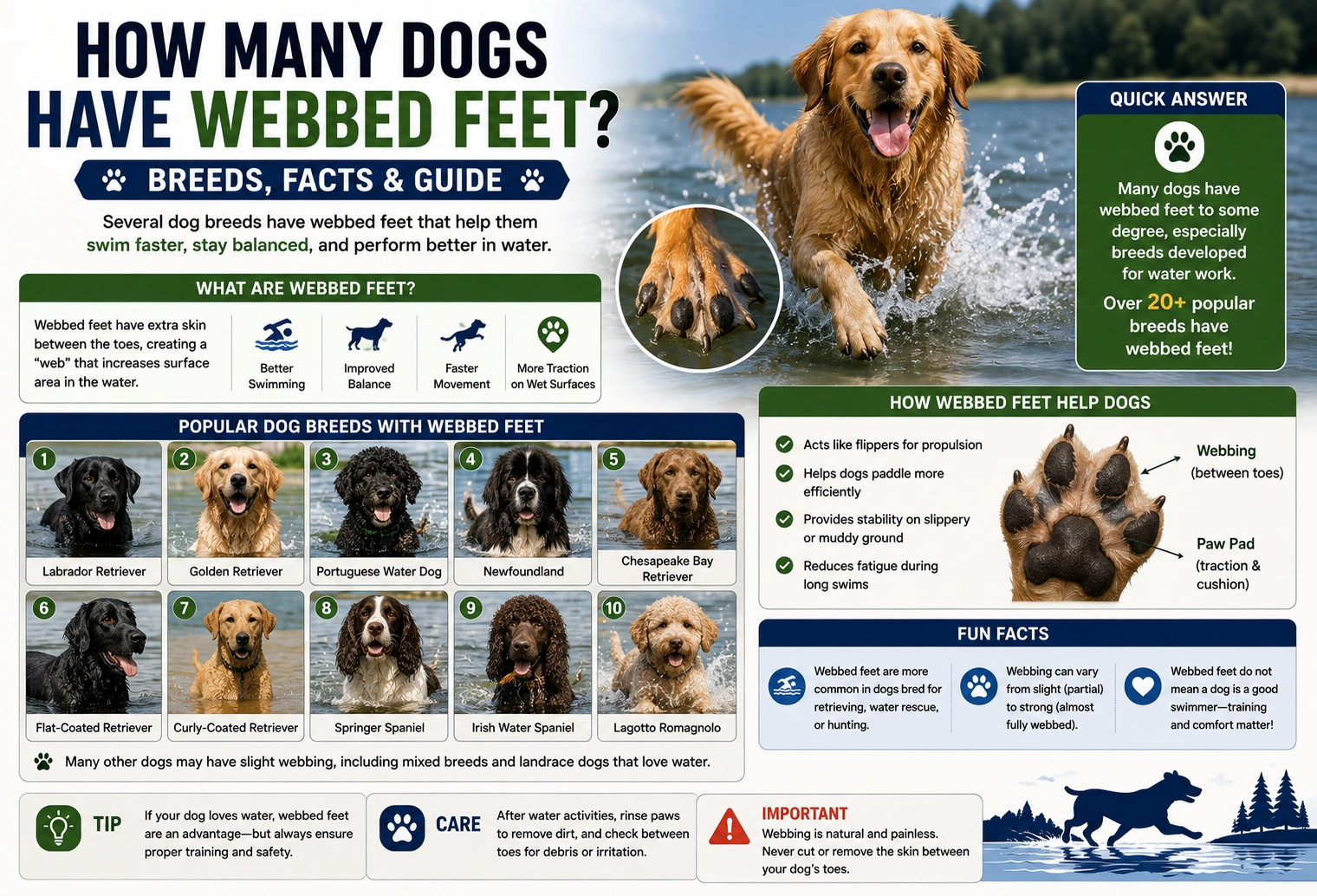
How many dogs have webbed feet? Most dogs have some natural webbing between their toes, but the amount varies by breed. Dogs with more pronounced webbed feet are often breeds developed for swimming, retrieving, hunting, or working in wet environments.
Breeds such as the Newfoundland, Labrador Retriever, Golden Retriever, Portuguese Water Dog, and Chesapeake Bay Retriever are well known for having noticeable webbing.
There is no exact number of individual dogs worldwide with webbed feet because webbing is a natural anatomical feature that varies from dog to dog. Instead, it is more useful to look at which dog breeds commonly have pronounced webbing.
Do Dogs Really Have Webbed Feet?
Yes. Dogs generally have skin between their toes, which can be described as interdigital webbing.
However, dog feet aren’t usually webbed like a duck’s feet.
The toes remain separate, but a membrane of skin connects portions of the toes.
The amount of webbing can vary because of:
- Breed genetics
- Individual anatomy
- Paw structure
- Evolutionary history
- Working purpose
Some dogs have relatively little visible webbing, while others have much more noticeable skin between their toes.
How Many Dog Breeds Have Webbed Feet?
There isn’t a universally agreed number of dog breeds with webbed feet because some degree of interdigital webbing occurs in many dogs.
However, several breeds are especially recognized for having pronounced webbing.
| Dog Breed | Webbed Feet | Common Historical Purpose |
|---|---|---|
| Newfoundland | Very pronounced | Water rescue, hauling |
| Labrador Retriever | Pronounced | Water retrieving |
| Golden Retriever | Some webbing | Retrieving |
| Chesapeake Bay Retriever | Pronounced | Waterfowl retrieving |
| Portuguese Water Dog | Pronounced | Water work |
| Irish Water Spaniel | Pronounced | Water retrieving |
| American Water Spaniel | Pronounced | Hunting and retrieving |
| Nova Scotia Duck Tolling Retriever | Some webbing | Waterfowl retrieving |
| German Shorthaired Pointer | Some webbing | Hunting |
| Dachshund | Some webbing | Hunting |
The exact degree of webbing can vary among individual dogs within the same breed.
Why Do Some Dogs Have Webbed Feet?
Webbing can provide practical advantages for dogs that spend a lot of time in water.
The skin between the toes can help create a broader paw surface, potentially making swimming more efficient.
Dogs bred for water work were often selected for traits that helped them perform tasks such as:
- Swimming
- Retrieving birds
- Working around lakes
- Crossing marshes
- Moving through wet terrain
- Water rescue
Over generations, these physical characteristics became common in certain breeds.
Newfoundland Dogs and Webbed Feet
The Newfoundland is one of the most famous breeds associated with webbed feet.
These large working dogs were developed in Newfoundland and became well known for their strength and ability in water.
Their physical characteristics include:
- Large paws
- Strong legs
- Dense water-resistant coat
- Noticeable interdigital webbing
- Powerful swimming ability
Their webbed feet work alongside their large body, strong limbs, and thick coat to help them work in cold water.
Newfoundlands have historically been used for water rescue and other demanding tasks around water.
Do Labrador Retrievers Have Webbed Feet?
Yes. Labrador Retrievers are well known for having webbed feet.
Their feet are adapted for their historical role as retrieving dogs.
A Labrador’s paws can help it move through water while retrieving objects or game.
Other useful physical characteristics include:
- Short, dense coat
- Strong tail
- Athletic body
- Water-resistant outer coat
- Webbed toes
Their webbing is one part of the breed’s overall adaptation to water.
Do Golden Retrievers Have Webbed Feet?
Golden Retrievers have some interdigital webbing, although it may not be as dramatic as the webbing seen in some highly water-oriented breeds.
Golden Retrievers were developed as retrieving dogs and are comfortable around water.
Their athletic bodies and retrieving instincts make them strong swimmers, although individual swimming ability varies.
It’s important not to assume that every Golden Retriever will naturally be an excellent swimmer. Dogs differ in confidence, body structure, fitness, and swimming experience.
Do Chesapeake Bay Retrievers Have Webbed Feet?
Yes. Chesapeake Bay Retrievers are another breed associated with webbed feet and water work.
They were developed for retrieving waterfowl in the Chesapeake Bay region.
Their physical characteristics include:
- Strong, athletic body
- Dense coat
- Webbed feet
- Powerful swimming ability
The combination of these traits helped them work in challenging water conditions.
Do Portuguese Water Dogs Have Webbed Feet?
Yes. The Portuguese Water Dog is another breed with noticeable webbing between its toes.
Historically, these dogs worked with fishermen and were used for tasks involving water.
Their jobs included helping with:
- Herding fish
- Retrieving objects
- Carrying messages
- Working around boats
- Swimming
Their webbed feet are therefore consistent with their working history.
Do All Dogs With Webbed Feet Like Water?
No.
Having webbed feet doesn’t automatically mean a dog likes swimming.
A dog can have noticeable webbing and still dislike or fear water.
Swimming ability also depends on:
- Body shape
- Confidence
- Experience
- Age
- Fitness
- Water temperature
- Individual temperament
Never force a dog into water simply because it belongs to a breed known for swimming.
Are Webbed Feet Normal in Dogs?
Yes. Some degree of webbing between the toes can be completely normal.
The skin between the toes is part of normal paw anatomy.
However, sudden changes in the appearance of the webbing can be different.
For example, swelling, redness, pain, discharge, or a lump between the toes may indicate a problem that isn’t simply normal webbing.
If your dog’s feet suddenly look different or the dog is limping or repeatedly licking the area, a veterinarian can determine the cause.
Webbed Feet vs. Normal Dog Toes
It can be difficult to tell whether a dog’s feet are unusually webbed.
A typical dog paw has four main weight-bearing toes, with a higher rear toe structure known as the dewclaw in many dogs.
The toes can have skin connecting them.
The important difference is the degree of connection and breed-specific paw structure.
| Feature | Typical Dog Paw | Pronounced Webbing |
|---|---|---|
| Skin between toes | Present | More noticeable |
| Toes | Separate | Still separate |
| Water adaptation | Not necessarily | Common in some breeds |
| Swimming advantage | Variable | Can help |
| Breed association | Many breeds | Water-working breeds |
Why Is Webbing Useful for Swimming?
Think about how a paddle works.
A broader surface can push against water more effectively.
Webbing between the toes can increase the effective surface area of the paw when the dog spreads its toes while swimming.
This can help some dogs generate propulsion.
However, webbing isn’t the only factor responsible for swimming ability.
A dog’s:
- Leg strength
- Body shape
- Buoyancy
- Tail
- Coat
- Coordination
also influence how well it swims.
Dog Breeds Known for Water Work
Several breeds have historical connections to water.
Newfoundland
Known for water rescue and strength.
Labrador Retriever
Developed for retrieving and working around water.
Chesapeake Bay Retriever
Bred for retrieving waterfowl in challenging water conditions.
Portuguese Water Dog
Historically worked alongside fishermen.
Irish Water Spaniel
Developed as a hunting and retrieving dog with strong water ability.
American Water Spaniel
Bred for hunting and retrieving in wet environments.
These breeds aren’t the only dogs that can have webbing, but their relationship with water makes the trait particularly noticeable.
Can You Tell If a Dog Has Webbed Feet?
Usually, yes.
If your dog is comfortable with having its paws handled, gently look between the toes.
You may notice skin connecting the toes.
Don’t pull the toes apart forcefully.
Instead, look for:
- Normal skin
- Healthy nails
- No swelling
- No redness
- No foreign objects
- No obvious wounds
If your dog becomes uncomfortable, stop examining the paw.
Do Webbed Feet Make Dogs Better Swimmers?
They can help, but webbed feet don’t guarantee swimming ability.
A dog’s overall anatomy is important.
For example, some breeds with short legs or heavy bodies may have more difficulty swimming despite having webbing.
Other dogs with less noticeable webbing may swim very well.
Therefore, webbing should be considered one physical adaptation, not a complete measure of swimming skill.
Are Webbed Feet Genetic?
In many dog breeds, physical characteristics such as paw shape and interdigital webbing have a genetic component.
Selective breeding can make certain traits more common within a breed.
This is one reason why water-working breeds often share physical characteristics suited to swimming.
However, individual dogs can vary. Not every dog within a breed will have identical feet.
Webbed Feet in Puppies
Puppies can also have visible skin between their toes.
As a puppy grows, its paws and body proportions change.
The appearance of webbing may therefore look different as the dog matures.
If you’re concerned about a puppy’s feet, especially if there is pain, swelling, or abnormal development, ask a veterinarian to examine them.
Do Webbed Feet Need Special Care?
Normally, webbed feet don’t require special treatment simply because they are webbed.
Regular paw care is usually enough.
Check your dog’s feet for:
- Dirt
- Small stones
- Grass seeds
- Cuts
- Irritation
- Cracked paw pads
- Excess moisture
After swimming, particularly in dirty or treated water, rinse and dry the paws as appropriate.
Keeping the spaces between the toes clean and dry can help reduce irritation.
Common Misconceptions About Webbed Dog Feet
Myth 1: Only Water Dogs Have Webbed Feet
Not true. Some degree of interdigital webbing can occur in many dogs.
Myth 2: Webbed Feet Mean a Dog Is a Great Swimmer
Not necessarily. Swimming ability varies by individual dog and body structure.
Myth 3: Webbing Means the Toes Are Fused Together
No. The toes remain separate; skin connects portions of them.
Myth 4: Every Labrador Has Identical Webbing
Individual dogs can vary in paw structure.
Myth 5: A Dog Should Be Forced Into Water Because It Has Webbed Feet
Never assume a dog is comfortable in water based only on anatomy.
How Many Dogs Have Webbed Feet? The Best Answer
There isn’t a reliable worldwide count of individual dogs with webbed feet.
That’s because:
- There are hundreds of dog breeds and countless mixed-breed dogs.
- Interdigital webbing varies in degree.
- There is no global registry recording paw-webbing prevalence.
- Many dogs have some skin between their toes without having strongly pronounced webbing.
So rather than saying “X number of dogs have webbed feet,” it is more accurate to say that many dogs have some natural interdigital webbing, while certain breeds have more pronounced webbing associated with water-related work.
FAQs
1. How many dogs have webbed feet?
There is no exact worldwide number. Many dogs have some natural skin between their toes, while breeds such as Newfoundlands, Labradors, and Portuguese Water Dogs are known for more noticeable webbing.
2. Which dog breeds have the most noticeable webbed feet?
Newfoundland, Labrador Retriever, Chesapeake Bay Retriever, Portuguese Water Dog, Irish Water Spaniel, and American Water Spaniel are among the breeds commonly associated with pronounced webbing.
3. Do webbed feet help dogs swim?
Yes, webbing can help create a broader paw surface and may assist swimming. However, swimming ability also depends on body shape, strength, coordination, confidence, and other traits.
4. Do all Labradors have webbed feet?
Labradors commonly have webbing between their toes, but the degree can vary among individual dogs.
5. Are webbed feet a problem for dogs?
Normal interdigital webbing is generally not a problem. However, sudden swelling, redness, pain, discharge, or a growth between the toes should be evaluated by a veterinarian.
Conclusion
So, how many dogs have webbed feet? There is no exact number because webbing occurs naturally to varying degrees across many dogs. It is especially noticeable in breeds developed for swimming, retrieving, hunting, and water-related work.
Newfoundlands, Labrador Retrievers, Chesapeake Bay Retrievers, Portuguese Water Dogs, and several spaniel and retriever breeds are well-known examples.
Webbed feet can help with swimming by increasing the effective surface area of the paw, but they don’t automatically make every dog a strong or willing swimmer. For your own dog, normal webbing is usually nothing to worry about; focus on keeping the paws clean and checking regularly for signs of irritation or injury.
Discover More Articles
How Many Cubic Feet Are There in a Cubic Yard?