

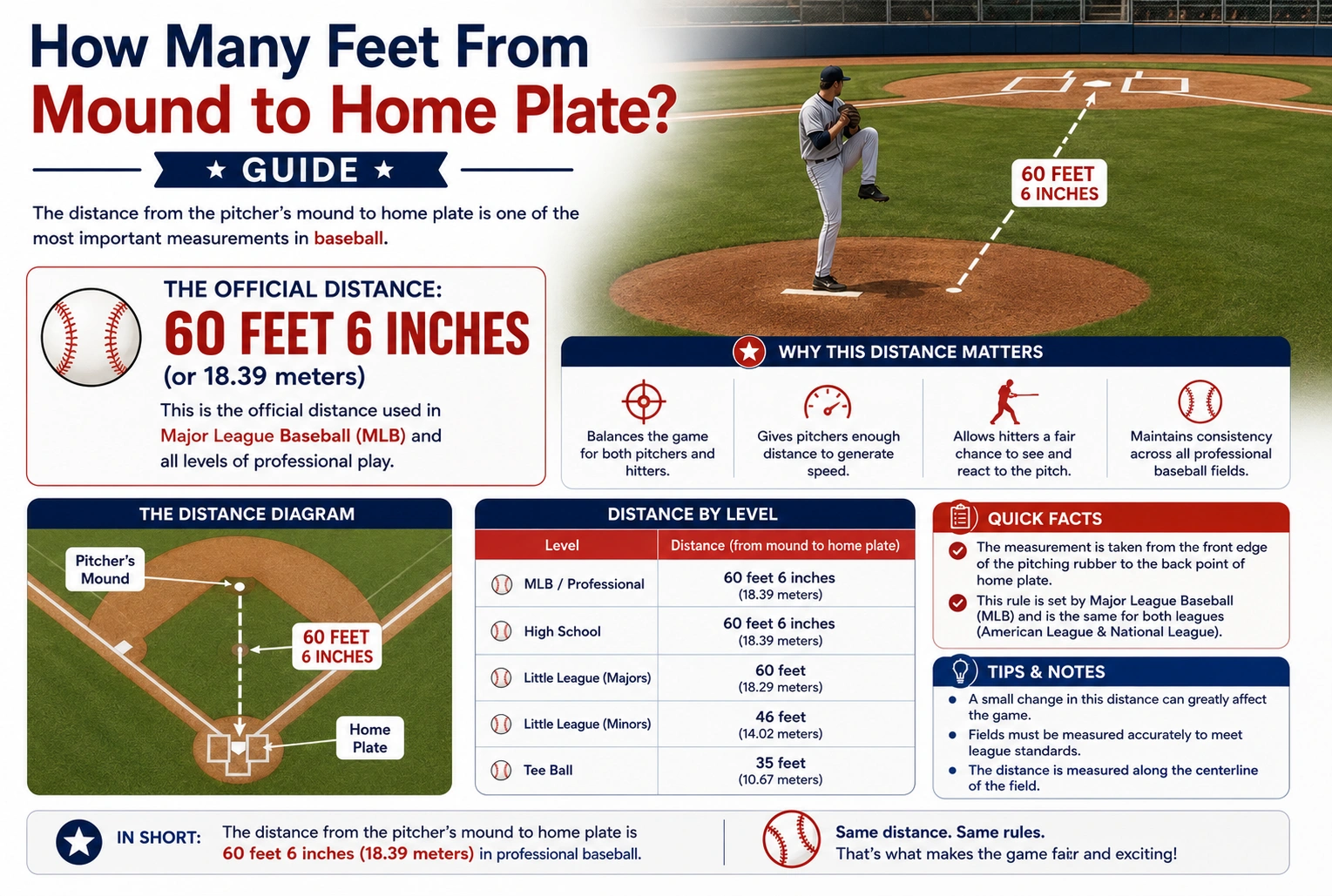
If you’re wondering how many feet from mound to home plate, the official distance in Major League Baseball (MLB) is:
60 feet 6 inches (18.44 meters)
This measurement is taken from the front edge of the pitcher’s rubber to the back point of home plate. It is one of the most important dimensions on a baseball field and is used in professional, college, high school, and many amateur leagues.
Different youth baseball and softball leagues use shorter pitching distances to match the age and skill level of players.
Quick Answer
| League | Distance from Pitcher’s Rubber to Home Plate |
|---|---|
| MLB / Professional Baseball | 60 ft 6 in (18.44 m) |
Answer: In regulation baseball, the pitching distance from the mound to home plate is 60 feet 6 inches.
Official MLB Distance
According to official baseball rules:
- Pitching distance: 60 feet 6 inches
- Equivalent to 60.5 feet
- Equivalent to 18.44 meters
This standard has remained unchanged for more than a century and is used throughout professional baseball.
How the Distance Is Measured
A common misconception is that the measurement is taken from the center of the mound.
In reality, the official measurement is:
- From the front edge of the pitcher’s rubber
- To the back point of home plate
Because the pitching rubber sits on top of the mound, the mound itself extends several feet around it.
Pitching Distances by Baseball League
Not every baseball league uses the professional pitching distance.
| League | Pitching Distance |
|---|---|
| MLB | 60 ft 6 in |
| College (NCAA) | 60 ft 6 in |
| High School | 60 ft 6 in |
| Little League Major (Ages 11–12) | 46 ft |
| Intermediate (50/70) | 50 ft |
| Pony League | 54 ft |
| Youth Divisions | 35–50 ft (varies) |
Youth leagues shorten the distance to improve safety and player development.
Softball Pitching Distances
Softball uses different pitching distances depending on the level of play.
| Softball Level | Distance |
|---|---|
| Fastpitch (High School & College) | 43 ft |
| Little League Softball | 35–40 ft |
| Adult Recreational | 40–43 ft |
Unlike baseball, softball pitchers deliver the ball underhand.
Why the Distance Matters
The 60-foot-6-inch distance creates a balance between pitchers and hitters.
It affects:
- Pitch velocity
- Batter reaction time
- Pitch movement
- Strikeout rates
- Offensive strategy
Even a small change in pitching distance can significantly impact gameplay.
Baseball Field Measurement Chart
| Measurement | Distance |
|---|---|
| Pitcher’s Rubber to Home Plate | 60 ft 6 in |
| Base Path | 90 ft |
| Home Plate to Second Base | 127 ft 3⅜ in |
| Pitcher’s Rubber to Second Base | Approximately 127 ft 3⅜ in |
These dimensions are standard for professional baseball fields.
Real-World Examples
Major League Baseball
Every MLB stadium uses a pitching distance of 60 feet 6 inches, ensuring consistency across all games.
High School Baseball
High school players also pitch from 60 feet 6 inches, helping prepare athletes for college-level competition.
Little League Baseball
Players aged 11–12 typically pitch from 46 feet, allowing them to develop proper mechanics before transitioning to longer distances.
History of the Pitching Distance
The pitching distance hasn’t always been 60 feet 6 inches.
Originally, pitchers threw from much closer to home plate. In 1893, the distance was increased to 60 feet 6 inches to reduce pitcher dominance and create a more balanced game.
This measurement has remained the standard ever since.
Common Mistakes
Measuring From the Center of the Mound
The official measurement starts at the front edge of the pitching rubber, not the center of the mound.
Confusing Baseball and Softball Distances
Softball pitching distances are significantly shorter than those used in baseball.
Assuming All Youth Leagues Use the Same Distance
Pitching distances vary by age group and league organization.
Forgetting the Extra Six Inches
The official distance is 60 feet 6 inches, not simply 60 feet.
Those additional six inches make a measurable difference in the game.
Expert Tips
- Measure from the front of the pitching rubber for accurate field layout.
- Verify league rules before building or marking a field.
- Use professional measuring tools for regulation fields.
- Teach young players using the correct pitching distance for their age division.
- Regularly inspect field markings to ensure compliance.
Quick Reference Table
| League | Distance |
|---|---|
| MLB | 60 ft 6 in |
| NCAA | 60 ft 6 in |
| High School | 60 ft 6 in |
| Little League Major | 46 ft |
| Intermediate (50/70) | 50 ft |
| Pony League | 54 ft |
| Fastpitch Softball | 43 ft |
9. Frequently Asked Questions
1. How many feet from the mound to home plate in Major League Baseball?
The official distance is 60 feet 6 inches (18.44 meters).
2. Is the distance measured from the center of the mound?
No. It is measured from the front edge of the pitching rubber to the back point of home plate.
3. Why is the pitching distance 60 feet 6 inches?
The distance was established in 1893 to create a better balance between pitchers and hitters.
4. How far is the pitching mound in Little League?
For the Major Division (ages 11–12), the pitching distance is 46 feet.
5. Is softball pitching distance the same as baseball?
No. Fastpitch softball typically uses a pitching distance of 43 feet, while baseball uses 60 feet 6 inches.
10. Conclusion
If you’re asking how many feet from mound to home plate, the official regulation distance in baseball is 60 feet 6 inches (18.44 meters). This measurement is taken from the front edge of the pitcher’s rubber to the back point of home plate and is used in Major League Baseball, college baseball, and most high school competitions.
Understanding the correct pitching distance is essential for players, coaches, umpires, and anyone building or maintaining a baseball field. While youth baseball and softball leagues use shorter distances based on age and skill level, 60 feet 6 inches remains the universally recognized standard for professional baseball.
Discover More Articles
How Many Cubic Feet in a 4×8 Raised Bed? Guide