

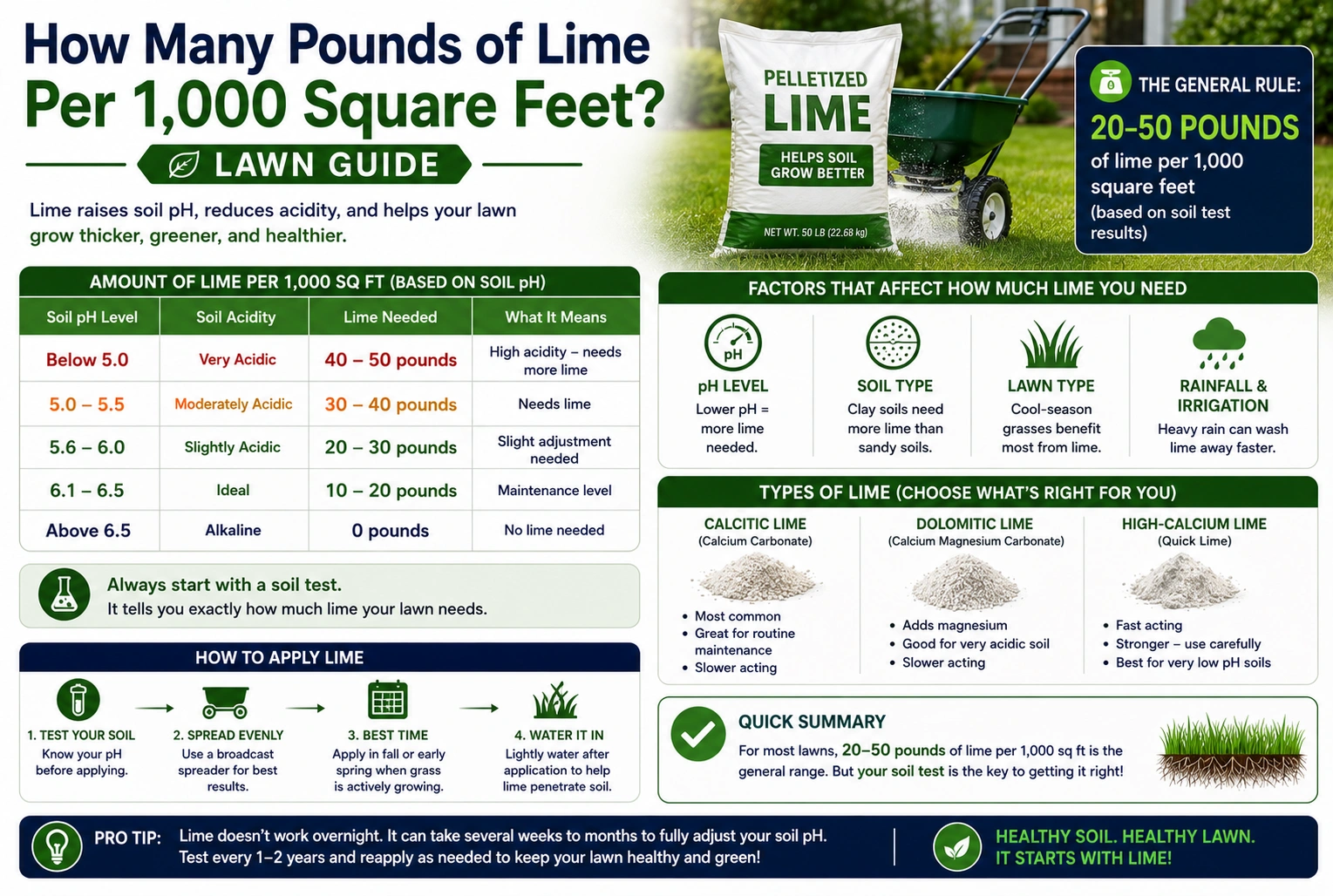
If you’re wondering how many pounds of lime per 1,000 square feet you should apply, the answer depends on your soil pH, soil type, and the specific lime product you’re using.
For many residential lawns, a common application range is 20 to 50 pounds of pelletized or agricultural lime per 1,000 square feet. However, the correct amount should ideally be determined by a soil test, since applying too little may not correct acidic soil, while applying too much can raise the pH beyond the desired level.
Always follow the application rate listed on your lime product’s label and any recommendations provided by your local agricultural extension service or soil test report.
Quick Answer
| Soil Condition | Typical Lime Application* |
|---|---|
| Slightly Acidic Soil | 20–30 lbs per 1,000 sq ft |
| Moderately Acidic Soil | 30–40 lbs per 1,000 sq ft |
| Strongly Acidic Soil | 40–50 lbs per 1,000 sq ft |
*General guidelines only. Actual requirements depend on soil test results, soil texture, and the lime product used.
Why Does Lime Matter?
Lime is commonly applied to lawns and gardens to raise soil pH when the soil becomes too acidic.
Correcting acidic soil can help:
- Improve nutrient availability
- Encourage stronger root development
- Promote healthier grass growth
- Improve fertilizer efficiency
- Increase calcium levels
- Reduce soil acidity over time
Not every lawn needs lime, which is why testing your soil first is strongly recommended.
Recommended Lime Application Rates
General recommendations for 1,000 square feet often fall within the following ranges:
- 20–30 pounds for mildly acidic soil
- 30–40 pounds for moderately acidic soil
- 40–50 pounds for highly acidic soil
Some products recommend smaller or larger amounts depending on:
- Lime purity
- Pelletized vs. pulverized lime
- Soil texture
- Current soil pH
- Desired target pH
Always check the manufacturer’s instructions before applying any soil amendment.
Why a Soil Test Is Important
A soil test is the most accurate way to determine how much lime your lawn actually needs.
A soil analysis typically measures:
- Current pH level
- Nutrient levels
- Organic matter
- Calcium content
- Magnesium content
Based on these results, you’ll receive recommendations tailored to your lawn instead of relying on general estimates.
Types of Lime
Several types of lime are available for lawn and garden use.
Pelletized Lime
Pelletized lime is easy to spread with most broadcast spreaders and produces less dust than pulverized lime.
It is a popular choice for homeowners because of its convenience.
Agricultural Lime
Agricultural lime (calcitic lime) is a finely ground limestone product commonly used to raise soil pH and add calcium.
Dolomitic Lime
Dolomitic lime contains both calcium and magnesium, making it a suitable option when soil tests indicate a magnesium deficiency.
When Should You Apply Lime?
Many homeowners apply lime:
- During the fall
- In early spring
- Before major lawn renovations
Applying lime when the soil is moist—but not saturated—can help it begin reacting with the soil over time.
Keep in mind that lime does not change soil pH immediately. It may take several months before the full effects become noticeable, depending on the product, weather conditions, and soil characteristics.
How to Apply Lime Correctly
Applying lime properly helps ensure even coverage and improves its effectiveness.
Measure Your Lawn
Before purchasing lime, calculate the total square footage of the area you plan to treat.
For example:
- Lawn size: 1,000 square feet
- Recommended application: 30 pounds per 1,000 sq ft
You would apply approximately 30 pounds of lime across the entire lawn, following your soil test recommendations and the product label.
Use a Broadcast or Drop Spreader
A lawn spreader helps distribute lime evenly.
Many homeowners apply half the recommended amount in one direction and the remaining half at a right angle to improve uniform coverage.
Water the Lawn
After application, light watering may help move lime into the soil surface if rainfall is not expected. Follow the instructions on the specific lime product you are using.
Avoid Overapplication
Applying more lime than recommended will not make it work faster and can raise soil pH too much, which may reduce the availability of certain nutrients.
Signs Your Lawn May Need Lime
Only a soil test can confirm whether lime is needed, but some lawns with acidic soil may show signs such as:
- Slow grass growth
- Yellow or pale green grass
- Poor fertilizer performance
- Increased moss growth
- Thin or patchy turf
- Difficulty establishing new grass
These symptoms can also result from other lawn problems, so testing the soil is the best way to identify the cause.
Common Lime Application Mistakes
Skipping the Soil Test
Applying lime without knowing your soil’s pH can lead to unnecessary applications or incorrect rates.
Applying Too Much at Once
Large amounts of lime should not always be applied in a single application. Follow product instructions or soil test recommendations, which may suggest split applications for higher rates.
Uneven Spreading
Uneven application may leave some parts of the lawn untreated while others receive excessive lime.
A properly calibrated spreader helps ensure consistent coverage.
Expecting Immediate Results
Lime reacts gradually with the soil.
Depending on the product, soil type, and weather, noticeable pH changes may take several months.
Lawn Care Tips After Applying Lime
To get the best results:
- Test soil every few years or as recommended.
- Mow the lawn at the appropriate height for your grass type.
- Water consistently during dry periods.
- Fertilize according to soil test recommendations.
- Overseed thin areas if needed.
- Monitor lawn health throughout the growing season.
Healthy soil provides the foundation for a healthy lawn.
Frequently Asked Questions
How many pounds of lime per 1,000 square feet should I use?
Many lawns require 20 to 50 pounds per 1,000 square feet, but the correct amount depends on your soil pH, soil type, and the lime product being used. A soil test provides the most accurate recommendation.
Can you apply too much lime?
Yes. Excessive lime can raise soil pH too high, reducing the availability of certain nutrients and potentially affecting grass health.
How often should lime be applied?
The frequency depends on soil conditions. Many homeowners only apply lime when a soil test indicates it is needed, rather than on a fixed annual schedule.
How long does lime take to work?
Lime works gradually. Depending on soil conditions and the product used, noticeable changes in soil pH may take several months.
Is pelletized lime better than agricultural lime?
Both can be effective. Pelletized lime is generally easier for homeowners to spread with lawn equipment, while agricultural lime is commonly used on larger properties. The best choice depends on your lawn, equipment, and soil test recommendations.
Conclusion
If you’re wondering how many pounds of lime per 1,000 square feet to apply, a general guideline is 20 to 50 pounds, depending on soil acidity and the type of lime being used. However, because every lawn is different, a soil test is the most reliable way to determine the correct application rate.
Applying the proper amount of lime can help improve soil pH, increase nutrient availability, and promote healthier grass over time. By following soil test recommendations, using the right spreading equipment, and avoiding overapplication, you can maintain a stronger, greener, and more resilient lawn.
Discover More Articles
How Many Cubic Feet in a 4×8 Raised Bed? Guide