
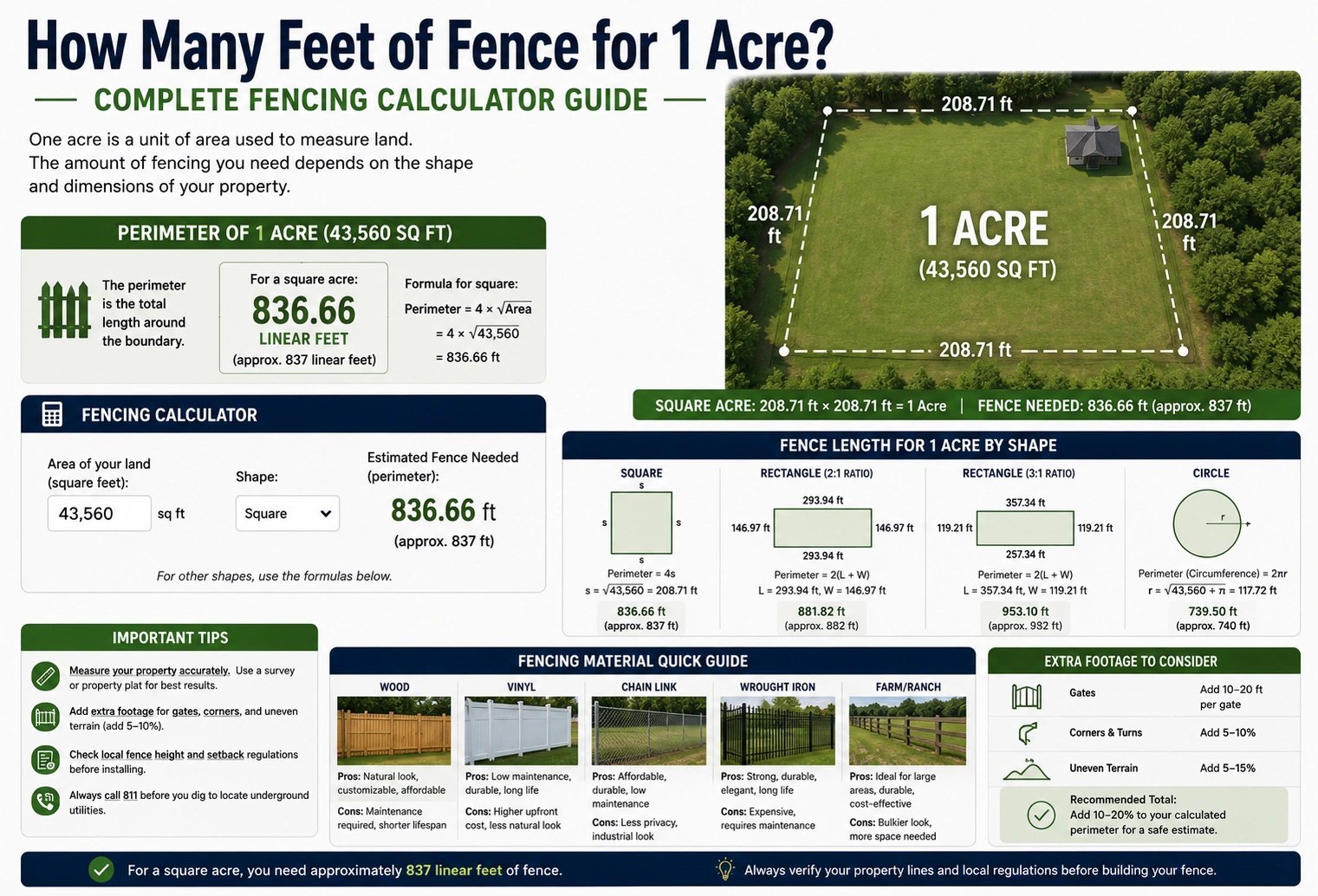
If you’re planning to fence a one-acre property, the amount of fencing required depends on the shape of the land. While an acre always contains 43,560 square feet, the perimeter changes depending on whether the property is square, rectangular, or irregularly shaped.
For a perfectly square acre, the required fencing is approximately 835 feet.
Calculation:
First, find the length of one side:
Then calculate the perimeter:
A square acre requires approximately 835 linear feet of fence.
Quick Answer
The typical fencing needed for a square 1-acre lot is:
About 835 feet of fencing.
Actual requirements may vary depending on the property’s shape.
Understanding Acre Dimensions
What Is an Acre?
An acre is a unit of land area equal to:
It is commonly used to measure residential, agricultural, and commercial land.
Acre Area vs Perimeter
Area measures the amount of space inside a property.
Perimeter measures the distance around the property’s boundary.
Fence requirements are based on perimeter, not area.
Why Shape Matters
Two properties can both be one acre while requiring different amounts of fencing.
Longer, narrower lots need more fencing than square lots.
How to Calculate Fence for 1 Acre
Step 1: Determine the Side Length
For a square acre:
Each side measures approximately 208.7 feet.
Step 2: Calculate the Perimeter
Multiply the side length by four:
Step 3: Determine Fence Needed
A square acre requires approximately 835 linear feet of fence.
Fence Requirements for Different Acre Shapes
| Acre Shape | Approximate Fence Needed |
|---|---|
| Perfect Square | 835 ft |
| 100 ft × 435.6 ft | 1,071 ft |
| 150 ft × 290.4 ft | 881 ft |
| Irregular Shape | Varies |
The more elongated the property, the more fencing is generally required.
Acre Fence Comparison Chart
| Property Size | Approximate Fence Needed (Square Lot) |
|---|---|
| 0.25 Acre | 417 ft |
| 0.5 Acre | 590 ft |
| 1 Acre | 835 ft |
| 2 Acres | 1,181 ft |
| 5 Acres | 1,868 ft |
These figures assume square-shaped lots.
Factors That Affect Fence Length
Property Shape
Square lots require the least fencing for a given area.
Gates
Gate openings reduce the amount of fence material needed.
Easements
Some areas may not require fencing.
Terrain
Slopes, curves, and irregular boundaries can increase fence requirements.
Practical Examples
Example 1: Square Acre
Side length:
- 208.7 feet
Calculation:
Result:
- About 835 feet of fence
Example 2: Rectangular Acre
Dimensions:
- 100 ft × 435.6 ft
Calculation:
Result:
- Approximately 1,071 feet of fence
Example 3: Half-Acre Square Lot
Calculation:
Result:
- Approximately 590 feet of fence
FAQs
How many feet of fence do I need for 1 acre?
A square acre requires approximately 835 linear feet of fencing.
Does every acre require the same amount of fence?
No. Fence requirements depend on the shape of the property.
How many fence posts are needed for 1 acre?
With posts spaced every 8 feet:
You would need roughly 104 to 105 posts.
Is 835 feet the exact amount?
It is the approximate requirement for a perfectly square acre.
How much fencing is needed for 5 acres?
A square 5-acre parcel requires approximately:
Result:
- About 1,868 feet of fence
Conclusion
The amount of fencing needed for one acre depends on the shape of the property. A perfectly square acre requires approximately 835 linear feet of fence because each side measures about 208.7 feet. Rectangular and irregularly shaped properties may require significantly more fencing. Understanding perimeter calculations helps property owners estimate material costs and plan fence installations more accurately.
Final calculation:
A square 1-acre property requires approximately 835 feet of fence.
Discover More Articles
How Many Feet Wide Is a Football Field?